AR Sights Explained: Every Type, Every Use Case

Published on: March 23, 2026
AR Sights Explained Every Type, Every Use Case

Reading time: 8 mins 56 sec

Choosing the right AR sights is one of the most consequential decisions you’ll make for your build. The wrong pick doesn’t just waste money—it puts a rifle in your hands that works against you. Whether you’re setting up for home defense, competition, or hunting, this guide breaks down every sighting system available so you can stop guessing and start building with confidence.

Highlights

  • There are six main types of AR sighting systems, each built for a specific purpose and range.
  • EOTech’s standard reticle is a 68 MOA ring + 1 MOA dot—Holosun uses a 65 MOA ring with a 2 MOA dot, and the two are commonly confused.
  • Prism sights with etched reticles are the most reliable fix for shooters with astigmatism.
  • A 50-yard zero creates a near second zero around 200–231 yards, not an exact one—that distinction matters.
  • A great optic on a bad mount is still a bad setup.

Why Your AR Sights Choice Matters More Than Most Upgrades

Your sights aren’t just an add-on—they’re your primary connection to the rifle. They control how fast you get on target, how accurate your shots are, and how the rifle performs under pressure.

You can swap triggers, change stocks, and add muzzle devices. None of those changes how you see and aim. The sighting system does.

Here’s something most first-time AR owners don’t realize: many factory ARs ship with no sighting system at all. That makes your optic or iron sights the very first purchase you need to make—and getting it right saves you from expensive re-dos down the road.

ARs also have specific demands that other platforms don’t. The MIL-STD-1913 Picatinny rail, cheek weld geometry, and the platform’s range of calibers—from 5.56 all the way to .308, .300 BLK, and 6.5 Creedmoor—all influence which sighting system actually fits your build.

If you’re looking for a Picatinny rail, check out our Heckler and Koch SP5/SP5K Picatinny Rail 50226207.

The 6 Main Types of AR 15 Sights

1. Iron Sights (BUIS and Fixed)

Iron sights are the most reliable sighting option you can put on a rifle—no batteries, no electronics, nothing to fail. The standard AR setup pairs a front post with a rear aperture in either A1 or A2 style. The A2 gives you two aperture sizes: small for precision at distance, large for close-quarters use.

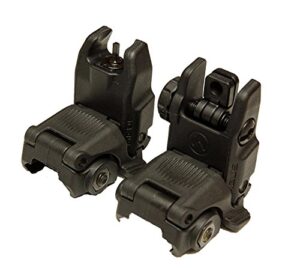
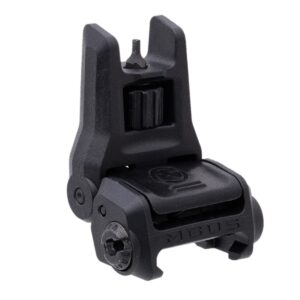
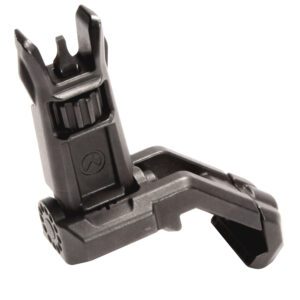
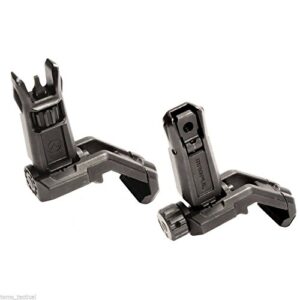
Fixed irons are always deployed. BUIS (Backup Iron Sights) fold flat and flip up on demand—the better option when you’re also running a primary optic. For shooters running magnified scopes, offset 45° irons let you cant the rifle slightly for fast close-range use without switching optics.

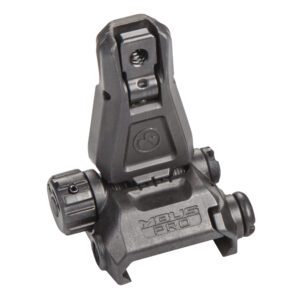
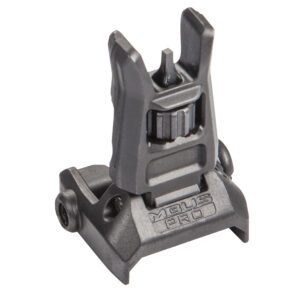
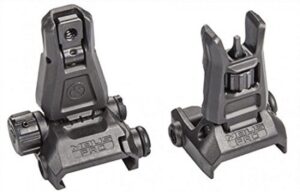
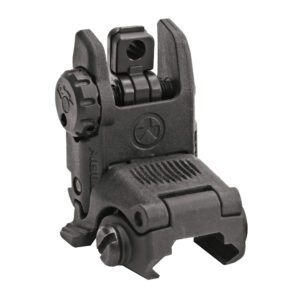
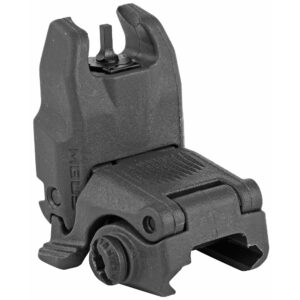
Material matters here. Polymer BUIS, like the Magpul MBUS Gen 2, saves weight. Steel options like the Magpul MBUS Pro are heavier but take more abuse. Popular brands: Magpul, Troy, and Daniel Defense.

Explore our selection of Magpul MBUS products—there might be something that fits your setup:
2. AR Red Dot Sights

An AR red dot works by bouncing an LED off a partially reflective lens, creating a glowing dot you place on a target. There’s no magnification—just a clean sight picture and fast target acquisition.

That simplicity is why red dots pair so naturally with ARs. You shoot with both eyes open, maintain full situational awareness, and get on target faster than with iron sights or magnified optics. They cover everything from CQB to about 200 yards effectively.

Here are some popular red dot forms:

  • Tube-style (e.g., Aimpoint PRO): Enclosed housing, ultra-durable, all-weather ready
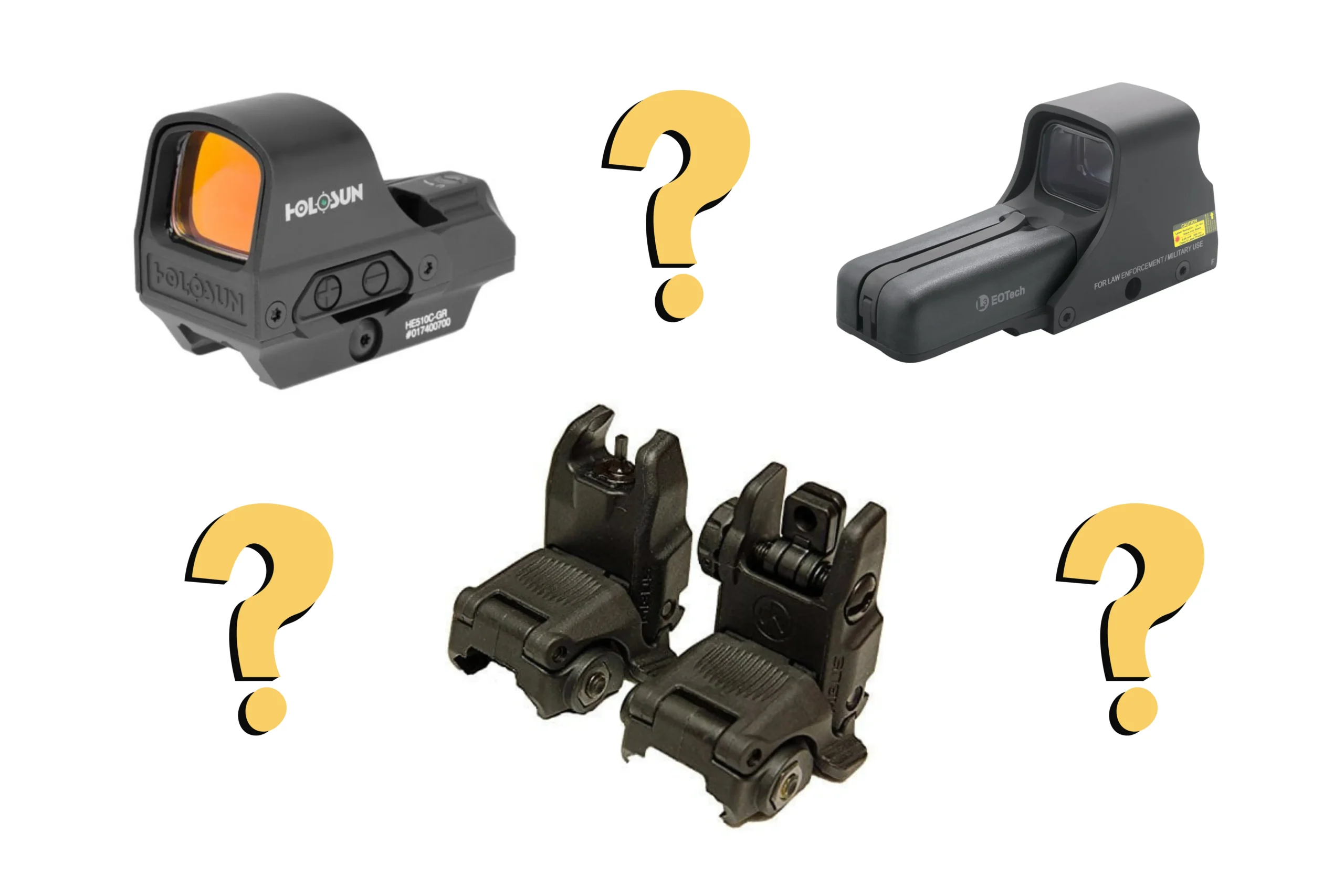
  • Open reflex (e.g., Holosun 510C): Open frame, larger window, wider field of view, popular for competition

Dot size is measured in MOA. A 2 MOA dot is smaller and better for precise shots at distance. A 4 MOA dot is larger and faster to pick up in CQB. For a deeper look at how this technology actually works, check out our full guide on how red dot sights work.

Battery life separates tiers. Budget red dots run 500–5,000 hours. Premium models like the Aimpoint CompM5 reach up to 5 years continuous (approximately 43,800 hours) on a single AAA battery. Some Holosun models add solar backup for virtually unlimited run time.

If you have astigmatism and the dot looks like a starburst rather than a clean circle, try a green reticle first. Prism sights are the most reliable long-term fix.

Price range: Entry ($150–$250), mid-range ($300–$500), premium ($600+)

3. Holographic Sights

Holographic sights look similar to red dots on the outside, but the internal technology is completely different. Instead of reflecting an LED, they use a laser to illuminate a hologram recorded inside the optic. That hologram projects out toward the target—not sitting on the lens in front of you.

The reticle lives at the target plane, not the lens. Your eyes don’t have to choose which to focus on. That design is one reason many experienced shooters find holographic sights faster for real-world target acquisition.

The standard EOTech reticle is a 68 MOA ring + 1 MOA center dot. The ring pulls your eye to the center for fast shots; the 1 MOA dot handles precision. This gets confused a lot with Holosun’s circle-dot system—but Holosun’s ring is 65 MOA and pairs with a 2 MOA dot, so the specs are actually different on both counts.

The trade-off is battery life. Most holographic sights run 600–1,000 hours per battery—weeks, not years like a red dot. Holographic sights also run larger and heavier, which matters on lighter builds.

Best for: Tactical and defensive builds, law enforcement, shooters who prioritize situational awareness

4. Prism Sights (Fixed Magnification)

Prism sights use an internal glass prism alongside lenses to achieve magnification in a compact, rugged package. The feature that sets them apart is the etched reticle—physically engraved into the glass, always visible even with a dead battery.

For shooters with astigmatism, prism sights are often the best option available. The etched reticle doesn’t produce the blur or starburst effect that LED-based red dots do.

Common magnifications and best uses:

  • 1x — CQB and general-purpose; the best red dot alternative for astigmatism sufferers
  • 3x — Medium-range work, versatile from 50–300 yards
  • 5x — Precision-focused and DMR-style builds

The Trijicon ACOG is the benchmark here. Most ACOG models use fiber optic illumination for daylight and tritium for darkness—no battery needed. (A small number of ACOG variants do use an LED-powered reticle and require a battery, so always confirm your specific model.)

The downside is a tighter eye box and fixed eye relief. You need a consistent cheek weld every time, or you’ll lose the sight picture.

5. LPVOs (Low Power Variable Optics)

An LPVO starts at true 1x—functioning like a red dot with both eyes open—and gives you the reach of a rifle scope when you need it. The most common ranges are 1-6x, 1-8x, and 1-10x.

  • 1-6x — The competition standard and the best general-purpose choice for most AR shooters
  • 1-8x — Extended range without going full precision scope
  • 1-10x — Maximum versatility, heavier, for more distance-focused builds

Not all LPVOs deliver true 1x. A poorly built 1x creates edge distortion (sometimes called a “fishbowl effect”) that kills your close-range speed. Always verify this before buying.

You’ll also choose between two reticle positions:

  • FFP (First Focal Plane): Reticle scales with magnification. Holdover marks stay accurate at every power level—better for ranging.
  • SFP (Second Focal Plane): Reticle stays the same size regardless of zoom. Bolder, easier to see in low light—often preferred for hunting at dawn or dusk.

LPVOs are heavier than red dots, which shifts your rifle’s balance forward. It’s a real ergonomic consideration for shooters who do a lot of off-hand work.

Price range: Budget ($200–$400), mid ($500–$900), premium ($1,000+)

6. Magnified AR Scopes (Fixed and Variable)

A traditional AR scope starts at 3x or higher. These are purpose-built for distance—they give up CQB capability in exchange for precision at range.

They make the most sense on dedicated varmint rifles, AR-10 builds in .308 or 6.5 Creedmoor, and purpose-built precision platforms. For AR-platform rifles, look for at least 3–4 inches of eye relief to match the AR’s shooting geometry and avoid scope bite.

AR-10 builds in .308 and 6.5 Creedmoor genuinely justify the investment here. The caliber’s capability extends well past what an LPVO handles comfortably.

Matching Your AR Optics to Your Use Case

Use Case Best Sighting System
Home defense / CQB Red dot or holographic sight
Competition (3-gun, USPSA) Open reflex red dot or 1-6x LPVO
Hunting (close-medium range) 1-6x LPVO
Precision / long-range Magnified scope or 1-8x+ LPVO
Budget + versatility Red dot + folding BUIS
Astigmatism shooters Prism sight

For home defense, keep it simple: a quality red dot with shake-awake or auto-on functionality, mounted at absolute or lower 1/3 co-witness height with folding BUIS as backup. Magnification at 10–15 yards only adds complexity you don’t need.

For competition, check your division rules first—different 3-gun and USPSA divisions have specific optic restrictions that should drive your selection before anything else.

For hunting, SFP is often the better choice because the reticle stays bold and visible during those low-light shots at dawn and dusk. Don’t skip weather sealing—and carry spare batteries on any multi-day hunt.

Key Specs You Need to Understand

MOA and MRAD

MOA (Minute of Angle) equals approximately 1 inch at 100 yards, 2 inches at 200 yards, and so on. MRAD (milliradians) equals approximately 3.6 inches at 100 yards—a larger unit that makes long-range adjustments faster to dial.

The most important rule: pick one system and stay consistent across all your gear. Mixing an MOA scope with an MRAD rangefinder means conversion math in the field, which is a recipe for missed shots.

Eye Relief and Eye Box

Eye relief is the distance your eye needs to be from the optic to see a full image. Too little with high-recoil calibers causes scope bite. On ARs, aim for at least 3–4 inches.

Eye box describes how forgiving the optic is about head position. Red dots are the most forgiving. LPVOs demand the most consistency.

Mounts

A great optic on a bad mount is still a bad setup. Mounts affect zero retention, eye alignment consistency, and long-term reliability under recoil.

A few things to know:

  • Picatinny (MIL-STD-1913) rail is the standard optic mounting surface on flat-top AR uppers
  • M-LOK and KeyMod are handguard systems for accessories—not optic mounting rails
  • Absolute co-witness aligns the iron sights with the center of your optic
  • Lower 1/3 co-witness keeps irons in the lower third of the optic window, out of your sight picture during normal shooting
  • Cantilever mounts push longer scopes forward for proper eye relief on AR platforms

Always use correct torque specs on ring screws. Under-torquing causes zero drift; over-torquing strips threads. A small amount of Loctite Blue keeps screws from walking loose under recoil.

AR Sights Zeroing: Getting It Right

The Best Zero Distances for AR-15

Your zero distance should match your caliber and use case. Here’s what actually works:

  • 50-yard zero: Creates a near-second zero around 200–231 yards—the exact distance varies by load and barrel length. It’s versatile and practical for defensive builds. This is not a perfect second zero at exactly 200 yards—that’s a persistent myth worth correcting.
  • 100-yard zero: Simpler, easier to verify, still excellent for most civilian shooting needs.
  • 25-yard zero: A good starting point to get on paper before moving to distance. It does not approximate a 100-yard zero—always confirm your actual zero at the distance you intend.

For .300 BLK, .308, and 6.5 Creedmoor, ballistics differ enough that you’ll need to calculate the right zero distance specifically for your load and barrel.

Step-by-Step Zeroing Process

  1. Bore-sight to get on paper without burning ammo.
  2. Fire at 25 yards to confirm you’re close before moving out.
  3. Fire 3–5 round groups—not single shots—to find your true average point of impact.
  4. Adjust clicks based on where your group landed vs. where you want it.
  5. Confirm at your final zero distance.
  6. Record your zero data—log it or note it on the optic.

Zero can drift over time from loose mount screws or extreme temperature changes. Check your torque specs periodically, and always re-verify zero after removing and remounting the optic.

Common Mistakes to Avoid

  • Buying without knowing your use case. A $1,200 LPVO on a home defense carbine is overkill and adds complexity where you need simplicity. Shoot first, then buy.
  • Skimping on mounts. This is where shooters lose the most ground. A quality mount holds zero, repeats consistently, and lasts longer than the optic itself.
  • Ignoring astigmatism. If red dots look like starbursts to you, the optic isn’t broken—your eye needs a different solution. Start with a green reticle; move to a prism sight if needed.
  • Running without backup sights. Optics fail. Batteries die. Lenses crack. Folding BUIS on any defensive or field rifle is a small investment that protects you from a total sighting failure at the worst possible time.

Conclusion

There’s no single “best” AR sighting system—only the right one for your build and your purpose. Iron sights give you fail-proof backup reliability. Red dots deliver exceptional speed at close to moderate range. Holographic sights add reticle projection advantages for tactical builds. Prism sights solve the astigmatism problem with an etched reticle that stays visible even without battery power. LPVOs bring versatility from CQB to 500 yards. And magnified AR scopes unlock the full potential of precision platforms.

Match your optic to your mission, invest in quality mounts, and always build in a backup—those three principles cover the vast majority of mistakes shooters make when setting up their AR.

Ready to find the right setup for your build? Gold Trigger offers a range of optics for your needs—built for shooters who don’t cut corners where it counts. You may also call us at 713-485-5773.

Disclaimer: The products and information in this article are intended for lawful use by responsible adults in full compliance with all applicable federal, state, and local laws and regulations. Firearms and tactical accessories are serious equipment. Always handle firearms safely, follow all manufacturer instructions, and verify that any accessory or modification complies with the laws in your jurisdiction. This content is for educational and informational purposes only and does not constitute legal advice. Gold Trigger is not responsible for misuse, accidents, or legal violations arising from the information provided herein.

Recent Posts

Categories

Comments

Leave a Reply

Your email address will not be published. Required fields are marked *

AR Sights Explained: Every Type, Every Use Case

AR Sights Explained Every Type, Every Use Case

Reading time: 8 mins 56 sec

Choosing the right AR sights is one of the most consequential decisions you’ll make for your build. The wrong pick doesn’t just waste money—it puts a rifle in your hands that works against you. Whether you’re setting up for home defense, competition, or hunting, this guide breaks down every sighting system available so you can stop guessing and start building with confidence.

Highlights

  • There are six main types of AR sighting systems, each built for a specific purpose and range.
  • EOTech’s standard reticle is a 68 MOA ring + 1 MOA dot—Holosun uses a 65 MOA ring with a 2 MOA dot, and the two are commonly confused.
  • Prism sights with etched reticles are the most reliable fix for shooters with astigmatism.
  • A 50-yard zero creates a near second zero around 200–231 yards, not an exact one—that distinction matters.
  • A great optic on a bad mount is still a bad setup.

Why Your AR Sights Choice Matters More Than Most Upgrades

Your sights aren’t just an add-on—they’re your primary connection to the rifle. They control how fast you get on target, how accurate your shots are, and how the rifle performs under pressure.

You can swap triggers, change stocks, and add muzzle devices. None of those changes how you see and aim. The sighting system does.

Here’s something most first-time AR owners don’t realize: many factory ARs ship with no sighting system at all. That makes your optic or iron sights the very first purchase you need to make—and getting it right saves you from expensive re-dos down the road.

ARs also have specific demands that other platforms don’t. The MIL-STD-1913 Picatinny rail, cheek weld geometry, and the platform’s range of calibers—from 5.56 all the way to .308, .300 BLK, and 6.5 Creedmoor—all influence which sighting system actually fits your build.

If you’re looking for a Picatinny rail, check out our Heckler and Koch SP5/SP5K Picatinny Rail 50226207.

The 6 Main Types of AR 15 Sights

1. Iron Sights (BUIS and Fixed)

Iron sights are the most reliable sighting option you can put on a rifle—no batteries, no electronics, nothing to fail. The standard AR setup pairs a front post with a rear aperture in either A1 or A2 style. The A2 gives you two aperture sizes: small for precision at distance, large for close-quarters use.

Fixed irons are always deployed. BUIS (Backup Iron Sights) fold flat and flip up on demand—the better option when you’re also running a primary optic. For shooters running magnified scopes, offset 45° irons let you cant the rifle slightly for fast close-range use without switching optics.

Material matters here. Polymer BUIS, like the Magpul MBUS Gen 2, saves weight. Steel options like the Magpul MBUS Pro are heavier but take more abuse. Popular brands: Magpul, Troy, and Daniel Defense.

Explore our selection of Magpul MBUS products—there might be something that fits your setup:
2. AR Red Dot Sights

An AR red dot works by bouncing an LED off a partially reflective lens, creating a glowing dot you place on a target. There’s no magnification—just a clean sight picture and fast target acquisition.

That simplicity is why red dots pair so naturally with ARs. You shoot with both eyes open, maintain full situational awareness, and get on target faster than with iron sights or magnified optics. They cover everything from CQB to about 200 yards effectively.

Here are some popular red dot forms:

  • Tube-style (e.g., Aimpoint PRO): Enclosed housing, ultra-durable, all-weather ready
  • Open reflex (e.g., Holosun 510C): Open frame, larger window, wider field of view, popular for competition

Dot size is measured in MOA. A 2 MOA dot is smaller and better for precise shots at distance. A 4 MOA dot is larger and faster to pick up in CQB. For a deeper look at how this technology actually works, check out our full guide on how red dot sights work.

Battery life separates tiers. Budget red dots run 500–5,000 hours. Premium models like the Aimpoint CompM5 reach up to 5 years continuous (approximately 43,800 hours) on a single AAA battery. Some Holosun models add solar backup for virtually unlimited run time.

If you have astigmatism and the dot looks like a starburst rather than a clean circle, try a green reticle first. Prism sights are the most reliable long-term fix.

Price range: Entry ($150–$250), mid-range ($300–$500), premium ($600+)

3. Holographic Sights

Holographic sights look similar to red dots on the outside, but the internal technology is completely different. Instead of reflecting an LED, they use a laser to illuminate a hologram recorded inside the optic. That hologram projects out toward the target—not sitting on the lens in front of you.

The reticle lives at the target plane, not the lens. Your eyes don’t have to choose which to focus on. That design is one reason many experienced shooters find holographic sights faster for real-world target acquisition.

The standard EOTech reticle is a 68 MOA ring + 1 MOA center dot. The ring pulls your eye to the center for fast shots; the 1 MOA dot handles precision. This gets confused a lot with Holosun’s circle-dot system—but Holosun’s ring is 65 MOA and pairs with a 2 MOA dot, so the specs are actually different on both counts.

The trade-off is battery life. Most holographic sights run 600–1,000 hours per battery—weeks, not years like a red dot. Holographic sights also run larger and heavier, which matters on lighter builds.

Best for: Tactical and defensive builds, law enforcement, shooters who prioritize situational awareness

4. Prism Sights (Fixed Magnification)

Prism sights use an internal glass prism alongside lenses to achieve magnification in a compact, rugged package. The feature that sets them apart is the etched reticle—physically engraved into the glass, always visible even with a dead battery.

For shooters with astigmatism, prism sights are often the best option available. The etched reticle doesn’t produce the blur or starburst effect that LED-based red dots do.

Common magnifications and best uses:

  • 1x — CQB and general-purpose; the best red dot alternative for astigmatism sufferers
  • 3x — Medium-range work, versatile from 50–300 yards
  • 5x — Precision-focused and DMR-style builds

The Trijicon ACOG is the benchmark here. Most ACOG models use fiber optic illumination for daylight and tritium for darkness—no battery needed. (A small number of ACOG variants do use an LED-powered reticle and require a battery, so always confirm your specific model.)

The downside is a tighter eye box and fixed eye relief. You need a consistent cheek weld every time, or you’ll lose the sight picture.

5. LPVOs (Low Power Variable Optics)

An LPVO starts at true 1x—functioning like a red dot with both eyes open—and gives you the reach of a rifle scope when you need it. The most common ranges are 1-6x, 1-8x, and 1-10x.

  • 1-6x — The competition standard and the best general-purpose choice for most AR shooters
  • 1-8x — Extended range without going full precision scope
  • 1-10x — Maximum versatility, heavier, for more distance-focused builds

Not all LPVOs deliver true 1x. A poorly built 1x creates edge distortion (sometimes called a “fishbowl effect”) that kills your close-range speed. Always verify this before buying.

You’ll also choose between two reticle positions:

  • FFP (First Focal Plane): Reticle scales with magnification. Holdover marks stay accurate at every power level—better for ranging.
  • SFP (Second Focal Plane): Reticle stays the same size regardless of zoom. Bolder, easier to see in low light—often preferred for hunting at dawn or dusk.

LPVOs are heavier than red dots, which shifts your rifle’s balance forward. It’s a real ergonomic consideration for shooters who do a lot of off-hand work.

Price range: Budget ($200–$400), mid ($500–$900), premium ($1,000+)

6. Magnified AR Scopes (Fixed and Variable)

A traditional AR scope starts at 3x or higher. These are purpose-built for distance—they give up CQB capability in exchange for precision at range.

They make the most sense on dedicated varmint rifles, AR-10 builds in .308 or 6.5 Creedmoor, and purpose-built precision platforms. For AR-platform rifles, look for at least 3–4 inches of eye relief to match the AR’s shooting geometry and avoid scope bite.

AR-10 builds in .308 and 6.5 Creedmoor genuinely justify the investment here. The caliber’s capability extends well past what an LPVO handles comfortably.

Matching Your AR Optics to Your Use Case

Use Case Best Sighting System
Home defense / CQB Red dot or holographic sight
Competition (3-gun, USPSA) Open reflex red dot or 1-6x LPVO
Hunting (close-medium range) 1-6x LPVO
Precision / long-range Magnified scope or 1-8x+ LPVO
Budget + versatility Red dot + folding BUIS
Astigmatism shooters Prism sight

For home defense, keep it simple: a quality red dot with shake-awake or auto-on functionality, mounted at absolute or lower 1/3 co-witness height with folding BUIS as backup. Magnification at 10–15 yards only adds complexity you don’t need.

For competition, check your division rules first—different 3-gun and USPSA divisions have specific optic restrictions that should drive your selection before anything else.

For hunting, SFP is often the better choice because the reticle stays bold and visible during those low-light shots at dawn and dusk. Don’t skip weather sealing—and carry spare batteries on any multi-day hunt.

Key Specs You Need to Understand

MOA and MRAD

MOA (Minute of Angle) equals approximately 1 inch at 100 yards, 2 inches at 200 yards, and so on. MRAD (milliradians) equals approximately 3.6 inches at 100 yards—a larger unit that makes long-range adjustments faster to dial.

The most important rule: pick one system and stay consistent across all your gear. Mixing an MOA scope with an MRAD rangefinder means conversion math in the field, which is a recipe for missed shots.

Eye Relief and Eye Box

Eye relief is the distance your eye needs to be from the optic to see a full image. Too little with high-recoil calibers causes scope bite. On ARs, aim for at least 3–4 inches.

Eye box describes how forgiving the optic is about head position. Red dots are the most forgiving. LPVOs demand the most consistency.

Mounts

A great optic on a bad mount is still a bad setup. Mounts affect zero retention, eye alignment consistency, and long-term reliability under recoil.

A few things to know:

  • Picatinny (MIL-STD-1913) rail is the standard optic mounting surface on flat-top AR uppers
  • M-LOK and KeyMod are handguard systems for accessories—not optic mounting rails
  • Absolute co-witness aligns the iron sights with the center of your optic
  • Lower 1/3 co-witness keeps irons in the lower third of the optic window, out of your sight picture during normal shooting
  • Cantilever mounts push longer scopes forward for proper eye relief on AR platforms

Always use correct torque specs on ring screws. Under-torquing causes zero drift; over-torquing strips threads. A small amount of Loctite Blue keeps screws from walking loose under recoil.

AR Sights Zeroing: Getting It Right

The Best Zero Distances for AR-15

Your zero distance should match your caliber and use case. Here’s what actually works:

  • 50-yard zero: Creates a near-second zero around 200–231 yards—the exact distance varies by load and barrel length. It’s versatile and practical for defensive builds. This is not a perfect second zero at exactly 200 yards—that’s a persistent myth worth correcting.
  • 100-yard zero: Simpler, easier to verify, still excellent for most civilian shooting needs.
  • 25-yard zero: A good starting point to get on paper before moving to distance. It does not approximate a 100-yard zero—always confirm your actual zero at the distance you intend.

For .300 BLK, .308, and 6.5 Creedmoor, ballistics differ enough that you’ll need to calculate the right zero distance specifically for your load and barrel.

Step-by-Step Zeroing Process

  1. Bore-sight to get on paper without burning ammo.
  2. Fire at 25 yards to confirm you’re close before moving out.
  3. Fire 3–5 round groups—not single shots—to find your true average point of impact.
  4. Adjust clicks based on where your group landed vs. where you want it.
  5. Confirm at your final zero distance.
  6. Record your zero data—log it or note it on the optic.

Zero can drift over time from loose mount screws or extreme temperature changes. Check your torque specs periodically, and always re-verify zero after removing and remounting the optic.

Common Mistakes to Avoid

  • Buying without knowing your use case. A $1,200 LPVO on a home defense carbine is overkill and adds complexity where you need simplicity. Shoot first, then buy.
  • Skimping on mounts. This is where shooters lose the most ground. A quality mount holds zero, repeats consistently, and lasts longer than the optic itself.
  • Ignoring astigmatism. If red dots look like starbursts to you, the optic isn’t broken—your eye needs a different solution. Start with a green reticle; move to a prism sight if needed.
  • Running without backup sights. Optics fail. Batteries die. Lenses crack. Folding BUIS on any defensive or field rifle is a small investment that protects you from a total sighting failure at the worst possible time.

Conclusion

There’s no single “best” AR sighting system—only the right one for your build and your purpose. Iron sights give you fail-proof backup reliability. Red dots deliver exceptional speed at close to moderate range. Holographic sights add reticle projection advantages for tactical builds. Prism sights solve the astigmatism problem with an etched reticle that stays visible even without battery power. LPVOs bring versatility from CQB to 500 yards. And magnified AR scopes unlock the full potential of precision platforms.

Match your optic to your mission, invest in quality mounts, and always build in a backup—those three principles cover the vast majority of mistakes shooters make when setting up their AR.

Ready to find the right setup for your build? Gold Trigger offers a range of optics for your needs—built for shooters who don’t cut corners where it counts. You may also call us at 713-485-5773.

Disclaimer: The products and information in this article are intended for lawful use by responsible adults in full compliance with all applicable federal, state, and local laws and regulations. Firearms and tactical accessories are serious equipment. Always handle firearms safely, follow all manufacturer instructions, and verify that any accessory or modification complies with the laws in your jurisdiction. This content is for educational and informational purposes only and does not constitute legal advice. Gold Trigger is not responsible for misuse, accidents, or legal violations arising from the information provided herein.

Leave a Reply

Your email address will not be published. Required fields are marked *

Shopping cart0
There are no products in the cart!