


Best Shotgun Red Dot Sights: Complete Buyer’s Guide
Published on: February 16, 2026
Reading Time: 7 mins 9 sec
The right red dot transforms how you shoot your shotgun, whether you’re hunting turkeys at dawn, protecting your home, or running 3-gun stages. Shotgun red dot sights face challenges that rifle optics never see—brutal recoil, awkward mounting, and the need for lightning-fast target acquisition.
The Vortex Viper red dot changed the game with its integrated mounting system, but it’s not your only solid choice. This guide walks you through everything from understanding MOA to matching reticles with your choke patterns.
Highlights
- Shotgun recoil demands optics rated for extreme punishment with proper mounting that holds zero through hundreds of rounds.
- The Vortex Viper’s single-piece design eliminates rail stacking for the lowest possible mounting height.
- Circle-dot reticles with 32 MOA circles show exactly where your buckshot pattern lands at defensive ranges.
- Direct mounting to drilled receivers beats rail systems for cheek weld and zero retention.
Why Shotguns Need Different Red Dots Than Rifles
The Recoil Problem
Shotgun recoil isn’t just stronger than most rifles—it’s a completely different beast. A 12-gauge firing standard turkey loads hits you with 40-50 ft-lbs of recoil energy, while the heaviest 3.5″ magnums can reach a punishing 80-90 ft-lbs.
Even a lighter 20-gauge delivers 11-20 ft-lbs, depending on the load, which is still more than many centerfire rifles. This violent impulse creates extreme G-forces that’ll wreck electronics not built to handle it.
Standard rifle red dots might survive a few hundred rounds before they start losing zero. Mount screws work themselves loose, internal components shift position, and LED emitters begin to flicker or die entirely.
This is exactly why you need optics that’ve been tested specifically for shotgun punishment.
Mounting Height: The Cheek Weld Crisis
Here’s where traditional setups create a real problem. Stack a Picatinny rail, then an adapter plate, then your optic on top—you’ve just added 1.5-2 inches of height above your receiver.
Now you’re craning your neck up to see through the sight. You’ve lost your natural cheek weld, which means you’re absorbing more felt recoil and your follow-up shots are slower.
Micro red dots help somewhat, but they still need mounting hardware that adds unwanted height. The newer integrated designs solve this by combining the mount and housing into one low-profile unit.
Speed vs. Precision: What Actually Matters
You don’t need rifle-level precision for most shotgun work. A 2 MOA dot handles turkey head shots at 40 yards just fine, while defensive shooters often prefer 6 MOA dots that they can find instantly.
Circle-dot reticles give you both worlds in one package. The outer circle—usually 32 MOA or 65 MOA—shows you exactly where your pattern’s going to land, while the center dot provides a precise aiming point.
Critical Features to Evaluate Before Buying
Reticle Options: Matching Patterns to Your Purpose
Single dot reticles come in sizes from 2-6 MOA, and the difference matters more than you’d think. A 2 MOA dot excels for precision turkey shots past 40 yards, but disappears when you need it fast.
The 3-4 MOA sweet spot balances precision with acquisition speed for most applications. For home defense, the best shotgun red dot sights feature 6 MOA dots or circle-dot combinations where that 32 MOA circle matches your full-choke buckshot pattern.
Battery Life and Power Management
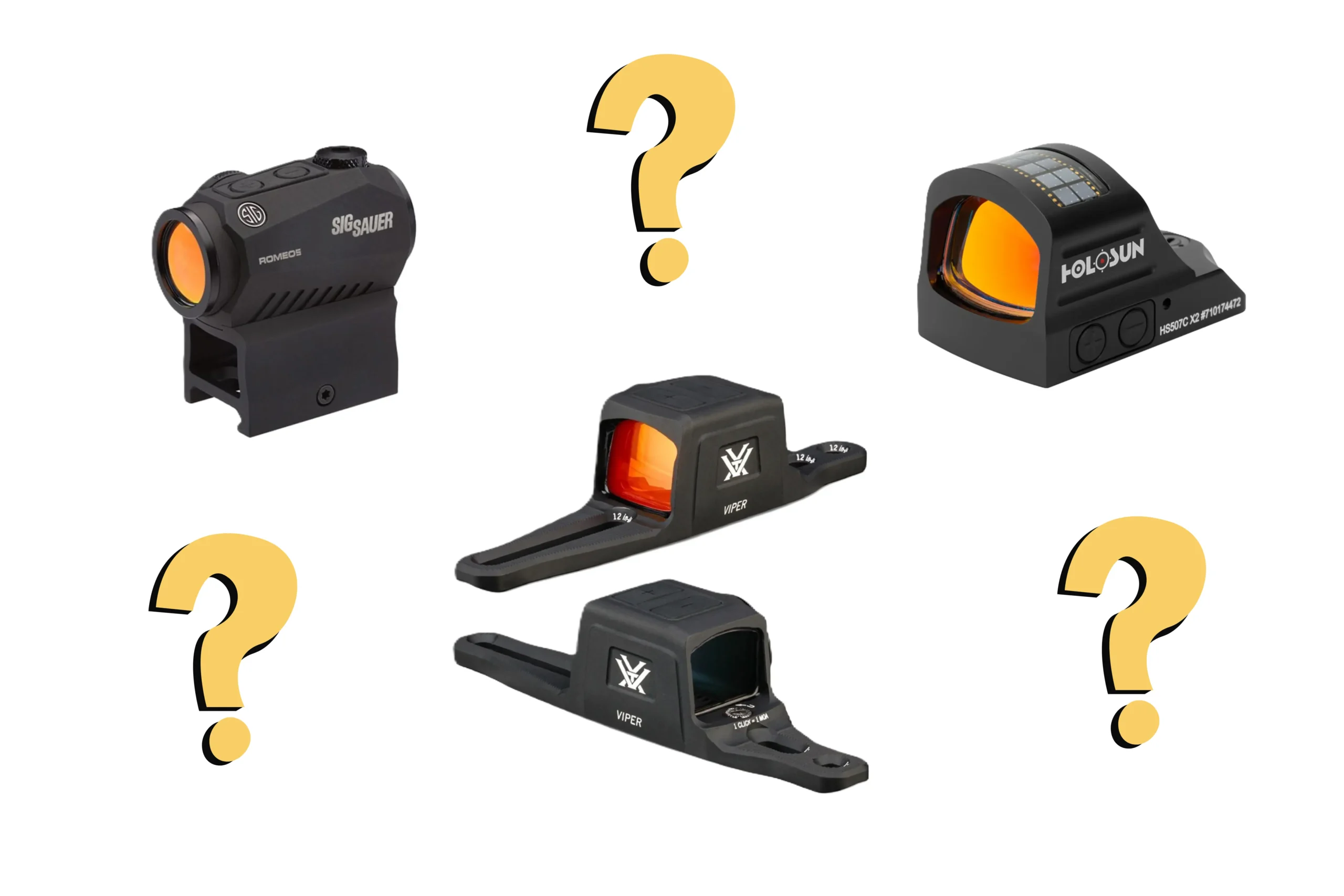
Real-world battery life depends heavily on your settings and reticle choice. A Holosun 507C delivers up to 50,000 hours with just the 2 MOA dot running, but that drops significantly when you’re using the circle-dot because it draws more power.
Motion activation features work brilliantly here. Sig’s MOTAC or Holosun’s Shake Awake turn the dot on the instant you move the gun, then shut off after 10 minutes of stillness to preserve battery life.
Durability and Environmental Protection
IPX7 waterproof rating should be your baseline for serious use—that’s submersion to 1 meter for 30 minutes. Nitrogen purging prevents internal fogging when you bring a cold gun into a warm room.
Look for one-piece construction from 6061 or 7075 aluminum. Single-piece housings resist the flexing that causes zero shift under the pounding of heavy recoil.
Mounting System Compatibility
The RMR footprint dominates aftermarket support with hundreds of compatible mounting plates available. For shotguns specifically, drilled and tapped receivers like the Mossberg 500/590 and Remington 870 work best with direct-mount systems.
Torque specifications typically run 12-15 inch-pounds for mounting screws. Never exceed manufacturer specs—overtightening can crack receivers or damage the optic housing.
Top Shotgun Red Dot Sight Recommendations by Budget
Premium Tier: Vortex Viper Shotgun ($300-500)
The Vortex Viper Shotgun represents the gold standard for dedicated shotgun optics. Its integrated mount eliminates rail stacking by machining the mount and housing from a single piece of 6061 aluminum.
This revolutionary design sits remarkably low on the receiver—lower than any traditional rail-and-adapter setup you’ll find. You maintain a natural cheek weld, dramatically improving recoil control and follow-up shots.
The multi-reticle version offers seven configurations using a 3 MOA dot, 32 MOA circle, and 65 MOA circle. Compatibility spans dozens of shotgun models, including Mossberg, Remington, Benelli, and Winchester.
Battery life hits 50,000 hours with motion activation and 10-minute auto-shutoff. Side battery access preserves your zero during changes, and Vortex testing confirmed 1,000 live rounds plus 5,000 simulated recoil cycles without zero shift.
Mid-Range Excellence: Holosun 507C-X2 ($280-320)
The Holosun 507C-X2 delivers premium features at half the price. Its multi-reticle system provides a 2 MOA dot and 32 MOA circle—perfect for visualizing buckshot patterns.
Solar Failsafe technology gives you backup power if the CR1632 battery dies. Shake Awake motion sensing activates instantly when you move the gun, delivering up to 50,000 hours with the dot-only reticle or 20,000 hours using the circle-dot combination.
The RMR footprint means universal compatibility with mounting plates. Side-loading battery access lets you swap batteries without removing the optic or losing your zero.
Budget Choice: Sig Sauer Romeo 5 ($140-180)
The Romeo 5 proves you don’t need $500 for reliable performance. Its MOTAC system works flawlessly—pick up the gun and the dot appears instantly.
A 2 MOA dot provides adequate precision for most shotgun applications. Ten daylight brightness settings plus two night-vision compatible settings cover every scenario.
Battery life reaches 40,000+ hours at medium brightness. Budget an extra $30-50 for a proper low-profile shotgun mount since the included mounts won’t work well.
Mounting Your Shotgun Red Dot
Understanding Drilled and Tapped Receivers
Factory-drilled receivers make installation straightforward. Mossberg 500/590/835 shotguns and most Remington 870 tactical variants come standard with drilled and tapped receiver tops.
Common thread pitches include 6-48, 8-40, and 10-32. Most quality optics include multiple screw sets covering these sizes.
The Direct Mount Advantage
Direct mounting beats rail systems every time for red dot sights for shotgun applications. You eliminate tolerance stacking by adding a rail, adapter plate, and optic separately.
The Vortex Viper takes this to its logical conclusion: The mount is the optic housing. For optics requiring adapter plates, apply blue Loctite to all screws and torque to 12-15 inch-pounds in a cross pattern.
Zeroing Your Shotgun Red Dot
Start at 15 yards to get on paper with minimal ammunition. Fire a 3-5 shot group and make coarse adjustments to center your pattern.
Move to your primary zero distance once centered. For turkey hunting, 25 yards works well, while home defense buckshot zeros at 15-25 yards where you expect to engage threats.
Pattern verification matters more with shotguns than point-of-impact zeroing. Set up a 4×4 foot cardboard sheet and fire at your zero distance to verify the pattern center matches your dot placement.
Application-Specific Selection Guide
Turkey Hunting: Precision at Distance
Turkey hunting demands precision rivaling rifle shooting. You’re taking headshots on a softball-sized target at 35-45 yards, often from awkward positions.
A 3 MOA dot provides the precision you need without being so small it disappears in poor lighting. The Vortex Viper’s multi-reticle option lets you verify your pattern matches the 32 MOA or 65 MOA circle.
Enclosed emitters protect against rain and fog during those early morning setups. Low-profile mounting becomes critical when shouldering from seated positions.
Home Defense: Speed and Reliability
Defensive shotgun optics must be instantly ready without fumbling for buttons. Motion activation or always-on capability is non-negotiable.
Large 6 MOA dots or circle-dot combinations excel in high-stress scenarios. The 32 MOA circle matching your buckshot pattern provides accountability for every pellet—which matters both tactically and legally.
Battery management becomes simpler with motion sensing. Replace annually and keep a spare taped to the stock for defensive shotguns.
Competition: Versatility and Speed
Three-gun stages demand adaptability. You’ll engage close steel, mid-range slugs, and various mixed targets all in one stage.
The Holosun 507C’s multi-reticle system shines here—switch between dot-only for precision slug work and circle-dot for speed stages. Large sight windows help with rapid target transitions, and understanding how red dot sights work helps you maximize durability factors.
Maintaining Zero and Long-Term Care
Simply knowing how to zero a red dot for your shotgun isn’t enough; you need to maintain it.
Check mounting screw tightness every 200-500 rounds, as shotgun recoil can gradually loosen even properly torqued screws. Verify your zero at the beginning of each season or every six months for defensive guns.
Clean lenses with proper lens paper or microfiber cloths only—never paper towels or rough materials that scratch coatings. Store firearms with optics in padded cases when transporting to prevent hard impacts that cause more zero loss than recoil.
Replace batteries on a calendar schedule rather than waiting for failure. For defensive shotguns, replace annually regardless of reported life remaining.
The Vortex Viper Revolution
The Vortex Viper changed shotgun optics fundamentally. Before its release, mounting a red dot meant stacking components that raised sight height by 1.5-2 inches minimum.
Vortex solved this by machining the mount and housing as one component. The result sits dramatically lower than traditional setups—giving you proper cheek weld without compromising sight picture.
The elongated front mounting slot accommodates different receiver hole patterns without custom drilling. Two rear mount points plus adjustable front positioning work with dozens of shotgun models.
Frequently Asked Questions
Do I really need a red dot on my shotgun?
No, but it helps. Traditional bead sights work fine, but red dots provide measurable accuracy improvements for turkey hunting, slugs, home defense, and competition.
Can I use a pistol red dot on my shotgun?
Yes, with appropriate mounting. Many shooters use Trijicon RMRs and Holosun 507Cs on shotguns successfully, though you’ll need a low-profile mount or adapter plate.
How long do shotgun red dots last?
Battery life ranges from 1 to 5 years of continuous use, depending on settings. The optic itself should last 10-20+ years with proper mounting and maintenance.
Will recoil break my red dot?
Quality optics handle shotgun recoil fine when properly mounted. Always use proper torque specifications and blue Loctite on mounting screws.
What if I have astigmatism?
Try lower brightness settings first—this often reduces the starburst effect significantly. Green dots sometimes appear clearer than red, and circle reticles work better than dots for many people.
Conclusion
Selecting the right red dot sights for shotgun applications requires balancing recoil durability, mounting height, battery life, and reticle design. Budget options like the Sig Romeo 5 provide reliable performance, while the Vortex Viper Shotgun offers purpose-built excellence for serious hunters.
The Holosun 507C-X2 ($280-320) hits the sweet spot with multi-reticle versatility and solar backup. Proper mounting matters as much as optic selection—direct receiver mounting keeps sight height low and maintains your natural cheek weld.
Lucky for you, we have Holosun 507C-X2s in stock! Give us a call at 713-485-5773 now. Gold Trigger would be more than happy to serve you.
Disclaimer: The information provided in this blog is for educational and informational purposes only. Always follow manufacturer guidelines, local laws, and safety protocols when purchasing, installing, or using firearm accessories. Gold Trigger is not responsible for any misuse of products or information provided. Consult with qualified professionals for specific advice related to firearms and accessories.
Comments