
Candela vs Lumens: Weapon Light Output Explained

Published on: April 13, 2026
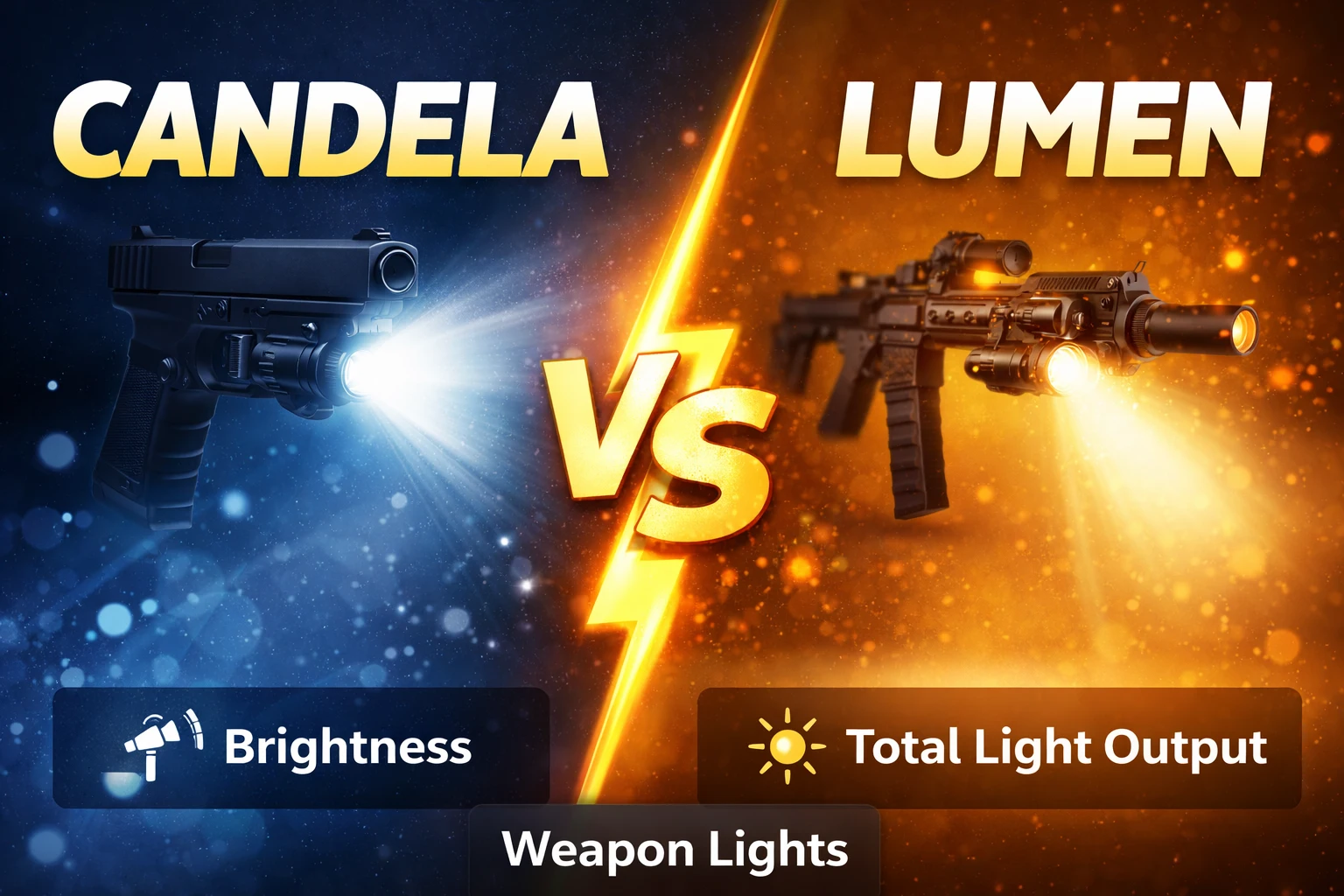
Candela vs Lumen comparison for weapon lights

Reading Time: 9 mins 37 sec

You’re shopping for a weapon light and see two models side by side. One advertises 1,000 lumens with 15,000 candela, while another claims 800 lumens with 50,000 candela. Which one actually reaches your target when it matters?

Understanding candela vs lumens means knowing which specifications match your defensive environment. In this guide, you’ll learn what each measurement reveals about real-world performance and how to choose the right light for your situation.

Highlights

  • Lumens measure total light output, while candela measures beam intensity in a specific direction.
  • Indoor defense needs 400-800 lumens with 8,000-20,000 candela for wide coverage.
  • Outdoor applications require 800-1,500 lumens with 30,000-80,000 candela for distance identification.
  • The candela-to-lumen ratio (cd/lm) predicts whether a light floods or throws.
  • Understanding both measurements prevents choosing the wrong light for your scenario.

What Are Lumens? (Total Light Output)

The Science Behind Lumen Measurements

Lumens measure the total amount of visible light a source produces in all directions. Think of them like water flowing from a hose—they tell you the complete volume coming out, regardless of where it goes.

The ANSI/PLATO FL1 Standard defines how manufacturers test lumens using an integrating sphere that captures every bit of light. The measurement happens 30 seconds after activation with fresh batteries, giving you a standardized number you can trust.

Here’s what matters most: Lumens don’t tell you where the light goes or how it spreads. A 1,000-lumen light could flood a wide area or focus into a tight beam. This differs from watts, which only measure electrical power consumption, not actual light output.

How Lumens Affect Performance

Higher lumens mean more total light for your spill beam—the peripheral illumination that maintains situational awareness around your primary target. When you’re clearing rooms or working in fog, smoke, or rain, environmental factors scatter and absorb light. More lumens help overcome this loss.

But here’s the catch: The relationship between lumens vs candela determines actual performance. Most weapon lights range from 300 to 2,000+ lumens, depending on what you need them to do.

Lumen Requirements by Environment

  • Indoor and Home Defense: This typically needs 400-800 lumens. At shorter distances—usually 5 to 25 yards—enclosed spaces with reflective surfaces amplify whatever output you produce. Too many lumens create washout and glare that destroy your night-adapted vision when light bounces off white walls.
  • Outdoor and Rural Defense: This demands 800-1,500+ lumens. Open environments lack those reflective surfaces, so light dissipates into space rather than bouncing back to you. Atmospheric conditions and ambient light from streetlights or moonlight also require higher output to remain effective.
  • Professional and Law Enforcement: Users often carry multiple lights with 500-2,000+ lumens for different missions. Different scenarios demand different tools. For comprehensive guidance on selecting output levels, check out our complete guide to weapon lights.

Marketing Myths About Lumens

Manufacturers advertise “burst lumens” that only last 30-60 seconds before thermal throttling reduces output. Your light gets hot, efficiency drops, and the circuit reduces power to prevent damage. Always look for sustained performance data, not just peak numbers measured at that initial 30-second mark.

Another myth: Doubling lumens doubles brightness. Human perception works logarithmically—you need roughly four times the lumens to perceive twice the brightness. Going from 500 to 1,000 lumens feels brighter, but nowhere near twice as bright as you’d expect.

What Is Candela? (Beam Intensity)

Understanding Luminous Intensity

While lumens measure total output, candela measures how concentrated that light is in a specific direction. If lumens are water volume, candela is water pressure hitting the target.

The ANSI FL1 Standard measures candela at the brightest point in your beam—typically the center hotspot. What is candela’s practical meaning? It determines how far your light effectively reaches and how well it penetrates barriers like fog, smoke, vehicle glass, and opposing light sources.

How Candela Determines Throw Distance

The FL1 Standard provides this formula: Beam Distance (meters) = 2 × √(Candela)

Let’s see what this means practically:

  • 10,000 candela = approximately 200-meter beam distance
  • 50,000 candela = approximately 447-meter beam distance
  • 100,000 candela = approximately 632-meter beam distance

But here’s the critical detail: These distances assume 0.25 lux at the target—roughly equivalent to full moonlight. That’s barely enough to detect movement, not nearly sufficient for positive threat identification.

Tactical lighting experts recommend using about 50% of the FL1-rated distance for realistic target identification. If your light claims 200 meters of throw, plan on clearly identifying targets at 100 meters under actual conditions.

The inverse square law governs how beam intensity vs output works over distance. Light intensity decreases with the square of distance, which explains why candela matters so much when you need to reach farther targets.

Required Candela for Distance

For practical threat identification, you need significantly more than the mathematical minimum. The 0.25 lux standard isn’t enough for detailed recognition—you need closer to 1-5 lux to confidently assess whether that figure is a threat or your neighbor.

  • For 25-yard home defense: You need 5,000-15,000 candela realistically, though the mathematical FL1 minimum is only 132 candela.
  • For 50-yard property perimeter: Target 20,000-40,000 candela for positive identification, far exceeding the 529 candela FL1 minimum.
  • For 100-yard rifle applications: You want 50,000-100,000+ candela to see details at distance, well beyond the 2,070 candela mathematical threshold.

These realistic numbers account for contrast, detail recognition, and operating under stress—not just detecting that something’s there.

The Candela-to-Lumen Ratio

The cd/lm ratio instantly tells you whether a light floods or throws. Divide candela by lumens to get this revealing number.

Low ratio (5-15 cd/lm) indicates a flood beam with wide coverage and minimal throw, perfect for close-range work where you need peripheral vision.

Medium ratio (25-45 cd/lm) provides balanced performance with adequate throw for most defensive distances while maintaining enough spill for situational awareness.

High ratio (50-150+ cd/lm) creates a thrower beam designed for distance, where the hotspot reaches far but spill is minimal or nonexistent.

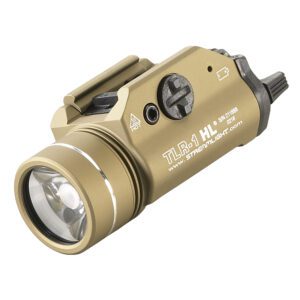
Real examples help clarify this. The Streamlight TLR-1 HL produces 1,000 lumens with 33,000 candela—that’s 33 cd/lm, perfectly balanced for general use. The Modlite OKW outputs 680 lumens with 69,000 candela—101 cd/lm, making it a dedicated thrower. Despite having fewer total lumens, the OKW throws dramatically farther.

Understanding this ratio helps you predict real-world performance from specifications alone. If you’re considering lights from the Streamlight TLR series, knowing their cd/lm ratios helps you choose the right model for your application.

Lux: The Third Measurement

Lux measures illuminance—the amount of light hitting a surface per square meter. The lux vs lumen relationship is straightforward: one lux equals one lumen per square meter.

At one meter distance, lux and candela are identical since 1² equals 1. The formula connecting them: Lux = Candela / Distance²

An example clarifies this: A 10,000 candela light produces 10,000 lux at 1 meter, 2,500 lux at 2 meters, and 625 lux at 4 meters. The light hasn’t changed—only how concentrated it is at different distances.

Manufacturers rarely list lux because it varies with distance. Candela solves this problem by providing a fixed property you can use to calculate lux at any distance you need.

Understanding common lux levels provides context for what different intensities feel like:

  • Full daylight: approximately 100,000 lux
  • Office lighting: 300-500 lux
  • Full moon illumination: 0.1 lux
  • FL1 Standard threshold: 0.25 lux

The FL1 0.25 lux threshold represents moonlight-equivalent illumination. For actual threat identification, you need 1-5 lux minimum, explaining why practical candela requirements far exceed mathematical minimums when real-world recognition matters.

How Optics Convert Lumens to Candela

Your LED produces a certain number of lumens. Reflectors and optics convert that into focused beams with specific candela output—this is where identical LEDs can perform dramatically differently.

Parabolic reflectors collect LED light and direct it forward in a more parallel pattern. Deeper reflectors create tighter focus and higher candela from identical LED output. A light with a shallow reflector might produce 15,000 candela from 800 lumens, while a deeper reflector could hit 50,000 candela with the same LED.

TIR (Total Internal Reflection) optics use shaped lenses instead of reflectors, achieving higher efficiency by reducing light loss. Many modern weapon lights use TIR because they’re compact and provide controlled beam patterns in smaller packages.

LED die size fundamentally affects beam characteristics. Small emitters like the Osram CSLNM1 focus easily for maximum throw. Large emitters like the Cree XHP70 produce more total lumens but resist tight focusing, limiting candela potential.

Most weapon lights use 5,000-6,500K cool white LEDs because this color temperature appears brighter to human eyes than warmer alternatives at identical lumen output. Your eyes respond more strongly to this range.

Here’s why identical lumens produce different candela: design philosophy. The Modlite PLHv2 produces 1,350 lumens with 54,000 candela for balanced use. The Modlite OKW outputs 680 lumens with 69,000 candela as a dedicated thrower. You can’t maximize both simultaneously—more flood means less candela, more throw means sacrificing spill width.

Choosing the Right Specifications

Indoor Applications

For home defense and room clearing, prioritize these specifications:

  • Lumens: 400-1,000 (sweet spot: 500-800)
  • Candela: 8,000-20,000
  • Ratio: 10-25 cd/lm (flood-biased)

Reflective surfaces amplify light indoors. Lower candela with wider spill maintains peripheral vision and prevents washout from bright hotspots bouncing off walls, mirrors, and light-colored surfaces that would destroy your ability to see into shadows.

Outdoor Applications

For property defense and rural environments, target different specifications:

  • Lumens: 800-1,500
  • Candela: 30,000-80,000
  • Ratio: 30-60 cd/lm (balanced to throw-biased)

Open environments lack reflective surfaces, requiring more raw output to maintain usable illumination. Higher candela becomes critical for identifying threats at 50-100+ yards, where you need intensity to distinguish details in darkness.

Balanced Versatility

If you genuinely face varied scenarios with one light, aim for the middle ground:

  • Lumens: 800-1,200
  • Candela: 25,000-50,000
  • Ratio: 25-45 cd/lm (true balance)

This compromise provides adequate throw for typical defensive distances (25-75 yards) while maintaining enough spill for room clearing. You won’t excel at extremes, but you’ll perform adequately in both indoor and outdoor situations.

Common Misconceptions Debunked

“More Lumens Always Means Brighter”

Brightness perception depends on beam focus, not just total output. At 50 yards, a 500-lumen thrower with 50,000 candela appears dramatically brighter on target than a 1,000-lumen flooder with 15,000 candela.

Your eyes respond to intensity at the point you’re observing—that’s candela, determining what you actually see.

“You Can Convert Lumens to Candela”

Direct conversion is impossible because they measure fundamentally different properties. Lumens describe total output (quantity), while candela describes directional intensity (focus).

They’re not two ways of expressing the same thing—you need both specifications to understand a light’s complete performance profile.

“High Candela Causes Backscatter”

This misconception confuses candela with lumens. Backscatter comes from total light scattering off water droplets or dust particles—that’s lumens creating more particles to reflect.

High-lumen floods actually create worse backscatter than moderate-candela throwers. Focused beams with moderate lumens often penetrate fog better because less spill means fewer light rays hitting particles.

Optimal fog and rain performance uses 600-1,000 lumens with 25,000-60,000 candela. You get enough punch to reach the target without excessive scatter bouncing back at you.

Testing and Evaluating Specifications

Understanding Manufacturer Claims

The ANSI FL1 Standard provides an objective testing methodology. FL1 certification means specifications underwent standardized testing, but certification is voluntary. Many manufacturers self-report numbers that may be optimistic without third-party verification.

Red flags indicating questionable claims include:

  • No FL1 certification from reputable brands
  • Impossibly high lumens for battery size
  • Missing candela specifications
  • No runtime graphs showing sustained output

Trusted manufacturers like Streamlight, SureFire, and Modlite provide accurate, tested specifications you can rely on for making purchasing decisions.

Real-World Testing

Specifications only tell part of the story. Test at multiple distances—5, 15, 25, and 50+ yards—with actual targets. Observe how the beam illuminates each distance and whether you can identify details clearly with adequate spill coverage.

Run lights continuously for 5-10 minutes to check thermal throttling. Many lights dim substantially after the initial burst of output. Compare beam profiles by shining different lights at a white wall from identical distances—the hotspot size, intensity, and spill pattern become immediately obvious through direct comparison.

Frequently Asked Questions

Is More Lumens Always Better?

No—output must match your application. Indoor use needs only 400-800 lumens to avoid overwhelming reflective surfaces. Outdoor property defense might need 800-1,500 lumens to maintain effectiveness. Excessive lumens create washout, reduce runtime, and increase size without providing a practical benefit for your actual scenario.

What’s More Important: Candela or Lumens?

Both matter, but their importance varies by application. Indoor work prioritizes lumens for wide coverage and peripheral vision. Outdoor work prioritizes candela for distance identification. Most users benefit from balanced specifications, evaluating both numbers together using the cd/lm ratio rather than focusing on just one measurement.

Can Low-Lumen Lights Have High Candela?

Absolutely. The Modlite OKW demonstrates this perfectly: 680 lumens with 69,000 candela. Tight reflector focus creates intense hotspots from moderate output. The trade-off is a minimal spill that creates tunnel vision, sacrificing peripheral awareness for maximum distance.

What Candela Do I Need for Distance?

Practical recommendations based on real-world identification needs:

  • 25-yard home defense: 5,000-15,000 candela
  • 50-yard property work: 20,000-40,000 candela
  • 100-yard rifle use: 50,000-100,000+ candela

These ranges account for contrast, detail recognition, and operating under stress—not just mathematical minimums that only detect presence without identifying threats.

Conclusion

Understanding candela vs lumens means recognizing which measurements matter for your defensive needs. Lumens tell you the total light output for peripheral illumination and situational awareness. Candela reveals how effectively that light reaches distant targets for threat identification. When you evaluate candela vs lumens vs lux together, you get the complete performance picture.

Balance wins for most applications—typically 600-1,000 lumens with 20,000-50,000 candela provides versatility across varied scenarios. Don’t chase maximum numbers on the shelf. Choose specifications matching your environment and realistic engagement distances.

Ready to find the perfect weapon light for your gun? Browse our catalogue now or call us at 713-485-5773.

Disclaimer

Important Safety and Legal Notice: This article provides educational information about weapon-mounted light specifications and technical lighting principles for informational purposes only. The information presented is not intended as professional tactical training, legal advice, or a substitute for proper firearms instruction from certified professionals.

Weapon Light Usage: The deployment of weapon-mounted lights in defensive situations involves significant legal, ethical, and safety considerations that vary by jurisdiction. Always understand and comply with all applicable federal, state, and local laws regarding firearms, defensive tools, and the use of force. Consult with qualified legal counsel regarding the laws in your area.

Training Requirements: Never rely solely on equipment specifications or technical knowledge. Proper training in low-light tactics, threat identification, rules of engagement, and safe weapon handling is essential before carrying or deploying any weapon-mounted light system. Seek professional instruction from certified firearms instructors with specific expertise in low-light operations.

Product Performance: Actual product performance may vary from manufacturer specifications due to factors including but not limited to: battery condition, temperature, manufacturing tolerances, and individual unit variation. Always verify the performance of your specific equipment under realistic conditions. Manufacturers may update product specifications without notice.

No Warranty or Guarantee: While we strive for accuracy, this information is provided “as is” without warranty of any kind. We make no guarantees regarding the accuracy, completeness, or applicability of this information to your specific situation. Technical specifications and industry standards may change over time.

Personal Responsibility: The decision to carry, deploy, or use weapon-mounted lights is a personal one that carries significant responsibility. You are solely responsible for your actions, your safety, the safety of others, and compliance with all applicable laws. This article does not constitute an endorsement or recommendation of any specific products, tactics, or uses.

Environmental Considerations: Always consider your environment, backstop, and surroundings before activating any high-intensity light. Excessive brightness can cause temporary vision impairment to yourself and others, and may create liability in certain situations.

By reading and using this information, you acknowledge that you understand and accept these limitations and responsibilities.

Recent Posts

Categories

Comments

Leave a Reply

Your email address will not be published. Required fields are marked *

Candela vs Lumens: Weapon Light Output Explained

Candela vs Lumen comparison for weapon lights

Reading Time: 9 mins 37 sec

You’re shopping for a weapon light and see two models side by side. One advertises 1,000 lumens with 15,000 candela, while another claims 800 lumens with 50,000 candela. Which one actually reaches your target when it matters?

Understanding candela vs lumens means knowing which specifications match your defensive environment. In this guide, you’ll learn what each measurement reveals about real-world performance and how to choose the right light for your situation.

Highlights

  • Lumens measure total light output, while candela measures beam intensity in a specific direction.
  • Indoor defense needs 400-800 lumens with 8,000-20,000 candela for wide coverage.
  • Outdoor applications require 800-1,500 lumens with 30,000-80,000 candela for distance identification.
  • The candela-to-lumen ratio (cd/lm) predicts whether a light floods or throws.
  • Understanding both measurements prevents choosing the wrong light for your scenario.

What Are Lumens? (Total Light Output)

The Science Behind Lumen Measurements

Lumens measure the total amount of visible light a source produces in all directions. Think of them like water flowing from a hose—they tell you the complete volume coming out, regardless of where it goes.

The ANSI/PLATO FL1 Standard defines how manufacturers test lumens using an integrating sphere that captures every bit of light. The measurement happens 30 seconds after activation with fresh batteries, giving you a standardized number you can trust.

Here’s what matters most: Lumens don’t tell you where the light goes or how it spreads. A 1,000-lumen light could flood a wide area or focus into a tight beam. This differs from watts, which only measure electrical power consumption, not actual light output.

How Lumens Affect Performance

Higher lumens mean more total light for your spill beam—the peripheral illumination that maintains situational awareness around your primary target. When you’re clearing rooms or working in fog, smoke, or rain, environmental factors scatter and absorb light. More lumens help overcome this loss.

But here’s the catch: The relationship between lumens vs candela determines actual performance. Most weapon lights range from 300 to 2,000+ lumens, depending on what you need them to do.

Lumen Requirements by Environment

  • Indoor and Home Defense: This typically needs 400-800 lumens. At shorter distances—usually 5 to 25 yards—enclosed spaces with reflective surfaces amplify whatever output you produce. Too many lumens create washout and glare that destroy your night-adapted vision when light bounces off white walls.
  • Outdoor and Rural Defense: This demands 800-1,500+ lumens. Open environments lack those reflective surfaces, so light dissipates into space rather than bouncing back to you. Atmospheric conditions and ambient light from streetlights or moonlight also require higher output to remain effective.
  • Professional and Law Enforcement: Users often carry multiple lights with 500-2,000+ lumens for different missions. Different scenarios demand different tools. For comprehensive guidance on selecting output levels, check out our complete guide to weapon lights.

Marketing Myths About Lumens

Manufacturers advertise “burst lumens” that only last 30-60 seconds before thermal throttling reduces output. Your light gets hot, efficiency drops, and the circuit reduces power to prevent damage. Always look for sustained performance data, not just peak numbers measured at that initial 30-second mark.

Another myth: Doubling lumens doubles brightness. Human perception works logarithmically—you need roughly four times the lumens to perceive twice the brightness. Going from 500 to 1,000 lumens feels brighter, but nowhere near twice as bright as you’d expect.

What Is Candela? (Beam Intensity)

Understanding Luminous Intensity

While lumens measure total output, candela measures how concentrated that light is in a specific direction. If lumens are water volume, candela is water pressure hitting the target.

The ANSI FL1 Standard measures candela at the brightest point in your beam—typically the center hotspot. What is candela’s practical meaning? It determines how far your light effectively reaches and how well it penetrates barriers like fog, smoke, vehicle glass, and opposing light sources.

How Candela Determines Throw Distance

The FL1 Standard provides this formula: Beam Distance (meters) = 2 × √(Candela)

Let’s see what this means practically:

  • 10,000 candela = approximately 200-meter beam distance
  • 50,000 candela = approximately 447-meter beam distance
  • 100,000 candela = approximately 632-meter beam distance

But here’s the critical detail: These distances assume 0.25 lux at the target—roughly equivalent to full moonlight. That’s barely enough to detect movement, not nearly sufficient for positive threat identification.

Tactical lighting experts recommend using about 50% of the FL1-rated distance for realistic target identification. If your light claims 200 meters of throw, plan on clearly identifying targets at 100 meters under actual conditions.

The inverse square law governs how beam intensity vs output works over distance. Light intensity decreases with the square of distance, which explains why candela matters so much when you need to reach farther targets.

Required Candela for Distance

For practical threat identification, you need significantly more than the mathematical minimum. The 0.25 lux standard isn’t enough for detailed recognition—you need closer to 1-5 lux to confidently assess whether that figure is a threat or your neighbor.

  • For 25-yard home defense: You need 5,000-15,000 candela realistically, though the mathematical FL1 minimum is only 132 candela.
  • For 50-yard property perimeter: Target 20,000-40,000 candela for positive identification, far exceeding the 529 candela FL1 minimum.
  • For 100-yard rifle applications: You want 50,000-100,000+ candela to see details at distance, well beyond the 2,070 candela mathematical threshold.

These realistic numbers account for contrast, detail recognition, and operating under stress—not just detecting that something’s there.

The Candela-to-Lumen Ratio

The cd/lm ratio instantly tells you whether a light floods or throws. Divide candela by lumens to get this revealing number.

Low ratio (5-15 cd/lm) indicates a flood beam with wide coverage and minimal throw, perfect for close-range work where you need peripheral vision.

Medium ratio (25-45 cd/lm) provides balanced performance with adequate throw for most defensive distances while maintaining enough spill for situational awareness.

High ratio (50-150+ cd/lm) creates a thrower beam designed for distance, where the hotspot reaches far but spill is minimal or nonexistent.

Real examples help clarify this. The Streamlight TLR-1 HL produces 1,000 lumens with 33,000 candela—that’s 33 cd/lm, perfectly balanced for general use. The Modlite OKW outputs 680 lumens with 69,000 candela—101 cd/lm, making it a dedicated thrower. Despite having fewer total lumens, the OKW throws dramatically farther.
Understanding this ratio helps you predict real-world performance from specifications alone. If you’re considering lights from the Streamlight TLR series, knowing their cd/lm ratios helps you choose the right model for your application.

Lux: The Third Measurement

Lux measures illuminance—the amount of light hitting a surface per square meter. The lux vs lumen relationship is straightforward: one lux equals one lumen per square meter.

At one meter distance, lux and candela are identical since 1² equals 1. The formula connecting them: Lux = Candela / Distance²

An example clarifies this: A 10,000 candela light produces 10,000 lux at 1 meter, 2,500 lux at 2 meters, and 625 lux at 4 meters. The light hasn’t changed—only how concentrated it is at different distances.

Manufacturers rarely list lux because it varies with distance. Candela solves this problem by providing a fixed property you can use to calculate lux at any distance you need.

Understanding common lux levels provides context for what different intensities feel like:

  • Full daylight: approximately 100,000 lux
  • Office lighting: 300-500 lux
  • Full moon illumination: 0.1 lux
  • FL1 Standard threshold: 0.25 lux

The FL1 0.25 lux threshold represents moonlight-equivalent illumination. For actual threat identification, you need 1-5 lux minimum, explaining why practical candela requirements far exceed mathematical minimums when real-world recognition matters.

How Optics Convert Lumens to Candela

Your LED produces a certain number of lumens. Reflectors and optics convert that into focused beams with specific candela output—this is where identical LEDs can perform dramatically differently.

Parabolic reflectors collect LED light and direct it forward in a more parallel pattern. Deeper reflectors create tighter focus and higher candela from identical LED output. A light with a shallow reflector might produce 15,000 candela from 800 lumens, while a deeper reflector could hit 50,000 candela with the same LED.

TIR (Total Internal Reflection) optics use shaped lenses instead of reflectors, achieving higher efficiency by reducing light loss. Many modern weapon lights use TIR because they’re compact and provide controlled beam patterns in smaller packages.

LED die size fundamentally affects beam characteristics. Small emitters like the Osram CSLNM1 focus easily for maximum throw. Large emitters like the Cree XHP70 produce more total lumens but resist tight focusing, limiting candela potential.

Most weapon lights use 5,000-6,500K cool white LEDs because this color temperature appears brighter to human eyes than warmer alternatives at identical lumen output. Your eyes respond more strongly to this range.

Here’s why identical lumens produce different candela: design philosophy. The Modlite PLHv2 produces 1,350 lumens with 54,000 candela for balanced use. The Modlite OKW outputs 680 lumens with 69,000 candela as a dedicated thrower. You can’t maximize both simultaneously—more flood means less candela, more throw means sacrificing spill width.

Choosing the Right Specifications

Indoor Applications

For home defense and room clearing, prioritize these specifications:

  • Lumens: 400-1,000 (sweet spot: 500-800)
  • Candela: 8,000-20,000
  • Ratio: 10-25 cd/lm (flood-biased)

Reflective surfaces amplify light indoors. Lower candela with wider spill maintains peripheral vision and prevents washout from bright hotspots bouncing off walls, mirrors, and light-colored surfaces that would destroy your ability to see into shadows.

Outdoor Applications

For property defense and rural environments, target different specifications:

  • Lumens: 800-1,500
  • Candela: 30,000-80,000
  • Ratio: 30-60 cd/lm (balanced to throw-biased)

Open environments lack reflective surfaces, requiring more raw output to maintain usable illumination. Higher candela becomes critical for identifying threats at 50-100+ yards, where you need intensity to distinguish details in darkness.

Balanced Versatility

If you genuinely face varied scenarios with one light, aim for the middle ground:

  • Lumens: 800-1,200
  • Candela: 25,000-50,000
  • Ratio: 25-45 cd/lm (true balance)

This compromise provides adequate throw for typical defensive distances (25-75 yards) while maintaining enough spill for room clearing. You won’t excel at extremes, but you’ll perform adequately in both indoor and outdoor situations.

Common Misconceptions Debunked

“More Lumens Always Means Brighter”

Brightness perception depends on beam focus, not just total output. At 50 yards, a 500-lumen thrower with 50,000 candela appears dramatically brighter on target than a 1,000-lumen flooder with 15,000 candela.

Your eyes respond to intensity at the point you’re observing—that’s candela, determining what you actually see.

“You Can Convert Lumens to Candela”

Direct conversion is impossible because they measure fundamentally different properties. Lumens describe total output (quantity), while candela describes directional intensity (focus).

They’re not two ways of expressing the same thing—you need both specifications to understand a light’s complete performance profile.

“High Candela Causes Backscatter”

This misconception confuses candela with lumens. Backscatter comes from total light scattering off water droplets or dust particles—that’s lumens creating more particles to reflect.

High-lumen floods actually create worse backscatter than moderate-candela throwers. Focused beams with moderate lumens often penetrate fog better because less spill means fewer light rays hitting particles.

Optimal fog and rain performance uses 600-1,000 lumens with 25,000-60,000 candela. You get enough punch to reach the target without excessive scatter bouncing back at you.

Testing and Evaluating Specifications

Understanding Manufacturer Claims

The ANSI FL1 Standard provides an objective testing methodology. FL1 certification means specifications underwent standardized testing, but certification is voluntary. Many manufacturers self-report numbers that may be optimistic without third-party verification.

Red flags indicating questionable claims include:

  • No FL1 certification from reputable brands
  • Impossibly high lumens for battery size
  • Missing candela specifications
  • No runtime graphs showing sustained output

Trusted manufacturers like Streamlight, SureFire, and Modlite provide accurate, tested specifications you can rely on for making purchasing decisions.

Real-World Testing

Specifications only tell part of the story. Test at multiple distances—5, 15, 25, and 50+ yards—with actual targets. Observe how the beam illuminates each distance and whether you can identify details clearly with adequate spill coverage.

Run lights continuously for 5-10 minutes to check thermal throttling. Many lights dim substantially after the initial burst of output. Compare beam profiles by shining different lights at a white wall from identical distances—the hotspot size, intensity, and spill pattern become immediately obvious through direct comparison.

Frequently Asked Questions

Is More Lumens Always Better?

No—output must match your application. Indoor use needs only 400-800 lumens to avoid overwhelming reflective surfaces. Outdoor property defense might need 800-1,500 lumens to maintain effectiveness. Excessive lumens create washout, reduce runtime, and increase size without providing a practical benefit for your actual scenario.

What’s More Important: Candela or Lumens?

Both matter, but their importance varies by application. Indoor work prioritizes lumens for wide coverage and peripheral vision. Outdoor work prioritizes candela for distance identification. Most users benefit from balanced specifications, evaluating both numbers together using the cd/lm ratio rather than focusing on just one measurement.

Can Low-Lumen Lights Have High Candela?

Absolutely. The Modlite OKW demonstrates this perfectly: 680 lumens with 69,000 candela. Tight reflector focus creates intense hotspots from moderate output. The trade-off is a minimal spill that creates tunnel vision, sacrificing peripheral awareness for maximum distance.

What Candela Do I Need for Distance?

Practical recommendations based on real-world identification needs:

  • 25-yard home defense: 5,000-15,000 candela
  • 50-yard property work: 20,000-40,000 candela
  • 100-yard rifle use: 50,000-100,000+ candela

These ranges account for contrast, detail recognition, and operating under stress—not just mathematical minimums that only detect presence without identifying threats.

Conclusion

Understanding candela vs lumens means recognizing which measurements matter for your defensive needs. Lumens tell you the total light output for peripheral illumination and situational awareness. Candela reveals how effectively that light reaches distant targets for threat identification. When you evaluate candela vs lumens vs lux together, you get the complete performance picture.

Balance wins for most applications—typically 600-1,000 lumens with 20,000-50,000 candela provides versatility across varied scenarios. Don’t chase maximum numbers on the shelf. Choose specifications matching your environment and realistic engagement distances.

Ready to find the perfect weapon light for your gun? Browse our catalogue now or call us at 713-485-5773.

Disclaimer

Important Safety and Legal Notice: This article provides educational information about weapon-mounted light specifications and technical lighting principles for informational purposes only. The information presented is not intended as professional tactical training, legal advice, or a substitute for proper firearms instruction from certified professionals.

Weapon Light Usage: The deployment of weapon-mounted lights in defensive situations involves significant legal, ethical, and safety considerations that vary by jurisdiction. Always understand and comply with all applicable federal, state, and local laws regarding firearms, defensive tools, and the use of force. Consult with qualified legal counsel regarding the laws in your area.

Training Requirements: Never rely solely on equipment specifications or technical knowledge. Proper training in low-light tactics, threat identification, rules of engagement, and safe weapon handling is essential before carrying or deploying any weapon-mounted light system. Seek professional instruction from certified firearms instructors with specific expertise in low-light operations.

Product Performance: Actual product performance may vary from manufacturer specifications due to factors including but not limited to: battery condition, temperature, manufacturing tolerances, and individual unit variation. Always verify the performance of your specific equipment under realistic conditions. Manufacturers may update product specifications without notice.

No Warranty or Guarantee: While we strive for accuracy, this information is provided “as is” without warranty of any kind. We make no guarantees regarding the accuracy, completeness, or applicability of this information to your specific situation. Technical specifications and industry standards may change over time.

Personal Responsibility: The decision to carry, deploy, or use weapon-mounted lights is a personal one that carries significant responsibility. You are solely responsible for your actions, your safety, the safety of others, and compliance with all applicable laws. This article does not constitute an endorsement or recommendation of any specific products, tactics, or uses.

Environmental Considerations: Always consider your environment, backstop, and surroundings before activating any high-intensity light. Excessive brightness can cause temporary vision impairment to yourself and others, and may create liability in certain situations.

By reading and using this information, you acknowledge that you understand and accept these limitations and responsibilities.

Leave a Reply

Your email address will not be published. Required fields are marked *

Shopping cart0
There are no products in the cart!