
Holographic Sight: Ultimate Precision Guide

Published on: March 16, 2026
Holographic Sights

Reading time: 8 mins 22 sec

You’re at the range watching your shooting partner acquire targets instantly with their holographic sight while you’re still catching up. What actually separates a true holographic optic from standard red dots?

A holographic sight uses laser technology to project a three-dimensional reticle onto a viewing window. Unlike red dot sights that use LED reflections, holographic sights create a true hologram—resulting in a pixelated but highly functional aiming point that remains visible even with partial lens obstruction.

This guide covers the physics behind how a holographic sight works, choosing between industry leaders EOTech and Vortex, and whether they’re worth your investment.

Highlights

  • Holographic sights use laser holography instead of LED reflections.
  • The reticle stays visible even with partial lens obstruction.
  • Only EOTech, Vortex, and DOT make true holographic sights.
  • Battery life typically ranges from 600 to 1,500 hours.
  • They excel at fast target acquisition for tactical shooting.

What Is a Holographic Sight?

The Technical Definition

What is a holographic sight from a technical standpoint? It’s the only optic type that uses true laser holography—a laser records a reticle image in three-dimensional space onto specialized holographic film during manufacture.

When you power on the sight, a laser diode illuminates this recorded hologram. The result is a floating reticle that appears to exist at the target distance rather than on a lens surface.

Red dots use LED light reflected off coated lenses—fundamentally different technology despite similar appearance.

Only Three True Manufacturers

Only three companies worldwide produce genuine holographic sights. EOTech pioneered the technology in 1996 at the SHOT Show, Vortex entered in 2017 with their Razor AMG UH-1, and DOT launched the EHS-1 in 2025.

However, in this blog, we’ll only focus on the first two.

Companies like Holosun market “holographic-style” reticles, but they use standard LED reflex technology. True holographic sights require specialized laser holography manufacturing expertise.

Are you looking for a HOLOSUN Red Dot Sight?

Gold Trigger offers a selection of Holosun Red Dot Sights at competitive pricing!

Key Differences from Red Dots

The reticle appearance differs noticeably. Red dots create a single, clean dot, while holographic reticles appear pixelated because they’re composed of thousands of small pixels that form the image—this “fuzziness” isn’t a defect; it’s how holographic technology works.

Battery life tells the real story. Holographic sights average 600-1,500 hours on a single battery, while red dots can run 25,000+ hours on the same battery type because laser diodes require significantly more power than simple LEDs.

The Partial Obstruction Advantage

Holographic sights remain functional even with severe lens damage. Break a significant portion of the front lens, and you’ll still see a usable reticle through the remaining clear area.

Red dots fail completely when the lens is cracked or heavily obscured. This resilience comes from transmission holography—the hologram exists throughout the entire viewing window, not at a single reflection point.

Military and law enforcement value this feature because optics take abuse in the field. A sight that keeps working despite damage can be mission-critical.

How Does a Holographic Sight Work?

Understanding how a holographic sight works requires following light through five stages:

  1. The laser diode emits a concentrated beam.
  2. A convex diverging mirror spreads it wider.
  3. A collimating reflector creates parallel light.
  4. A blazed diffraction grating filters the wavelength.
  5. This filtered light hits holographic film, reconstructing your three-dimensional reticle.

Changes in temperature would normally shift the laser’s wavelength, affecting your point of aim. Holographic sights solve this with a second grating that compensates for thermal wavelength drift.

The Parallax Reality

No firearm optic is truly parallax-free, despite marketing claims. Holographic sights minimize parallax to negligible levels at 100 yards—at this range, eye movement creates essentially zero point-of-impact shift.

Closer than 100 yards, you’ll experience slight parallax. This matters less than you’d think because you’re either shooting fast with both eyes open (where your brain compensates automatically) or naturally centering your eye for precision shots.

EOTech Holographic Sight: The Industry Standard

Model Lineup and Pricing

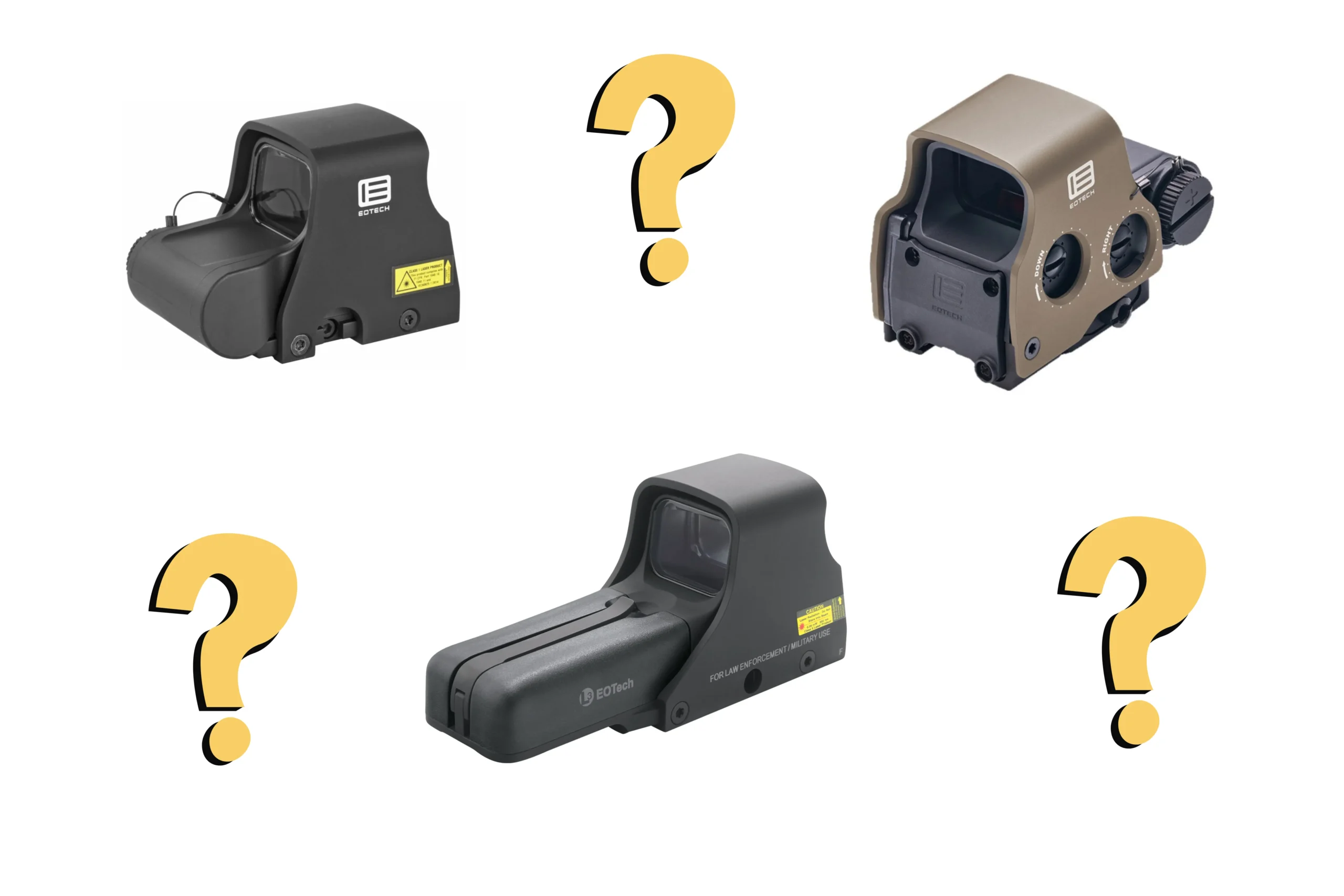
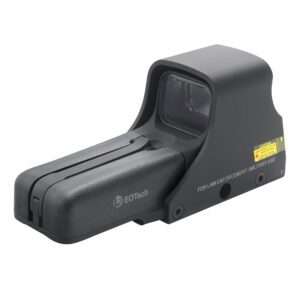
The EOTech holographic sight lineup starts with the 512 model at approximately $400-$450. It uses two AA batteries, mounts via a screw clamp, and sits at absolute co-witness height.

The 552 (around $600-$700) adds night vision compatibility—preferred by law enforcement for AA battery compatibility. The XPS series uses a single CR123 battery instead of two AAs, saving significant rail space.
The EXPS series tops the lineup at $600-$700 for the EXPS2 and $700-$750 for the EXPS3. These premium models include quick-detach mounts, side-mounted controls, and lower 1/3 co-witness height.

The EXPS3 adds dedicated night vision settings and enhanced waterproofing (33 feet vs 10 feet). If you’re running night vision devices, the EXPS3 is purpose-built for that mission.

If you’re interested in EOTech products, you may browse our collection.

The 68 MOA Ring Reticle

EOTech’s signature reticle combines a 68 MOA outer ring with a 1 MOA center dot. The large circle naturally draws your eye toward the center, accelerating target acquisition. At 100 yards, this ring covers 68 inches—roughly human torso width.

The 1 MOA center dot provides precision for longer shots. Some models offer a two-dot reticle with a second aiming point for 500-600 yard holdovers when paired with a magnifier.

The Thermal Drift Controversy

Earlier EOTech models were found to exhibit thermal drift, meaning a shift in point of aim under extreme temperature changes. Internal testing and later disclosures showed that these shifts could be noticeable at a distance under harsh environmental conditions.

Over time, EOTech addressed several performance-related issues, including moisture resistance and cold-weather image distortion, and made ongoing design improvements. While no optic is completely immune to thermal effects, EOTech acknowledges that minor thermal shift can occur across all holographic and reflex optics.

Post-2016 EOTech models show significantly improved thermal stability compared to earlier generations. Buyers considering a used optic should check the manufacturing date and generally avoid pre-2016 units.

Following these updates, EOTech optics were again adopted for military use, including a major 2018 procurement by the U.S. Special Operations Command for EXPS3 optics and G33 magnifiers.

Vortex Holographic Sight: The Competitive Alternative

Generation Evolution

Vortex holographic sight models launched in 2017 with the Razor AMG UH-1 (nicknamed “Huey”). Gen I suffered from reticle flaring and limited 1,000-hour battery life.

Vortex released Gen II in July 2020 with substantial improvements: 1,500-hour battery life, weight reduction to 11 ounces, eliminated reticle flaring, four dedicated night vision settings, and a toolless battery compartment.

Current Gen II models compete directly with EOTech’s EXPS series while typically costing $50-$100 less at approximately $550-$600.

The EBR-CQB Reticle

Vortex designed a unique 65 MOA ring with strategic cutouts at 9:00, 12:00, and 3:00 positions. These cutouts let you see more of your target while maintaining fast acquisition benefits.

A 1 MOA center dot provides precision aiming. Users consistently report that this dot appears crisper than EOTech’s, likely due to Gen II’s improved holographic recording process.

The bottom chevron serves as a close-quarters reference for 7-yard shots.

Warranty Advantage

Vortex’s VIP Warranty is legendary: lifetime, transferable, and unconditional. Break your sight? They’ll fix or replace it, no questions asked, no receipt required.

EOTech offers a 5-year limited warranty—non-transferable. Customer service response times favor Vortex significantly: 1-2 weeks versus EOTech’s 3-4 weeks.

This warranty difference adds real value. Even if you sell the optic later, the next owner will have full coverage, increasing resale value.

Choosing Between EOTech and Vortex

Battery Cost Analysis

The EOTech 512/552 runs on AA batteries for approximately 2,500 hours. At 50 hours annually, you’ll spend $15-$25 per year, $75-$125 over five years.

The EXPS2/3 uses CR123 batteries lasting 1,000 hours. Same usage means $40-$60 yearly or $200-$300 over five years.

Vortex UH-1 Gen II’s 1,500-hour battery life costs $30-$45 annually or $150-$225 over five years.

Add these to the purchase price for the true ownership cost. A $400 EOTech 512 actually costs $500-$525 over five years, while a $650 EXPS2 costs $850-$950 all-in.

Night Vision Compatibility

Only the EOTech 552, EXPS3, and Vortex UH-1 Gen II include dedicated NV brightness settings. Honest question: Do you actually need night vision compatibility?

Night vision devices cost $3,000-$8,000+ for quality units. If you’re not already running NODs or have immediate plans, save $100+ and skip NV-capable optics.

Passive aiming with an IR laser is often more effective than looking through your optic under night vision anyway.

Size Comparison

Rail space matters when building a complete setup. The EXPS2/3 measures 3.8 inches long—the shortest holographic sight available. The EOTech 512 measures 5.6 inches, while the Vortex UH-1 Gen II measures 4.6 inches, including the protective hood.

Weight-wise, EXPS models weigh 11.2 ounces, UH-1 Gen II weighs 11.6 ounces, and the 512 weighs 11.5 ounces. All holographic sights are heavy compared to red dots—an Aimpoint T2 weighs just 3 ounces.

Reticle Measurements and Zeroing

One Minute of Angle (MOA) equals approximately one inch at 100 yards. The EOTech 68 MOA ring covers 17 inches at 25 yards, 34 inches at 50 yards, 68 inches at 100 yards, and 136 inches at 200 yards.

The 1 MOA center dot covers one inch at 100 yards, two inches at 200 yards. This precision enables clean hits at extended ranges even with a non-magnified optic.

Zeroing your holographic sight starts at 25 yards. Fire a three-shot group, measure the distance from your point of aim to the group center.

EOTech adjustments move in 0.5 MOA clicks (half-inch per 100 yards), while Vortex adjustments move in 1 MOA clicks (one inch per 100 yards). Confirm your zero at 50 yards, then 100 yards.

Maintenance and Troubleshooting

Clean your lens with microfiber cloths and optical-grade lens cleaning solution only—never Windex, paper towels, or your shirt. Use compressed air to remove debris before wiping.

Remove batteries during long-term storage (6+ months) to prevent contact corrosion. Check your zero after any hard drops or impacts.

If your reticle appears dim, check battery orientation and freshness. The natural pixelated appearance is normal. For those with astigmatism, try viewing with prescription glasses, as corrective lenses often significantly clarify the holographic image.

EOTech models manufactured before 2016 may require factory service due to thermal drift. Post-2016 models perform within acceptable ranges.

When Holographic Sights Excel

For home defense, holographic sights offer massive advantages. The large viewing window allows both-eyes-open shooting while maintaining peripheral awareness, and the bright reticle works in any lighting condition, from bright daylight to darkness with a weapon light.

The downside: battery dependency. Keep a spare battery accessible and check the status monthly. For dedicated home defense rifles, remove the battery during storage to prevent parasitic drain.

USPSA Pistol Caliber Carbine, 3-Gun, and run-and-gun competitions favor holographic sights. The large window helps you find targets fast when moving at speed, while law enforcement chooses them for proven reliability and partial obstruction resilience during high-stress situations.

When Red Dots Win

If battery life tops your priority list, red dots win decisively—always-on operation for months versus holographic sights’ days or weeks.

Budgets under $400 total should use red dots. Ultralight rifle builds need red dots—saving 8 ounces makes a huge difference on long carries.

Handgun mounting requires red dots since holographic sights are too large for pistol slides.

Performance and Investment Analysis

Both EOTech and Vortex holographic sights withstand serious abuse. Drop tests from 4-6 feet onto concrete typically show no zero shift, while protective hoods save the objective lens during impacts.

Temperature cycling from -20°F to 140°F confirms operational capability, though POI shift may occur at extremes with older EOTech units. Submersion testing at 10-33 feet proves waterproofing claims.

Manufacturer battery life claims generally match real-world results within 5-10%. Cold weather reduces battery performance, while brightness settings significantly affect battery life—maximum brightness cuts life by 30-40%.

Total Cost Analysis

A $650 EOTech EXPS2 costs approximately $850-$950 over five years, including batteries. A $599 Vortex UH-1 Gen II costs approximately $750- $825 over five years, making it the value leader.

Consider resale value, too. EOTech optics retain 60-70% of the purchase price when sold used, while Vortex’s transferable warranty increases the used market value because buyers still receive full lifetime coverage.

Factor in mounting costs. Vortex includes an integrated QD mount worth $50-$75. While EOTech EXPS models include QD mounts, XPS models require a separate purchase.

Conclusion

Holographic sights represent the pinnacle of non-magnified optic technology, using genuine laser holography to create three-dimensional reticles. Only EOTech, Vortex, and DOT produce true models, distinguishing them from red dot mimics.

EOTech leads with military-proven reliability and a wide range of models, while Vortex offers superior value with longer battery life, a lifetime, transferable warranty, and lower pricing. Both excel in tactical and competitive scenarios where rapid acquisition is critical.

If you want a holographic sight, you can browse our catalogue or call us at 713-485-5773.

Disclaimer: The information in this article is provided for educational purposes only. It does not replace professional gunsmithing, legal, or manufacturer guidance. While every effort is made to ensure accuracy, results may vary based on firearm setup, ammunition, environment, and user technique.

Always follow fundamental firearm safety rules. Treat every firearm as loaded, keep your finger off the trigger until ready to fire, and ensure firearms are unloaded before installing or adjusting optics. Improper installation or zeroing of optics can result in equipment failure, injury, or death. If unsure, consult a qualified gunsmith or firearms professional. Zero and test firearms only in safe, authorized shooting environments.

Firearm optics, mounting configurations, and features may be regulated. Users are responsible for complying with all applicable local, state, and federal laws governing firearms and accessories. Installing aftermarket optics may affect firearm warranties. Product specifications, features, and availability may change without notice—always verify compatibility, warranty terms, and current specifications with the manufacturer before purchase.

Firearms and related equipment carry inherent risks. Users assume full responsibility for selection, installation, use, and maintenance. Gold Trigger is not liable for injury, damage, or legal consequences arising from the use or misuse of this information.

Comments

Leave a Reply

Your email address will not be published. Required fields are marked *

Holographic Sight: Ultimate Precision Guide

Holographic Sights

Reading time: 8 mins 22 sec

You’re at the range watching your shooting partner acquire targets instantly with their holographic sight while you’re still catching up. What actually separates a true holographic optic from standard red dots?

A holographic sight uses laser technology to project a three-dimensional reticle onto a viewing window. Unlike red dot sights that use LED reflections, holographic sights create a true hologram—resulting in a pixelated but highly functional aiming point that remains visible even with partial lens obstruction.

This guide covers the physics behind how a holographic sight works, choosing between industry leaders EOTech and Vortex, and whether they’re worth your investment.

Highlights

  • Holographic sights use laser holography instead of LED reflections.
  • The reticle stays visible even with partial lens obstruction.
  • Only EOTech, Vortex, and DOT make true holographic sights.
  • Battery life typically ranges from 600 to 1,500 hours.
  • They excel at fast target acquisition for tactical shooting.

What Is a Holographic Sight?

The Technical Definition

What is a holographic sight from a technical standpoint? It’s the only optic type that uses true laser holography—a laser records a reticle image in three-dimensional space onto specialized holographic film during manufacture.

When you power on the sight, a laser diode illuminates this recorded hologram. The result is a floating reticle that appears to exist at the target distance rather than on a lens surface.

Red dots use LED light reflected off coated lenses—fundamentally different technology despite similar appearance.

Only Three True Manufacturers

Only three companies worldwide produce genuine holographic sights. EOTech pioneered the technology in 1996 at the SHOT Show, Vortex entered in 2017 with their Razor AMG UH-1, and DOT launched the EHS-1 in 2025.

However, in this blog, we’ll only focus on the first two.

Companies like Holosun market “holographic-style” reticles, but they use standard LED reflex technology. True holographic sights require specialized laser holography manufacturing expertise.

Are you looking for a HOLOSUN Red Dot Sight?

Gold Trigger offers a selection of Holosun Red Dot Sights at competitive pricing!

Key Differences from Red Dots

The reticle appearance differs noticeably. Red dots create a single, clean dot, while holographic reticles appear pixelated because they’re composed of thousands of small pixels that form the image—this “fuzziness” isn’t a defect; it’s how holographic technology works.

Battery life tells the real story. Holographic sights average 600-1,500 hours on a single battery, while red dots can run 25,000+ hours on the same battery type because laser diodes require significantly more power than simple LEDs.

The Partial Obstruction Advantage

Holographic sights remain functional even with severe lens damage. Break a significant portion of the front lens, and you’ll still see a usable reticle through the remaining clear area.

Red dots fail completely when the lens is cracked or heavily obscured. This resilience comes from transmission holography—the hologram exists throughout the entire viewing window, not at a single reflection point.

Military and law enforcement value this feature because optics take abuse in the field. A sight that keeps working despite damage can be mission-critical.

How Does a Holographic Sight Work?

Understanding how a holographic sight works requires following light through five stages:

  1. The laser diode emits a concentrated beam.
  2. A convex diverging mirror spreads it wider.
  3. A collimating reflector creates parallel light.
  4. A blazed diffraction grating filters the wavelength.
  5. This filtered light hits holographic film, reconstructing your three-dimensional reticle.

Changes in temperature would normally shift the laser’s wavelength, affecting your point of aim. Holographic sights solve this with a second grating that compensates for thermal wavelength drift.

The Parallax Reality

No firearm optic is truly parallax-free, despite marketing claims. Holographic sights minimize parallax to negligible levels at 100 yards—at this range, eye movement creates essentially zero point-of-impact shift.

Closer than 100 yards, you’ll experience slight parallax. This matters less than you’d think because you’re either shooting fast with both eyes open (where your brain compensates automatically) or naturally centering your eye for precision shots.

EOTech Holographic Sight: The Industry Standard

Model Lineup and Pricing

The EOTech holographic sight lineup starts with the 512 model at approximately $400-$450. It uses two AA batteries, mounts via a screw clamp, and sits at absolute co-witness height.

The 552 (around $600-$700) adds night vision compatibility—preferred by law enforcement for AA battery compatibility. The XPS series uses a single CR123 battery instead of two AAs, saving significant rail space.

The EXPS series tops the lineup at $600-$700 for the EXPS2 and $700-$750 for the EXPS3. These premium models include quick-detach mounts, side-mounted controls, and lower 1/3 co-witness height.

The EXPS3 adds dedicated night vision settings and enhanced waterproofing (33 feet vs 10 feet). If you’re running night vision devices, the EXPS3 is purpose-built for that mission.

If you’re interested in EOTech products, you may browse our collection.

The 68 MOA Ring Reticle

EOTech’s signature reticle combines a 68 MOA outer ring with a 1 MOA center dot. The large circle naturally draws your eye toward the center, accelerating target acquisition. At 100 yards, this ring covers 68 inches—roughly human torso width.

The 1 MOA center dot provides precision for longer shots. Some models offer a two-dot reticle with a second aiming point for 500-600 yard holdovers when paired with a magnifier.

The Thermal Drift Controversy

Earlier EOTech models were found to exhibit thermal drift, meaning a shift in point of aim under extreme temperature changes. Internal testing and later disclosures showed that these shifts could be noticeable at a distance under harsh environmental conditions.

Over time, EOTech addressed several performance-related issues, including moisture resistance and cold-weather image distortion, and made ongoing design improvements. While no optic is completely immune to thermal effects, EOTech acknowledges that minor thermal shift can occur across all holographic and reflex optics.

Post-2016 EOTech models show significantly improved thermal stability compared to earlier generations. Buyers considering a used optic should check the manufacturing date and generally avoid pre-2016 units.

Following these updates, EOTech optics were again adopted for military use, including a major 2018 procurement by the U.S. Special Operations Command for EXPS3 optics and G33 magnifiers.

Vortex Holographic Sight: The Competitive Alternative

Generation Evolution

Vortex holographic sight models launched in 2017 with the Razor AMG UH-1 (nicknamed “Huey”). Gen I suffered from reticle flaring and limited 1,000-hour battery life.

Vortex released Gen II in July 2020 with substantial improvements: 1,500-hour battery life, weight reduction to 11 ounces, eliminated reticle flaring, four dedicated night vision settings, and a toolless battery compartment.

Current Gen II models compete directly with EOTech’s EXPS series while typically costing $50-$100 less at approximately $550-$600.

The EBR-CQB Reticle

Vortex designed a unique 65 MOA ring with strategic cutouts at 9:00, 12:00, and 3:00 positions. These cutouts let you see more of your target while maintaining fast acquisition benefits.

A 1 MOA center dot provides precision aiming. Users consistently report that this dot appears crisper than EOTech’s, likely due to Gen II’s improved holographic recording process.

The bottom chevron serves as a close-quarters reference for 7-yard shots.

Warranty Advantage

Vortex’s VIP Warranty is legendary: lifetime, transferable, and unconditional. Break your sight? They’ll fix or replace it, no questions asked, no receipt required.

EOTech offers a 5-year limited warranty—non-transferable. Customer service response times favor Vortex significantly: 1-2 weeks versus EOTech’s 3-4 weeks.

This warranty difference adds real value. Even if you sell the optic later, the next owner will have full coverage, increasing resale value.

Choosing Between EOTech and Vortex

Battery Cost Analysis

The EOTech 512/552 runs on AA batteries for approximately 2,500 hours. At 50 hours annually, you’ll spend $15-$25 per year, $75-$125 over five years.

The EXPS2/3 uses CR123 batteries lasting 1,000 hours. Same usage means $40-$60 yearly or $200-$300 over five years.

Vortex UH-1 Gen II’s 1,500-hour battery life costs $30-$45 annually or $150-$225 over five years.

Add these to the purchase price for the true ownership cost. A $400 EOTech 512 actually costs $500-$525 over five years, while a $650 EXPS2 costs $850-$950 all-in.

Night Vision Compatibility

Only the EOTech 552, EXPS3, and Vortex UH-1 Gen II include dedicated NV brightness settings. Honest question: Do you actually need night vision compatibility?

Night vision devices cost $3,000-$8,000+ for quality units. If you’re not already running NODs or have immediate plans, save $100+ and skip NV-capable optics.

Passive aiming with an IR laser is often more effective than looking through your optic under night vision anyway.

Size Comparison

Rail space matters when building a complete setup. The EXPS2/3 measures 3.8 inches long—the shortest holographic sight available. The EOTech 512 measures 5.6 inches, while the Vortex UH-1 Gen II measures 4.6 inches, including the protective hood.

Weight-wise, EXPS models weigh 11.2 ounces, UH-1 Gen II weighs 11.6 ounces, and the 512 weighs 11.5 ounces. All holographic sights are heavy compared to red dots—an Aimpoint T2 weighs just 3 ounces.

Reticle Measurements and Zeroing

One Minute of Angle (MOA) equals approximately one inch at 100 yards. The EOTech 68 MOA ring covers 17 inches at 25 yards, 34 inches at 50 yards, 68 inches at 100 yards, and 136 inches at 200 yards.

The 1 MOA center dot covers one inch at 100 yards, two inches at 200 yards. This precision enables clean hits at extended ranges even with a non-magnified optic.

Zeroing your holographic sight starts at 25 yards. Fire a three-shot group, measure the distance from your point of aim to the group center.

EOTech adjustments move in 0.5 MOA clicks (half-inch per 100 yards), while Vortex adjustments move in 1 MOA clicks (one inch per 100 yards). Confirm your zero at 50 yards, then 100 yards.

Maintenance and Troubleshooting

Clean your lens with microfiber cloths and optical-grade lens cleaning solution only—never Windex, paper towels, or your shirt. Use compressed air to remove debris before wiping.

Remove batteries during long-term storage (6+ months) to prevent contact corrosion. Check your zero after any hard drops or impacts.

If your reticle appears dim, check battery orientation and freshness. The natural pixelated appearance is normal. For those with astigmatism, try viewing with prescription glasses, as corrective lenses often significantly clarify the holographic image.

EOTech models manufactured before 2016 may require factory service due to thermal drift. Post-2016 models perform within acceptable ranges.

When Holographic Sights Excel

For home defense, holographic sights offer massive advantages. The large viewing window allows both-eyes-open shooting while maintaining peripheral awareness, and the bright reticle works in any lighting condition, from bright daylight to darkness with a weapon light.

The downside: battery dependency. Keep a spare battery accessible and check the status monthly. For dedicated home defense rifles, remove the battery during storage to prevent parasitic drain.

USPSA Pistol Caliber Carbine, 3-Gun, and run-and-gun competitions favor holographic sights. The large window helps you find targets fast when moving at speed, while law enforcement chooses them for proven reliability and partial obstruction resilience during high-stress situations.

When Red Dots Win

If battery life tops your priority list, red dots win decisively—always-on operation for months versus holographic sights’ days or weeks.

Budgets under $400 total should use red dots. Ultralight rifle builds need red dots—saving 8 ounces makes a huge difference on long carries.

Handgun mounting requires red dots since holographic sights are too large for pistol slides.

Performance and Investment Analysis

Both EOTech and Vortex holographic sights withstand serious abuse. Drop tests from 4-6 feet onto concrete typically show no zero shift, while protective hoods save the objective lens during impacts.

Temperature cycling from -20°F to 140°F confirms operational capability, though POI shift may occur at extremes with older EOTech units. Submersion testing at 10-33 feet proves waterproofing claims.

Manufacturer battery life claims generally match real-world results within 5-10%. Cold weather reduces battery performance, while brightness settings significantly affect battery life—maximum brightness cuts life by 30-40%.

Total Cost Analysis

A $650 EOTech EXPS2 costs approximately $850-$950 over five years, including batteries. A $599 Vortex UH-1 Gen II costs approximately $750- $825 over five years, making it the value leader.

Consider resale value, too. EOTech optics retain 60-70% of the purchase price when sold used, while Vortex’s transferable warranty increases the used market value because buyers still receive full lifetime coverage.

Factor in mounting costs. Vortex includes an integrated QD mount worth $50-$75. While EOTech EXPS models include QD mounts, XPS models require a separate purchase.

Conclusion

Holographic sights represent the pinnacle of non-magnified optic technology, using genuine laser holography to create three-dimensional reticles. Only EOTech, Vortex, and DOT produce true models, distinguishing them from red dot mimics.

EOTech leads with military-proven reliability and a wide range of models, while Vortex offers superior value with longer battery life, a lifetime, transferable warranty, and lower pricing. Both excel in tactical and competitive scenarios where rapid acquisition is critical.

If you want a holographic sight, you can browse our catalogue or call us at 713-485-5773.

Disclaimer: The information in this article is provided for educational purposes only. It does not replace professional gunsmithing, legal, or manufacturer guidance. While every effort is made to ensure accuracy, results may vary based on firearm setup, ammunition, environment, and user technique.

Always follow fundamental firearm safety rules. Treat every firearm as loaded, keep your finger off the trigger until ready to fire, and ensure firearms are unloaded before installing or adjusting optics. Improper installation or zeroing of optics can result in equipment failure, injury, or death. If unsure, consult a qualified gunsmith or firearms professional. Zero and test firearms only in safe, authorized shooting environments.

Firearm optics, mounting configurations, and features may be regulated. Users are responsible for complying with all applicable local, state, and federal laws governing firearms and accessories. Installing aftermarket optics may affect firearm warranties. Product specifications, features, and availability may change without notice—always verify compatibility, warranty terms, and current specifications with the manufacturer before purchase.

Firearms and related equipment carry inherent risks. Users assume full responsibility for selection, installation, use, and maintenance. Gold Trigger is not liable for injury, damage, or legal consequences arising from the use or misuse of this information.

Leave a Reply

Your email address will not be published. Required fields are marked *

Shopping cart0
There are no products in the cart!