



Red Dot Sight Astigmatism: Why Your Dot Looks Blurry
Published on: April 6, 2026
Reading time: 8 mins 8 sec
If you’ve ever looked through your red dot and thought, “Did I buy a defective optic?”—you’re not alone. That blurry, smeared, or starburst-shaped dot you’re seeing is one of the most common complaints among shooters. And more often than not, the optic is perfectly fine.
The culprit is a very common eye condition called red dot sight astigmatism, and this guide is going to explain exactly what’s happening, how to confirm it, and what you can do about it.
Highlights
- Astigmatism affects roughly 1 in 3 U.S. adults and distorts how the eye perceives LED light sources like red dot reticles.
- A simple smartphone camera test can tell you in seconds whether the issue is your eyes or a defective optic.
- Lowering your dot’s brightness is one of the easiest and most effective free fixes.
- Corrective lenses—glasses, contacts, or even LASIK—address the problem at its source.
- Prism scopes and holographic sights use fundamentally different technology that significantly reduces or bypasses the astigmatism problem for most shooters.
What Is Astigmatism—and Why Does It Ruin Your Red Dot?
The Eye Science, Explained Simply
According to the National Eye Institute, astigmatism happens when your cornea or lens has a slightly irregular shape—more like a football than a perfect sphere. Instead of bending incoming light to a single point on your retina, your eye scatters it across multiple focal lines, which causes blurry or distorted vision.
Here’s where it gets relevant for shooters. In everyday life, your brain compensates reasonably well for mild astigmatism because natural objects have edges, contrast, and depth that help fill in the gaps. A red dot’s LED, though, is a tiny, pure point of light—a single concentrated source with no surrounding detail. That kind of stimulus hits astigmatic eyes hard, and the result is anything but a clean dot.
This is also why so many shooters discover their astigmatism for the first time when they look through a red dot. If “why does my red dot look fuzzy” has been your go-to search lately, your eyes might be trying to tell you something.
Prevalence-wise, this isn’t a rare problem. Astigmatism affects roughly 1 in 3 Americans, and many don’t even know they have it until something like a red dot forces the issue.
What It Actually Looks Like Through Your Optic
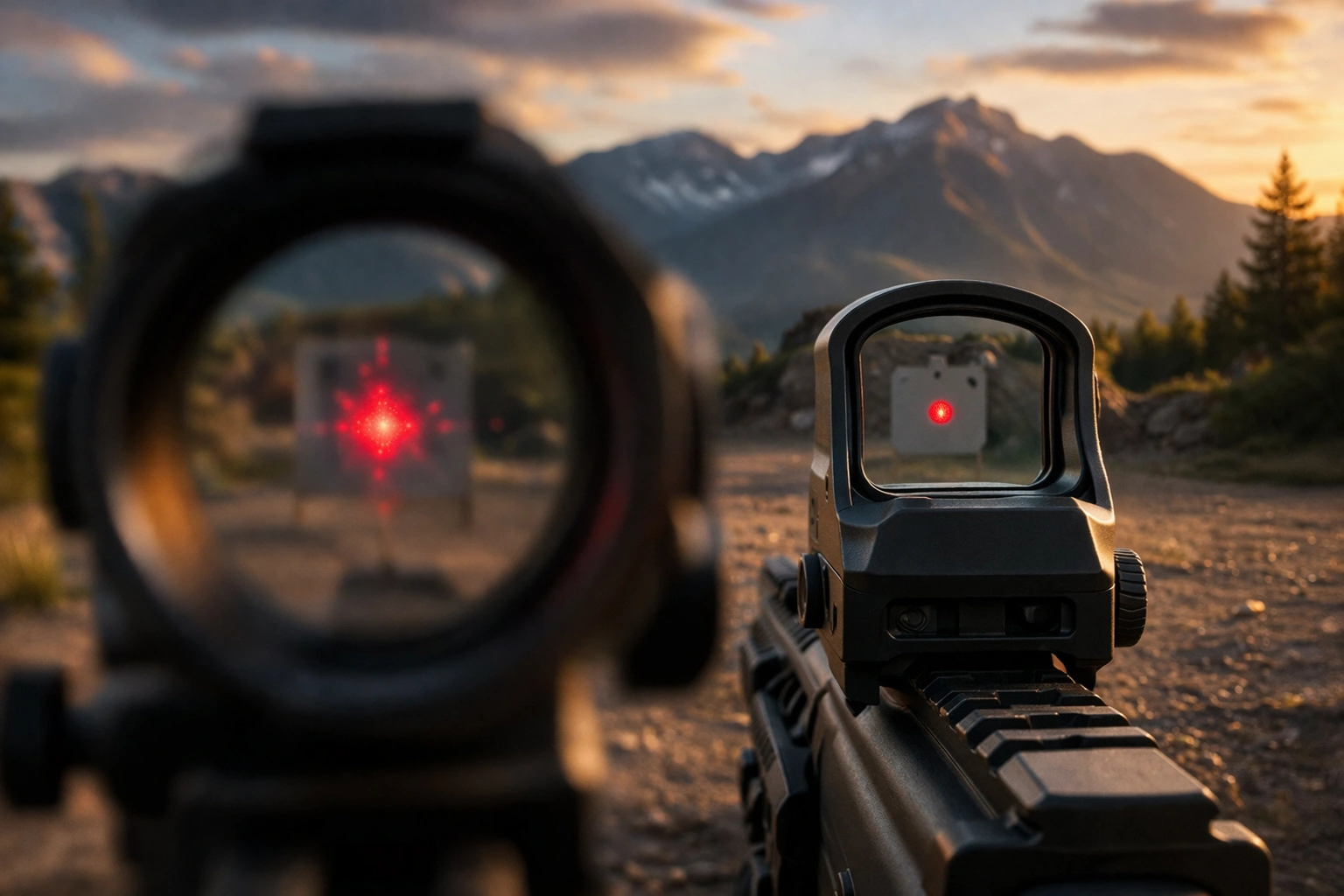
No two astigmatic eyes are exactly the same, so what you see depends on the direction and severity of your corneal irregularity. Here are the most common distortions:
- Starburst: the dot radiates spikes outward in all directions, like a tiny sun
- Comet/smear: the dot trails off in one direction, like a comma or comet tail
- Ghost dot: you see two overlapping or side-by-side dots instead of one
- Blob: the dot appears large, undefined, and without a clear center
The most important thing to understand is that the dot is projecting correctly onto your lens. The distortion only exists in your eye. Your optic isn’t broken—it’s your cornea doing the distorting.
Is It Astigmatism or a Defective Optic? How to Tell the Difference
The Smartphone Camera Test
Before you try any fixes, you need to confirm whether the issue is actually with your eyes. Here’s the fastest way to find out:
- Mount your red dot on your firearm or set it on a stable surface.
- Turn the red dot on at a moderate brightness setting.
- Open your phone’s standard camera app (no zoom, no filters).
- Hold the camera lens close to the rear of the optic—hover it, don’t press it.
- Look at what appears on your phone screen.
If the dot looks round and clean on your phone’s screen but blurry to your naked eye, the issue is your vision, not your optics. Modern smartphone cameras are optically corrected and don’t suffer from corneal astigmatism, so they capture what’s actually being projected. If the dot still looks distorted through the camera, you may have a defect or a dirty lens.
Three More Quick Checks
Beyond the camera test, these three checks can help you nail down the diagnosis:
- Rotation test: Look through your optic and slowly rotate it. If the blurry shape rotates with it, the optic may be defective. If the distortion stays fixed regardless of how you rotate it, your eye is the cause.
- Buddy test: Have someone else look through your optic. If they see a clean, round dot and you don’t, that’s a strong indicator the issue is your vision, not your gear.
- Lens cleanliness check: Before anything else, check the front and rear lenses for smudges, dust, or fingerprints. A dirty lens can mimic astigmatism symptoms and is the easiest fix of all.
Also worth noting: a brightness setting that’s too high for your environment can cause blooming and halo effects even for people with perfect vision. Always rule that out first.
Red Dot Starburst Fix: 6 Ways to Manage It Without Buying New Gear
Now for the part you’ve been looking for—a real red dot starburst fix that doesn’t require spending a dime.
1. Lower the Brightness
This is counterintuitive, but it works. A brighter LED pumps more light into your already-distorting eye, which amplifies the starburst. Dialing the brightness down reduces the intensity of the light source and often makes the distortion dramatically more manageable.
Start at the lowest setting where you can still clearly see the dot against your target. Outdoors, ambient light compensates well enough that you usually don’t need high brightness anyway. That said, if your astigmatism is severe, this fix alone may not be enough.
2. Try a Larger MOA Dot
Smaller dots—think 1 to 2 MOA—concentrate light into a tiny point, which is exactly what creates the most starburst effect. A larger dot (4 MOA and above) gives you a bigger visual target overall, so even when distortion is present, you still have a usable aiming reference—the starburst is proportionally less dominant relative to the dot’s total size.
If your optic has a multi-reticle option, switching to a larger dot or circle reticle is a free fix worth trying right now.
3. Switch to a Green Reticle
Green light sits at approximately 555 nanometers—the peak of human daytime visual sensitivity. Your eye resolves green more sharply and with less effort than red, which is why many astigmatic shooters report noticeably less starburst with a green dot.
4. Wear Corrective Lenses
Here’s the fix most guides skip over: corrective lenses solve the problem at its actual source—your eyes. The Mayo Clinic lists glasses, toric contact lenses, and refractive surgery (LASIK/PRK) as the primary treatments for astigmatism, all of which directly address the corneal irregularity that’s making your red dot look blurry.
One thing worth knowing: your everyday glasses prescription is usually calibrated for far-distance tasks like driving, not the intermediate focal distance of a rifle or pistol optic. If you want glasses that truly optimize your red dot performance, ask your optometrist specifically about a shooting-distance prescription.
Toric contact lenses are designed specifically for astigmatism correction—many shooters find that switching from regular contacts to torics dramatically reduces or eliminates the starburst. For a permanent fix, LASIK or PRK reshapes the cornea itself—a bigger upfront investment, but one that pays off over a lifetime of shooting.
5. Use Your Rear Iron Sight as an Aperture
Looking through the aperture of a rear iron sight naturally restricts the cone of light entering your eye—the same principle as squinting, which briefly sharpens blurry vision by reducing the eye’s effective aperture. That restriction cuts down on the bloom effect and can make the dot look noticeably cleaner. It’s a useful diagnostic confirmation and a short-term workaround, not a permanent fix.
6. Learn to Shoot Through the Distortion
This sounds like giving up, but it’s a legitimate technique used by experienced astigmatic shooters. The distortion doesn’t move your dot off-center—a starburst or blob is still centered in your optic window. If you shift your focus to the target rather than the dot and use the center of the distortion as your aiming reference, you can maintain solid accuracy at defensive distances of 0 to 25 yards.
It’s not ideal for precision rifle work, but for practical and defensive use, it’s a completely viable approach.
When Nothing Works: The Best Red Dot for Astigmatism Alternatives
If you’ve tried everything above and the red dot still looks blurry and is hurting your performance, the issue might not be fixable with a standard reflex sight. Here’s why.
To understand prism scope vs red dot astigmatism, you need to understand one key difference: a red dot projects an LED light source onto a lens—it’s a beam of light, not a physical object. Astigmatic eyes distort light projections. That’s the core problem.
Prism scopes and LPVOs (low-power variable optics) use etched reticles—reticles that are physically carved into the glass lens. Because an etched reticle is a physical object, your eye can focus on it the same way it focuses on iron sights. You can read more about how red dot sights work to understand exactly why LED projection is the root of the problem. Etched reticles sidestep it entirely.
Your Three Best Alternatives
- Prism Scopes: These use an internal prism optical system with an etched reticle. They’re available at 1x for CQB use and can be used with or without illumination. The main trade-off is a defined eye relief (like a traditional scope), unlike the unlimited eye relief of a standard red dot.
- Holographic Sights: A holographic sight astigmatism workaround operates differently from a prism scope. Holographic sights use a laser diode to illuminate a transmission hologram, reconstructing a 3D reticle image that appears to float at the target distance, rather than on the lens surface near your eye. Because the reticle is a holographic image rather than a reflected LED dot, many astigmatic shooters report a noticeably cleaner sight picture. Battery life is shorter than that of LED red dots, and the cost is higher, but for severe astigmatism, the clarity benefit is real.
- LPVOs: If you want versatility across CQB and longer ranges, a low-power variable optic with an etched reticle gives you 1x performance for close-up work and the option to magnify for distance. It’s a bigger, heavier system, but the etched reticle advantage applies at every magnification level.
A Quick Comparison
| Optic Type | Reticle | Astigmatism Friendly? | Eye Relief | Battery Needed |
|---|---|---|---|---|
| Reflex Red Dot | Projected LED | Most problematic | Unlimited | Yes |
| Holographic Sight | Laser hologram | Better for most | Unlimited | Yes |
| Prism Scope | Etched glass | Yes | Defined | Optional |
| LPVO | Etched glass | Yes | Defined | Optional |
Does the Brand Matter? Testing Before You Buy
Somehow, yes. Not all red dots use the same LED emitters. Different manufacturers and models emit light at slightly different wavelengths and intensities, which means an optic that starbursts badly for your eyes might look perfectly crisp to someone with a similar prescription.
Don’t write off all red dots based on one bad experience. The best red dot for astigmatism is genuinely the one that works best for your eyes. Visit your local range or gun store, look through different optics at different brightness settings, and try both red and green reticle options where available. Let your eyes make the call.
Conclusion
Red dot sight astigmatism is one of the most common—and most misunderstood—problems in the optics world. Your optic isn’t broken. Your eyes are simply distorting an LED light source in a way that everyday vision doesn’t expose. The good news is that you have real options: from zero-cost adjustments like lowering brightness and switching to a larger dot, to corrective lenses that fix the problem at its source, to alternative optics like prism scopes and holographic sights that use completely different reticle technology.
Whether you find a red dot sight blurry fix that works with your current optic or decide it’s time to upgrade to a system better suited to your eyes, the most important thing is understanding what’s happening clearly enough to make the right call for your setup.
If you’re ready to explore your options, Gold Trigger carries a range of optics suited to all types of shooters, including those dealing with astigmatism. Browse our selection and find the right optic for your eyes.
Disclaimer: The information in this article is for educational purposes only and does not constitute medical or professional advice. Firearm laws and regulations vary by jurisdiction—always comply with all applicable federal, state, and local laws before purchasing or using any firearm accessory. For vision concerns affecting your shooting performance, consult a licensed optometrist or ophthalmologist. Always handle all firearms safely and responsibly. Gold Trigger assumes no liability for any injury, damage, or legal consequence resulting from the use or misuse of any information presented here.
Comments