


SureFire Scout Light: M600 vs M640 Comparison
Published on: January 7, 2026
Reading Time: 7 mins 32 sec
You need a weapon light that actually works when darkness falls—and the SureFire Scout Light sets the standard that every other manufacturer chases. Picking between the M600 and M640 series models means the difference between confident target identification and wasted money on the wrong tool.
This guide shows you exactly which Scout Light fits your rifle, how Pro models improve over Legacy designs, and which features actually matter for your shooting distances.
Highlights
- SureFire M600DF delivers up to 1,500 lumens (18650 battery) or 1,200 lumens (2x CR123A) with 16,000 or 12,800 candela—perfect for most defensive situations.
- M640DF-PRO brings dual-fuel flexibility with 1,500 lumens, while the M640DFT-PRO Turbo variant hits 100,000 candela from rechargeable or disposable batteries.
- Scout Light Pro Low-Profile Mount lets you position lights exactly where you need them.
- Turbo variants deliver 100,000 candela for extreme-distance identification.
Understanding Scout Light Platform Evolution
Original SureFire Scout lights featured integrated Picatinny mounts built directly into the body. These worked fine but couldn’t adjust positioning—a problem when running suppressors or multiple accessories.
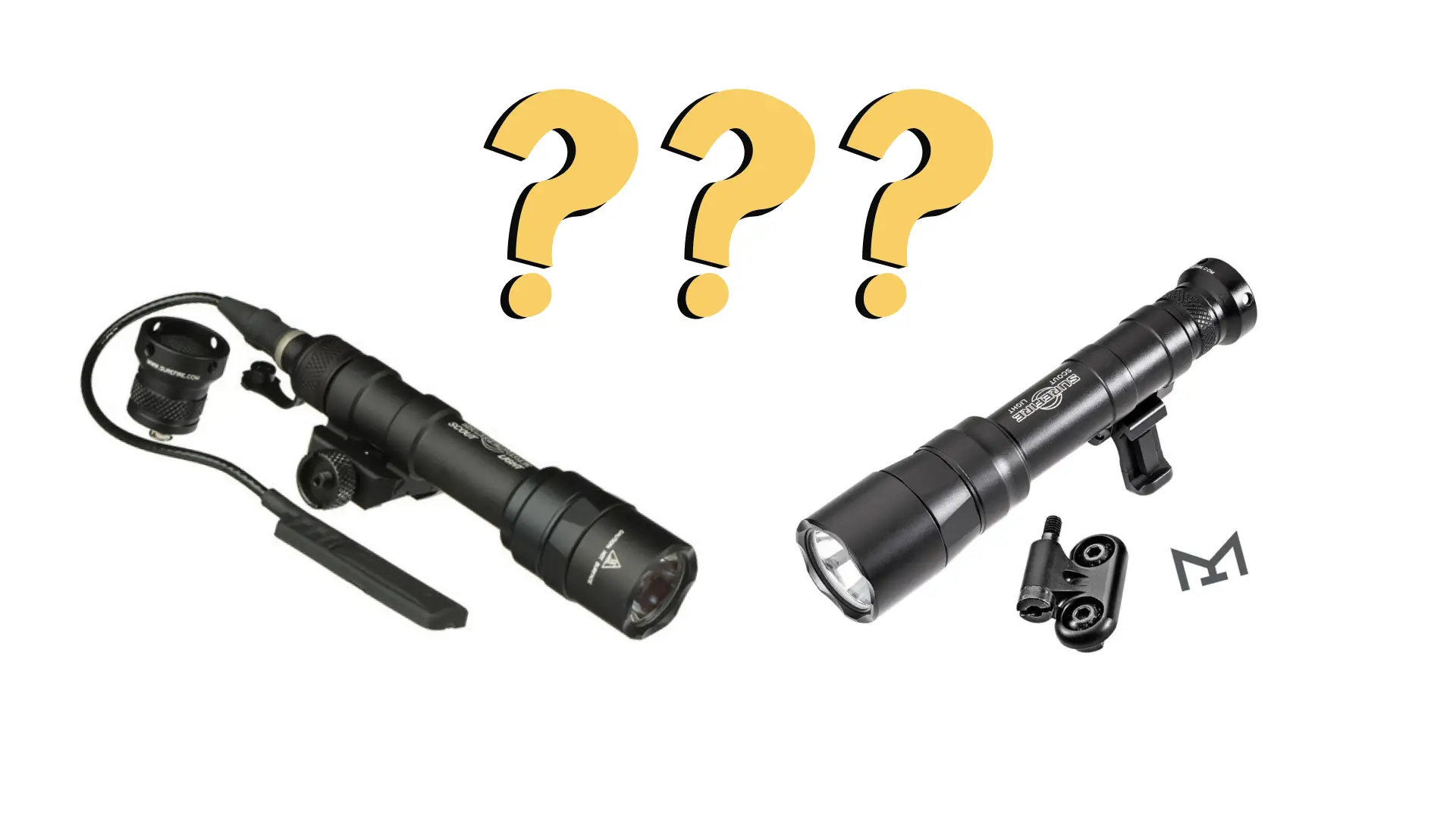
Scout Light Pro changed everything with the Low-Profile Mount system. The LPM rotates the light body closer to your rail, cutting bulk and positioning the beam where suppressor shadow won’t interfere.
Pro models include both Picatinny and M-LOK hardware in the box. Legacy versions need separate adapters and sit noticeably higher on your rail.
The Pro system works with all Legacy tailcaps and switches. If you’ve invested in Scout accessories, upgrading to Pro bodies protects that investment.
For new purchases, Pro makes the most sense with included hardware, adjustable positioning, and a lower profile.
Model Names Decoded
SureFire uses clear naming. Once you understand the system, specs become obvious without digging through data sheets.
- “M600” means standard Scout platform on two CR123A batteries at 5.5 inches—ideal for most rifles.
- “M640” signals a slightly longer body at 5.56 inches, suited for setups needing extra rail clearance.
- “M340” identifies the Scout Light Mini at 4.1 inches on single CR123A batteries—perfect when rail space runs tight.
Letter codes specify capabilities. “U” means Ultra output at 1,000 lumens on legacy models.
“DF” indicates dual-fuel: full-size models accept rechargeable 18650 or 2x CR123A batteries; Mini uses 18350 or 1x CR123A.
“T” signals Turbo optics with deep parabolic reflectors for high candela (up to 100,000), trading some lumens for throw.
“V” adds infrared for night vision work.
The “PRO” suffix means Scout Light Pro models with Low-Profile Mount. Non-PRO models use Legacy thumbscrew clamps.
TIR Versus Turbo Technology
Total Internal Reflection (TIR) lenses shape light through engineered surfaces. You get a concentrated center hotspot surrounded by useful peripheral spill—perfect for versatile applications.
TIR beams work best from contact distance to 100 yards with enough throw for identification while maintaining peripheral vision. Indoor performance strongly favors TIR since peripheral spill lights entire rooms.
Turbo models use parabolic reflectors concentrating all light into tight central beams with substantial spill. The M640DFT Turbo produces 100,000 candela—roughly nine times legacy standard intensity—for positive target ID well beyond 500 meters.
Turbo excels for rural property defense at 150-300 yards. The downside comes indoors where concentrated beams create spotlight effects, missing threats outside the narrower hotspot.
Choose TIR for most applications. Reserve Turbo for known long-range requirements beyond 150 yards.
M600 and M640 Series Comparison
M600U Scout Light Pro
The M600U puts out 1,000 lumens and 11,300 candela, reaching 213 meters. At 4.8 ounces and 5.2 inches, it’s sized perfectly for compact setups.
Runtime holds 1.25 hours on two CR123A batteries—plenty for missions, and realistic use with brief activations stretches time even longer. The TIR lens creates balanced beams excelling from 10-75 yards with a central hotspot and peripheral spill.
Authorized dealers price these around $330, positioning the M600U as SureFire’s entry point with flagship performance.
M640U Scout Light Pro
The M640U produces identical 1,000 lumens and 11,300 candela. The difference is body length at 5.5 inches, offering extra mounting flexibility on longer handguards.
Pick M640U for setups needing optimized positioning. Stick with M600U where compact size matters.
M640DF Scout Light Pro
The M640DF brings dual-fuel with 1,500 lumens (18650) or 1,200 lumens (CR123A). Candela reaches 16,000 with rechargeables, extending identification past 100 yards.
Runtime extends to 1.5 hours on 18650 versus 1.25 hours with disposables. The SF18650B battery features micro-USB charging—plug directly into the battery without a separate charger.
Though the M640DF costs around $330 – $400 versus $330 for the M600U, use rechargeables for training and CR123As for emergencies or cold weather below 20°F.
M640DFT-PRO Turbo
The M640DFT-PRO Turbo produces 700 lumens with 100,000 candela (18650) or 600 lumens with 90,000 candela (CR123A). Beam distance reaches 632 meters—over 2,000 feet.
The parabolic reflector creates extreme throw for rural property defense beyond 150 yards, cutting through fog and ambient light. However, focused beams cause tunnel vision indoors.
Runtime reaches up to 2.75 hours on 18650. Best for properties exceeding 5 acres and situations requiring 150+ yard identification. We price this at $368.
Scout Light Mini M340C
The compact M340C delivers 500 lumens and 7,600 candela in 4.1 inches at 3.65 ounces. Single CR123A batteries make it perfect for SBRs and tight rails.
The Mini frees 1.4 inches of rail space versus full-size lights. Performance reaches 50 yards clearly but fades beyond where 1,000-lumen models excel.
Choose M340C when rail space demands a compact size. Otherwise, full-size models deliver better performance for just 1.1 ounces more. Pricing runs $275 – $320.
Key Comparisons
M600U vs M640U
Both produce identical 1,000 lumens and 11,300 candela. The M640U’s longer body offers better mounting flexibility around backup sights and laser combinations without awkward offset angles.
Mounting flexibility increases too. The extended body positions better around backup sights and laser combinations without awkward offset angles.
Choose M600U for barrels under 14.5 inches and weight-sensitive competition builds. Choose M640U for 16+ inch barrels where positioning advantages matter, at similar pricing.
Standard vs Dual Fuel
Dual-fuel models provide 500 more lumens and roughly 4,700 additional candela compared to standard output versions. They cost slightly more upfront but offer long-term savings through rechargeable batteries.
CR123A batteries add up with regular training, while a single SF18650B recharges hundreds of times for substantial savings over time.
Pick DF for frequent training and duty use. Choose a standard for occasional or emergency-only applications.
The dual-fuel advantage delivers higher output and candela for improved performance and reach.
TIR vs Turbo
TIR lenses optimize 0-100 yards with balanced throw and peripheral awareness—perfect for unknown scenarios where threats could appear at any range. The hybrid beam pattern illuminates your target while maintaining situational awareness of surroundings.
Turbo reflectors excel at 100-300+ yards with concentrated spotlight beams but create tunnel vision at close range. That nine-times candela increase (100,000 vs 11,300) supports clearer identification at extended distances where TIR models may struggle.
Most users need TIR versatility for defensive work. Typical home defense happens at 10-30 feet indoors, property defense at 25-75 yards outdoors—TIR handles this entire range excellently.
Reserve Turbo for specific long-range rural property defense beyond 150 yards where extreme throw matters. Unless you’re defending acreage or working open desert terrain, TIR’s flexibility serves better.
Scout Comparison: Competitive Alternatives
Scout vs Streamlight ProTac
The Streamlight weapon light ProTac HL-X costs $154.99 versus M600U at $330. It delivers solid performance at lower cost—strong value for budget-conscious buyers.
Performance specs show ProTac HL-X at 1,000 lumens with 27,000 candela versus M600U’s 1,000 lumens and 11,300 candela. Streamlight throws farther on paper, while SureFire offers refined TIR and build quality many prefer in practice.
Choose Streamlight for home defense on a budget. It sees widespread law enforcement use with good reliability.
Opt for SureFire in professional duty needing maximum durability, long-term ownership, or existing Scout accessories.
Scout vs Cloud Defensive REIN
REIN 3.0 runs $350 – $400 with integrated design at 1,250 lumens and 100,000 candela. The all-in-one mount and switch simplify setup but commit you to their system.
Pick REIN for plug-and-play ease and high-candela output from U.S.-made gear with strong domestic support.
Choose Scout Lights for modular flexibility and broad aftermarket compatibility from brands like Arisaka, Unity Tactical, and Modlite—the Scout pattern dominates tactical accessories.
Scout vs Modlite
Modlite PLHv2 costs $280 – $3,50 producing 1,350 lumens with 54,000 candela. That’s higher output than M600U at overlapping pricing, making Modlite strong value for performance-focused buyers.
The modular system matches Scout philosophy—interchangeable heads, bodies, and tailcaps let you upgrade components individually. Modlite bodies pair with mounts for a low profile comparable to Scout Pro models.
Choose Modlite for maximum performance per dollar and when candela output matters more than brand legacy. The Texas-made construction appeals to enthusiasts demanding cutting-edge specs.
Choose Scout Lights for proven reliability refined over decades, polished beam quality through proprietary TIR lens design, and the longest professional track record. Sometimes refinement matters more than raw specifications.
Mounting and Installation
Scout Light Pro models include both Picatinny and M-LOK mounting hardware with T15 and T20 Torx keys in every box. Apply blue thread locker to mounting screws to help prevent loosening under recoil.
Mount at 1-3 o’clock for right-handed shooters or 9-11 o’clock for left-handed users. The LPM system lets you rotate the light body closer to your rail, reducing suppressor shadow and clearing other accessories cleanly.
For remote switches, use M-LOK cable clips rather than loose zip ties that can shift under recoil. Route cables away from heat sources like gas blocks and suppressors, and maintain a functional tailcap as a backup for when cables eventually fail.
Battery Management
CR123A disposables offer around 10-year shelf life and work from roughly -40°F to 140°F—ideal for emergency-only lights that sit ready for years. They cost a few dollars each but require virtually no maintenance.
SF18650B rechargeables cost about $30 – $35 upfront and can recharge hundreds of times before noticeable capacity loss. Over time, they can offset disposable costs and provide 500 more lumens in dual-fuel models compared to CR123A use.
Dual-fuel models let you combine both approaches: use 18650s for regular training, keep CR123A as backup for emergencies, and switch to disposables when temperatures drop below about 20°F where rechargeable performance can degrade.
Maintenance Essentials
Perform regular visual checks on duty lights—inspect for cracks, loose mounts, or lens damage as part of your routine. Clean lenses with isopropyl alcohol wipes and check battery contacts for corrosion periodically.
Address common issues like flickering from dirty contacts or dim output from LED wear or thermal protection with targeted cleaning.
For warranty service or support, visit SureFire’s official site at www.surefire.com for current contacts and authorized centers.
Buying Smart
Purchase only from authorized dealers.
Expect competitive pricing from legit retailers, typically M600U around $285 – $330, M640DF $330 – $400, and M640DFT $350 – $450, depending on promotions.
Pro kits include core components but exclude remote switches ($60 – $150 extra) and spare batteries—plan your full setup budget accordingly.
Conclusion
The SureFire Scout Light represents weapon-mounted illumination that special operations and law enforcement professionals trust worldwide. The M600 series handles close-medium work perfectly for most users, while the M640DF adds dual-fuel versatility for extended capability.
For most shooters, the M640DF Scout Light Pro with TIR lens delivers an optimal balance of output, runtime, and versatility. Specialized long-range requirements beyond 100 yards justify the M640DFT-PRO Turbo’s 100,000 candela performance—but that’s overkill for typical defensive scenarios.
Ready to upgrade your rifle with professional-grade illumination? Gold Trigger stocks select SureFire Scout models. Call us at 713-485-5773 for personalized recommendations.
Disclaimer: The information provided in this SureFire Scout Light guide is for educational purposes only. Users are solely responsible for ensuring all modifications and purchases comply with applicable federal, state, and local laws.
Improper installation of weapon lights can result in serious injury or equipment damage. We strongly recommend professional installation by qualified gunsmiths, particularly when routing cables near heat sources. This guide does not substitute for manufacturer instructions or professional expertise.
Legal requirements vary by jurisdiction. Some states restrict firearm modifications or the use of artificial illumination for specific purposes. Always verify compliance with your local laws before purchasing or installing weapon lights.
Product specifications, pricing, and legal requirements are subject to change. Always verify current information with manufacturers and authorized dealers before making purchasing decisions.
Gold Trigger is not responsible for modifications or installations made based on this information. Users assume all risks associated with firearm accessory use, including personal injury, equipment damage, and legal liability. Always prioritize safety, legal compliance, and proper training.
Comments