
The Complete Guide to Weapon Lights

Published on: December 3, 2025
Weapon Lights Guide

Reading Time: 13 mins 59 sec

Each year, a large share of violent crimes happen during late evening hours—data show that adult violent offenses rise throughout the day and peak around 10 p.m.

When light fades, being able to clearly identify a target becomes critical, and that’s where a weapon light steps in as a major safety tool.

Whether you’re securing your home, working in law enforcement, or training for competition, a weapon light isn’t optional equipment—it’s essential.

Choosing the right weapon light involves more than grabbing the brightest model you can find. Understanding lumens versus candela, matching mounting systems to your firearm, and knowing what features actually matter—these factors separate reliable tools from expensive disappointments.

This guide cuts through marketing hype to deliver straight answers. Whether you’re buying your first defensive pistol light or upgrading professional duty equipment, you’ll learn exactly what to look for.

Highlights

  • Weapon lights enable easy target identification during evening and nighttime hours.
  • Candela determines throw distance while lumens measure total output—both specifications matter for different applications.
  • Professional manufacturers deliver proven reliability through rigorous testing and quality control standards.
  • Effective deployment requires proper training with your specific equipment and realistic practice scenarios.
  • Multi-fuel designs accepting disposable and rechargeable batteries maximize long-term flexibility and value.

Understanding Weapon Light Fundamentals

What Makes Weapon Lights Essential Equipment

A weapon light attaches directly to your firearm’s accessory rail. This frees both hands to maintain a proper grip while illuminating potential threats.

Unlike handheld flashlights, mounted lights integrate with your shooting stance, letting you maintain control while lighting your target.

Why Light Matters

Violent crimes are more likely during late afternoon and evening hours. Many officer-involved shootings happen after dark, highlighting how crucial proper illumination is for safe engagement.

These patterns show that low-light situations are when your firearm is most likely needed. Shooting at shadows puts innocent people at risk and carries serious legal consequences.

Three Key Advantages

Weapon lights do more than just illuminate:

  1. Target Identification: They let you see clearly at distances where unaided vision struggles.
  2. Psychological Deterrence: Bright light can discourage criminals who rely on darkness.
  3. Control of Engagement: Proper light use lets you manage what both you and others can see.

Mounted vs. Handheld

Mounted lights keep both hands on your firearm, improving control and speed. Handheld lights give flexibility for general searches without pointing your weapon everywhere.

The best approach often combines both: a mounted light for immediate threats and a handheld for navigation.

The Science Behind Light Performance

Understanding how weapon lights work helps you pick the right one for your needs. Most people look at lumens, but that’s only part of the story.

Lumens measure total light output in all directions. A 1,000-lumen light shines brighter overall than a 500-lumen model, but it doesn’t tell you how far the light will reach.

Candela measures beam intensity in a specific direction. Higher candela means a tighter, more focused beam that throws light farther, even if lumen ratings are the same.

How lumens and candela balance determine your beam pattern. High lumens with low candela create a wide flood for close rooms, while high candela with moderate lumens produce a spotlight for distant targets.

Indoor scenarios usually benefit from 500–800 lumens with moderate candela to light whole rooms while still noticing everything around you. Outdoors, higher candela—20,000 or more—helps reach targets at 50–100 yards and cuts through environmental obstacles.

Photonic barriers like fog, rain, smoke, or bright streetlights can scatter and reduce light. Concentrated high-candela beams push through these barriers better, keeping your target visible.

Color temperature affects how clearly you see things under artificial light. Neutral white LEDs around 5,000–6,000K balance brightness and color accuracy. Cooler tints above 6,500K seem brighter but can wash out details, while warmer tones below 4,000K look natural but seem dimmer in stressful situations.

Critical Technical Specifications Explained

Runtime Ratings

Runtime ratings estimate how long a weapon light can operate before the battery voltage drops too low. These numbers come from controlled laboratory tests, so real-world runtimes are usually 10–20% shorter, especially if the light is switched on and off frequently or used in colder environments.

Modern weapon lights also offer multiple activation modes.

  • Momentary-on activates only while the switch is pressed, useful for quick identification without keeping a constant beam on.
  • Constant-on keeps the light running until switched off.
  • Strobe mode rapidly pulses the beam. While some appreciate it for distraction, its real-world effectiveness is still debated among instructors and end users.

Durability Ratings

Durability ratings show how well a light handles recoil and physical shock. Impact resistance is often expressed in Gs, with quality weapon lights commonly rated to withstand recoil-level forces.

Waterproof ratings follow the IEC 60529/IP standard:

  • IPX4: protects against splashes from any direction.
  • IPX7: survives temporary immersion (up to 1 meter for 30 minutes).
  • IPX8: survives continuous immersion at a depth specified by the manufacturer.

For duty or defensive use, IPX7 or higher is generally recommended.

Operating Temperature Ranges

Operating temperature ranges matter for reliability. Many high-end weapon lights function from roughly -40°F to 140°F, aligning with common military environmental test ranges. Lithium batteries are preferred over alkaline because they maintain voltage better in cold weather.

Material Choice

Material choice affects weight and durability.

  • 6061-T6 and 7075-T6 aluminum are commonly used because they are lightweight, corrosion-resistant, and strong when hard-anodized.
  • Polymer housings reduce weight but usually have lower impact resistance.
  • Glass lenses offer superior scratch resistance compared to plastic, though they can break under severe impact.

Weapon Light Types and Platforms

Pistol-Mounted Lights: Compact Power

Pistol weapon lights must stay small enough to fit your holster and keep the gun balanced, yet still deliver practical illumination. Because of this, pistol lights range from very compact models under 300 lumens to full-size duty lights that exceed 1,000 lumens.

Size matters when you carry daily or operate in tight spaces. Sub-compact lights are often around 2 inches long and add minimal bulk. Duty-grade models can be 3–4 inches, with more weight and noticeably higher output.

Rail compatibility determines whether the light attaches securely. Most modern pistol lights support 1913 Picatinny rails, and many include interchangeable rail keys for Glock, SIG, and other proprietary systems. Always verify compatibility with your exact pistol model before buying.

Mounting a light also affects holster selection and comfort. Light-bearing holsters cost more, and availability depends on the specific pistol-and-light combination. Some carry positions—like appendix—require precise compatibility to maintain safety and comfort.

Smaller lights typically trade brightness for compact size, averaging 300–500 lumens with moderate candela—good for indoor identification within about 20–25 feet, but limited outdoors. Full-size duty lights reach 800–1,000+ lumens and significantly higher candela for better range, spill, and target identification in defensive scenarios.

Combo units that include both a light and a laser save rail space and offer an additional aiming reference. However, they introduce more components, wiring, and potential failure points. Many experienced users prefer a dedicated white light for maximum reliability.

Switch ergonomics shape how fast and naturally you can activate the light under stress. Ambidextrous paddle switches are popular for instinctive use with either hand. Lever or side switches may work better for certain grip styles, so it’s best to test them in your normal shooting grip before committing.

Rifle and Carbine Light Systems

Rifles and carbines demand different lighting setups than pistols. Longer barrels, greater engagement distances, and a two-handed grip make rifle lights larger, more durable, and far more powerful than handgun-mounted lights.

Mounting position on the handguard directly affects beam shape, shadowing, heat exposure, and how easily you can activate the light.

  • 12 o’clock (top rail): Gives even, centered illumination but may block front sights and cast long shadows when using a suppressor.
  • 3 or 9 o’clock (side rails): Reduces suppressor shadowing but creates a slight left/right offset in the beam.
  • 6 o’clock (bottom rail): Stays clear of sights and accessories but is harder to reach without changing grip.

Most shooters set their light at 2–3 o’clock for right-handed use or 9–10 o’clock for left-handed use. These positions keep activation natural while balancing beam placement and shadow control. Offset mounts help tuck lights closer to the rail, reduce bulk, and increase clearance around lasers or front sights.

Rifle lights require significantly more performance than pistol lights because threats may appear 50–100+ yards away. Many rifle-focused models deliver 1,000–1,500 lumens with 40,000–100,000+ candela for long-range identification. These high-candela beams create a tight hotspot ideal for distance work but may feel overly focused for close-quarters situations under 10–15 feet.

Because rifles carry far more accessories, rail space planning becomes important. Lights must coexist with front sights, PEQ/laser/IR units, hand stops, grips, bipods, and sling mounts. Sketching or mapping your planned layout before buying components helps avoid interference and ensures everything fits cleanly.

Switches

Remote pressure switches transformed rifle light ergonomics by letting shooters place the light body near the muzzle—where it performs best—while keeping the switch where the support hand naturally rests.

Tape switches rely on pressure-sensitive pads you secure to the handguard using adhesive, Velcro, or special mounting clips. Good cable management is essential, since loose wires can snag on gear and fail under recoil or hard use.

Shotgun Lighting Solutions

Shotguns present their own challenges when mounting a weapon light. Strong recoil, limited rail space, and different action types (pump, semi-auto, break-action) make their lighting needs very different from rifles and pistols.

Because shotguns produce far more recoil than most rifles or handguns, recoil durability becomes a major factor. Low-quality lights can fail after just a few boxes of 12-gauge buckshot. Purpose-built shotgun lights use reinforced components, shock-isolated electronics, and rugged housings designed to survive 1,000+ Gs of force.

Magazine tube mounts are a popular option because they install quickly and don’t require altering the gun. They work well for home-defense shotguns that aren’t fired excessively. However, under sustained use, these clamps may loosen slightly over time and need periodic re-tightening.

For the cleanest setup, many shooters choose forend-integrated lights, which build the light directly into a replacement forend. These offer excellent ergonomics, intuitive activation, and no exposed wiring. The downside is that you’re locked into a specific model—when the light eventually fails or becomes outdated, replacing it means buying a whole new forend assembly.

Power Sources and Battery Technology

Primary Battery Options

CR123A lithium batteries are the most popular choice for weapon lights. They deliver 3 volts in a compact size and offer a long shelf life of up to 10 years, so you can store spares without worrying about them losing power.

These batteries handle extreme temperatures well, from about -40°F to 140°F. They stay reliable even in freezing weather, while alkalines lose a significant portion of their capacity in the cold.

The main drawbacks are cost and environmental impact. Single-use CR123A cells typically run $2–5 each, and frequent training can make them expensive.

Some multi-fuel weapon lights can use either CR123A or two AA batteries. This is convenient—you can find AA cells almost anywhere, even late at night. However, AA batteries usually produce slightly less output and shorter runtime compared to CR123A cells.

Proper battery storage and rotation are critical. Keep spares in a cool, dry place, check expiration dates yearly, and use older batteries first.

Rechargeable Solutions

18650 lithium-ion batteries are a game-changer for weapon lights. These standardized cells hold 2,500–3,500mAh at 3.6–3.7 volts and often include safety circuits to prevent overcharge, over-discharge, and short circuits.

Rechargeables cost more upfront—about $10–20 per cell—but you can recharge them hundreds of times, making them cheaper than disposables over time. They’re also better for the environment since you use fewer CR123A batteries.

Some lights, like Streamlight’s proprietary packs, charge directly via USB, eliminating separate chargers. Charging times vary, but these packs can match or slightly exceed disposable battery performance, making them ideal for frequent training or daily carry.

Proper battery care keeps them performing at their best. Store them at 40–60% charge for long-term storage. Avoid leaving them fully charged or completely drained, and top them off every 3–6 months to prevent over-discharge protection from locking out the battery.

Multi-fuel lights let you use rechargeable batteries for daily practice while keeping disposable CR123A cells as a backup. This gives you flexibility, reliability, and cost savings without sacrificing performance.

Battery Management Strategies

Home‑defense weapon lights require a different approach than range gear. For defensive guns, replace batteries on a fixed schedule—every 6 to 12 months—even if the light hasn’t been used. Many shooters time battery changes with smoke detector maintenance, so the routine is easy to remember.

Duty gear demands even stricter management. Professionals check their lights daily, either with a battery tester or a quick function check to confirm full output. Batteries are replaced on a scheduled cycle—monthly or quarterly—rather than waiting for visible dimming, ensuring maximum reliability under stress.

Training and recreational shooting burn through batteries fast, especially during low‑light drills. For regular training, rechargeable batteries become the most cost‑effective choice. Keep multiple sets ready: one set in your light, one set charging, and another as a backup so you’re never caught with a dead battery.

Top Weapon Light Manufacturers

Professional-Grade Options

SureFire

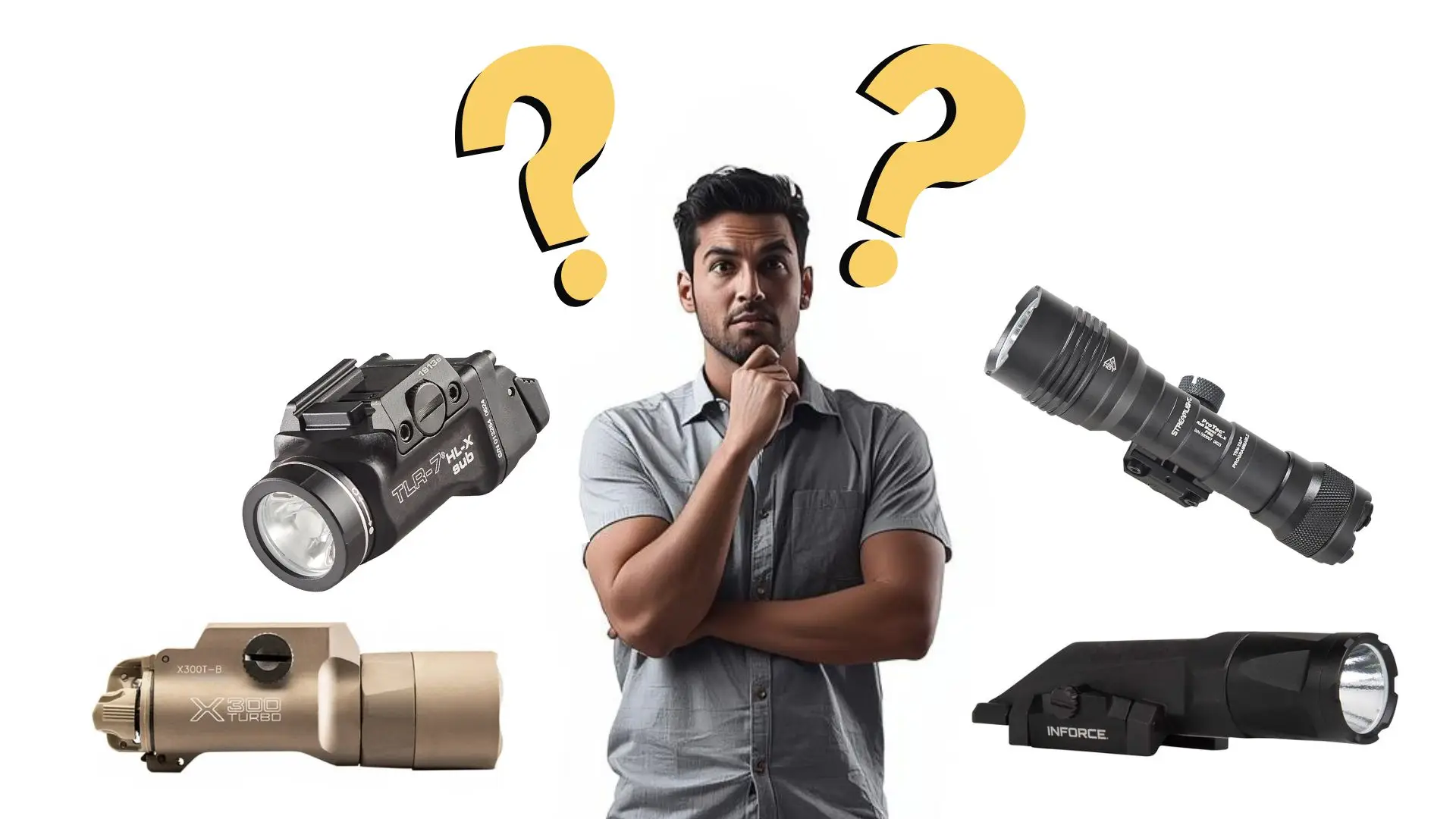
SureFire is known for lights that simply don’t fail. Their Scout series for rifles and X-series for pistols are industry favorites. The X300U-A pistol light produces 1,000 lumens with 11,300 candela and has proven reliability in harsh conditions.

SureFire lights cost more than most alternatives, but you’re paying for tested durability, dependable performance, and solid warranties. For professional duty use, the higher price is worth it. For home defense or recreational use, other brands can deliver nearly the same performance for less.

Streamlight

Streamlight offers high value without sacrificing reliability. The TLR-1 HL pistol light produces 1,000 lumens with 20,000 candela for around $300. Their ProTac Rail Mount series for rifles also delivers solid performance, with multi-fuel options accepting either CR123A or 18650 batteries.

Law enforcement agencies use Streamlight widely because it balances durability and affordability. The TEN-TAP system lets you select different modes quickly, like high only, high/strobe, or low/high, right from the tailcap.

Modlite

Modlite focuses on extreme throw with high-candela designs rather than maximum lumens. Their modular lights let you mix and match body lengths, head types, and tailcap switches to fit your exact needs.

These lights are ideal for distance applications, though most defensive scenarios don’t require more than 60,000 candela.

Cloud Defensive

Cloud Defensive builds lights in the U.S. with durability as the top priority. The REIN 3.0 rifle light produces 1,250 lumens with 100,000 candela. Its integrated mounting design simplifies installation and removes the need for extra pressure switches or cable routing.

American-made construction comes at a premium—around $300–400—but provides strong warranty support and domestic manufacturing benefits.

Budget and Mid-Tier Considerations

Olight

Olight produces feature-rich weapon lights at accessible prices. Their magnetic charging system (MCC‑1A or MCC‑3) snaps on easily, avoiding port covers, and allows convenient USB top-ups. The Baldr series combines a white light and laser in compact pistol-ready units, with many models priced around $110–$160, offering strong value against competitors.

Olight lights are mostly manufactured in China, but modern designs use protected lithium batteries, addressing past safety concerns and maintaining reliable performance.

Inforce

Inforce specializes in lightweight polymer lights. The WMLx Gen 3 uses glass-reinforced nylon, producing high output while keeping weight low, ideal for rifles and carbines. It features an ergonomic switch, integrated rail clamp, runs on two CR123A batteries, and is waterproof to 20 m.

These lights are used by professional law enforcement, though there’s no public record of formal SOCOM contracts.

Both brands provide durable, affordable options for training and defensive applications, balancing cost, weight, and reliability without compromising key performance features.

Choosing Your Ideal Weapon Light

Home Defense Selection

Indoor defensive scenarios require a balance of brightness and beam pattern. Too little light leaves you guessing; too much creates glare off walls, ceilings, and reflective surfaces. For pistol-mounted lights, 500–800 lumens with a candela of 10,000–20,000 provides clear identification at typical room distances (10–30 ft) without overwhelming your vision.

Rifle lights can safely use higher output, 1,000–1,200 lumens, because the weapon is held farther from the face. Going beyond 1,500 lumens indoors adds minimal benefit and increases reflections and temporary blindness.

Beam pattern matters:

  • Flood/spot balance: Wide flood beams illuminate corners and peripheral areas, essential for room clearing.
  • Spot/tight beams: Good for hallways or identifying distant targets, but risk missing threats outside the hotspot.

Activation simplicity is key under stress. Momentary-on or single-action switches prevent leaving the light on unintentionally. Avoid multi-mode lights requiring multiple clicks or mode cycling—fine motor skills degrade under adrenaline.

Home layout and distances guide selection:

  • Open single-story homes rarely need throw beyond 30–40 ft.
  • Multi-story homes or long hallways may benefit from a 50 ft+ beam reach to identify threats on staircases or distant rooms.

Don’t forget that positive identification is critical. Your light must reveal facial features clearly without producing blinding glare. Proper lumen output and beam quality ensure you can distinguish between family members, pets, and potential intruders.

Concealed Carry Optimization

Concealed carry weapon lights require careful trade-offs between performance and size. Added weight increases printing, reduces comfort, and can make all-day carry fatiguing. Extra length may prevent certain carry positions, particularly appendix or pocket carry, from working safely.

Micro lights for compact pistols offer 300–500 lumens in housings under 2.5 inches long, providing sufficient illumination for typical defensive distances (10–25 ft) while minimizing bulk. These lights generally remain flush with sub-compact slides.

Holster compatibility is often the limiting factor. Light-ready concealed carry holsters cost $80–150, compared to $40–60 for standard options. Appendix-carry holsters are less common, and quality options may require 4–6 weeks for delivery from reputable makers.

Comfort and concealment testing is essential. Carry your pistol with the light attached for a full day—walk, sit, drive, and perform routine tasks—before committing. Many shooters find that the theoretical benefits of higher output or larger lights don’t justify daily carry compromises.

Also, battery maintenance ensures readiness. Activate the light briefly each morning when holstering your pistol. This simple check catches dead batteries, loose mounts, or switch issues before they become critical in an emergency.

Maintenance and Care

Routine Maintenance Schedules

Daily Checks

For duty or defensive weapons, quick daily inspections should become automatic. Look for cracks, loose mounts, or lens damage during your pre-use routine. Activate the light briefly to confirm full output and proper switch function. These 30–60 second checks prevent minor issues from turning into critical failures.

Weekly Maintenance

Once a week, perform a more thorough inspection. Remove the light from the weapon if possible and examine O-rings for damage or debris. Clean lenses with a microfiber cloth and a small amount of isopropyl alcohol to remove fingerprints, carbon residue, or dust. Inspect battery contacts for corrosion or oxidation, and wipe them clean if necessary.

Monthly Deep Cleaning

Lights designed for disassembly should be taken apart per the manufacturer’s instructions for deeper maintenance. Clean all threads with isopropyl alcohol and apply light silicone or Teflon lubricant to O-rings and threaded components. Inspect internal parts—such as the LED assembly, springs, and wiring—for wear or damage.

Annual Professional Inspection

For lights used heavily in professional or tactical environments, consider sending them to the manufacturer or an authorized service center once a year. These inspections verify electronics function correctly, check LED condition, and replace worn or failing components before they become a problem.

Common Problems and Solutions

Flickering or Intermittent Operation

This usually points to battery contact issues. Remove the batteries and inspect contacts for corrosion, dirt, or residue. Clean them with isopropyl alcohol on a cotton swab. Lightly adjust springs if they feel weak.

If flickering continues, the switch or internal electronics may be failing. Some manufacturers offer replacement switches for user installation; otherwise, factory service may be required.

Dim Output Despite Fresh Batteries

LED degradation or thermal management is typically the cause. LEDs gradually lose brightness over tens of thousands of hours of use. Many modern lights also reduce output automatically when overheating to protect internal components.

Ensure vents or heat sinks are unobstructed and allow the light to cool between extended uses.

Light Won’t Activate

Start troubleshooting systematically:

  1. Confirm batteries are fully charged and installed with the correct polarity.
  2. Test with batteries from a known-good source.
  3. Inspect for obstructions in the battery compartment or switch mechanism.

If the light still won’t function, internal electronics may have failed, and professional or factory repair is required.

Water Damage

Act quickly to prevent permanent damage. Remove batteries immediately. Disassemble the light if possible, rinse components with distilled water to remove contaminants, and dry thoroughly using compressed air and desiccant packs for 48–72 hours. Lights rated IPX7 or IPX8 have some water tolerance, but exposure beyond the rated limit can still cause failures.

Conclusion

Effective use of firearm lights comes down to three things: choosing the right light, maintaining it, and training consistently. Premium gear means nothing without practice — and solid mid‑tier lights perform exceptionally well in trained hands.

Pick quality equipment that fits your mission, then invest in skill.

Ready to upgrade your setup? Gold Trigger offers dependable weapon lights and fast support to help you choose the right fit. You may call us at 713-485-5773.

Disclaimer: The information provided in this comprehensive weapon light guide is for educational and informational purposes only. Firearm modifications and accessory installations can affect weapon safety, performance, and legal compliance. Users are solely responsible for ensuring all modifications and purchases comply with applicable federal, state, and local laws before installation or use.

Improper installation of weapon lights or accessories can result in serious injury, equipment damage, or dangerous malfunction. We strongly recommend professional installation by qualified gunsmiths for all firearm modifications and accessories, particularly when mounting lights or routing cables near heat sources. Weapon lights don’t replace fundamental firearms safety practices—never point a weapon or gun flashlight at anything you’re not willing to destroy. This guide does not substitute for manufacturer instructions, proper training, or professional expertise.

Legal requirements vary significantly by jurisdiction. Some states and localities restrict certain firearm modifications, accessories, or the use of artificial illumination for specific purposes like hunting. Always verify compliance with your local laws before purchasing or installing any weapon light or accessories. Understand your legal responsibilities regarding use of force, self-defense, and target identification. When in doubt, consult with legal professionals specializing in firearms law.

Product specifications, availability, pricing, and legal requirements are subject to change without notice. Always verify current information with manufacturers, authorized dealers, and relevant legal authorities before making purchasing decisions. Individual product performance varies based on environmental conditions, maintenance, installation, and usage patterns. Inspect equipment regularly and immediately replace worn, damaged, or malfunctioning components.

Gold Trigger is not responsible for any modifications, installations, or purchases made based on this information. Users assume all risks associated with firearm modification and accessory use, including but not limited to personal injury, equipment damage, legal liability, and performance variations. The use of firearms and related accessories carries inherent risks including injury, death, property damage, and legal consequences. Always prioritize safety, legal compliance, and proper training over performance modifications or aesthetic preferences.

Comments

Leave a Reply

Your email address will not be published. Required fields are marked *

The Complete Guide to Weapon Lights

Weapon Lights Guide

Reading Time: 13 mins 59 sec

Each year, a large share of violent crimes happen during late evening hours—data show that adult violent offenses rise throughout the day and peak around 10 p.m.

When light fades, being able to clearly identify a target becomes critical, and that’s where a weapon light steps in as a major safety tool.

Whether you’re securing your home, working in law enforcement, or training for competition, a weapon light isn’t optional equipment—it’s essential.

Choosing the right weapon light involves more than grabbing the brightest model you can find. Understanding lumens versus candela, matching mounting systems to your firearm, and knowing what features actually matter—these factors separate reliable tools from expensive disappointments.

This guide cuts through marketing hype to deliver straight answers. Whether you’re buying your first defensive pistol light or upgrading professional duty equipment, you’ll learn exactly what to look for.

Highlights

  • Weapon lights enable easy target identification during evening and nighttime hours.
  • Candela determines throw distance while lumens measure total output—both specifications matter for different applications.
  • Professional manufacturers deliver proven reliability through rigorous testing and quality control standards.
  • Effective deployment requires proper training with your specific equipment and realistic practice scenarios.
  • Multi-fuel designs accepting disposable and rechargeable batteries maximize long-term flexibility and value.

Understanding Weapon Light Fundamentals

What Makes Weapon Lights Essential Equipment

A weapon light attaches directly to your firearm’s accessory rail. This frees both hands to maintain a proper grip while illuminating potential threats.

Unlike handheld flashlights, mounted lights integrate with your shooting stance, letting you maintain control while lighting your target.

Why Light Matters

Violent crimes are more likely during late afternoon and evening hours. Many officer-involved shootings happen after dark, highlighting how crucial proper illumination is for safe engagement.

These patterns show that low-light situations are when your firearm is most likely needed. Shooting at shadows puts innocent people at risk and carries serious legal consequences.

Three Key Advantages

Weapon lights do more than just illuminate:

  1. Target Identification: They let you see clearly at distances where unaided vision struggles.
  2. Psychological Deterrence: Bright light can discourage criminals who rely on darkness.
  3. Control of Engagement: Proper light use lets you manage what both you and others can see.

Mounted vs. Handheld

Mounted lights keep both hands on your firearm, improving control and speed. Handheld lights give flexibility for general searches without pointing your weapon everywhere.

The best approach often combines both: a mounted light for immediate threats and a handheld for navigation.

The Science Behind Light Performance

Understanding how weapon lights work helps you pick the right one for your needs. Most people look at lumens, but that’s only part of the story.

Lumens measure total light output in all directions. A 1,000-lumen light shines brighter overall than a 500-lumen model, but it doesn’t tell you how far the light will reach.

Candela measures beam intensity in a specific direction. Higher candela means a tighter, more focused beam that throws light farther, even if lumen ratings are the same.

How lumens and candela balance determine your beam pattern. High lumens with low candela create a wide flood for close rooms, while high candela with moderate lumens produce a spotlight for distant targets.

Indoor scenarios usually benefit from 500–800 lumens with moderate candela to light whole rooms while still noticing everything around you. Outdoors, higher candela—20,000 or more—helps reach targets at 50–100 yards and cuts through environmental obstacles.

Photonic barriers like fog, rain, smoke, or bright streetlights can scatter and reduce light. Concentrated high-candela beams push through these barriers better, keeping your target visible.

Color temperature affects how clearly you see things under artificial light. Neutral white LEDs around 5,000–6,000K balance brightness and color accuracy. Cooler tints above 6,500K seem brighter but can wash out details, while warmer tones below 4,000K look natural but seem dimmer in stressful situations.

Critical Technical Specifications Explained

Runtime Ratings

Runtime ratings estimate how long a weapon light can operate before the battery voltage drops too low. These numbers come from controlled laboratory tests, so real-world runtimes are usually 10–20% shorter, especially if the light is switched on and off frequently or used in colder environments.

Modern weapon lights also offer multiple activation modes.

  • Momentary-on activates only while the switch is pressed, useful for quick identification without keeping a constant beam on.
  • Constant-on keeps the light running until switched off.
  • Strobe mode rapidly pulses the beam. While some appreciate it for distraction, its real-world effectiveness is still debated among instructors and end users.

Durability Ratings

Durability ratings show how well a light handles recoil and physical shock. Impact resistance is often expressed in Gs, with quality weapon lights commonly rated to withstand recoil-level forces.

Waterproof ratings follow the IEC 60529/IP standard:

  • IPX4: protects against splashes from any direction.
  • IPX7: survives temporary immersion (up to 1 meter for 30 minutes).
  • IPX8: survives continuous immersion at a depth specified by the manufacturer.

For duty or defensive use, IPX7 or higher is generally recommended.

Operating Temperature Ranges

Operating temperature ranges matter for reliability. Many high-end weapon lights function from roughly -40°F to 140°F, aligning with common military environmental test ranges. Lithium batteries are preferred over alkaline because they maintain voltage better in cold weather.

Material Choice

Material choice affects weight and durability.

  • 6061-T6 and 7075-T6 aluminum are commonly used because they are lightweight, corrosion-resistant, and strong when hard-anodized.
  • Polymer housings reduce weight but usually have lower impact resistance.
  • Glass lenses offer superior scratch resistance compared to plastic, though they can break under severe impact.

Weapon Light Types and Platforms

Pistol-Mounted Lights: Compact Power

Pistol weapon lights must stay small enough to fit your holster and keep the gun balanced, yet still deliver practical illumination. Because of this, pistol lights range from very compact models under 300 lumens to full-size duty lights that exceed 1,000 lumens.

Size matters when you carry daily or operate in tight spaces. Sub-compact lights are often around 2 inches long and add minimal bulk. Duty-grade models can be 3–4 inches, with more weight and noticeably higher output.

Rail compatibility determines whether the light attaches securely. Most modern pistol lights support 1913 Picatinny rails, and many include interchangeable rail keys for Glock, SIG, and other proprietary systems. Always verify compatibility with your exact pistol model before buying.

Mounting a light also affects holster selection and comfort. Light-bearing holsters cost more, and availability depends on the specific pistol-and-light combination. Some carry positions—like appendix—require precise compatibility to maintain safety and comfort.

Smaller lights typically trade brightness for compact size, averaging 300–500 lumens with moderate candela—good for indoor identification within about 20–25 feet, but limited outdoors. Full-size duty lights reach 800–1,000+ lumens and significantly higher candela for better range, spill, and target identification in defensive scenarios.

Combo units that include both a light and a laser save rail space and offer an additional aiming reference. However, they introduce more components, wiring, and potential failure points. Many experienced users prefer a dedicated white light for maximum reliability.

Switch ergonomics shape how fast and naturally you can activate the light under stress. Ambidextrous paddle switches are popular for instinctive use with either hand. Lever or side switches may work better for certain grip styles, so it’s best to test them in your normal shooting grip before committing.

Rifle and Carbine Light Systems

Rifles and carbines demand different lighting setups than pistols. Longer barrels, greater engagement distances, and a two-handed grip make rifle lights larger, more durable, and far more powerful than handgun-mounted lights.

Mounting position on the handguard directly affects beam shape, shadowing, heat exposure, and how easily you can activate the light.

  • 12 o’clock (top rail): Gives even, centered illumination but may block front sights and cast long shadows when using a suppressor.
  • 3 or 9 o’clock (side rails): Reduces suppressor shadowing but creates a slight left/right offset in the beam.
  • 6 o’clock (bottom rail): Stays clear of sights and accessories but is harder to reach without changing grip.

Most shooters set their light at 2–3 o’clock for right-handed use or 9–10 o’clock for left-handed use. These positions keep activation natural while balancing beam placement and shadow control. Offset mounts help tuck lights closer to the rail, reduce bulk, and increase clearance around lasers or front sights.

Rifle lights require significantly more performance than pistol lights because threats may appear 50–100+ yards away. Many rifle-focused models deliver 1,000–1,500 lumens with 40,000–100,000+ candela for long-range identification. These high-candela beams create a tight hotspot ideal for distance work but may feel overly focused for close-quarters situations under 10–15 feet.

Because rifles carry far more accessories, rail space planning becomes important. Lights must coexist with front sights, PEQ/laser/IR units, hand stops, grips, bipods, and sling mounts. Sketching or mapping your planned layout before buying components helps avoid interference and ensures everything fits cleanly.

Switches

Remote pressure switches transformed rifle light ergonomics by letting shooters place the light body near the muzzle—where it performs best—while keeping the switch where the support hand naturally rests.

Tape switches rely on pressure-sensitive pads you secure to the handguard using adhesive, Velcro, or special mounting clips. Good cable management is essential, since loose wires can snag on gear and fail under recoil or hard use.

Shotgun Lighting Solutions

Shotguns present their own challenges when mounting a weapon light. Strong recoil, limited rail space, and different action types (pump, semi-auto, break-action) make their lighting needs very different from rifles and pistols.

Because shotguns produce far more recoil than most rifles or handguns, recoil durability becomes a major factor. Low-quality lights can fail after just a few boxes of 12-gauge buckshot. Purpose-built shotgun lights use reinforced components, shock-isolated electronics, and rugged housings designed to survive 1,000+ Gs of force.

Magazine tube mounts are a popular option because they install quickly and don’t require altering the gun. They work well for home-defense shotguns that aren’t fired excessively. However, under sustained use, these clamps may loosen slightly over time and need periodic re-tightening.

For the cleanest setup, many shooters choose forend-integrated lights, which build the light directly into a replacement forend. These offer excellent ergonomics, intuitive activation, and no exposed wiring. The downside is that you’re locked into a specific model—when the light eventually fails or becomes outdated, replacing it means buying a whole new forend assembly.

Power Sources and Battery Technology

Primary Battery Options

CR123A lithium batteries are the most popular choice for weapon lights. They deliver 3 volts in a compact size and offer a long shelf life of up to 10 years, so you can store spares without worrying about them losing power.

These batteries handle extreme temperatures well, from about -40°F to 140°F. They stay reliable even in freezing weather, while alkalines lose a significant portion of their capacity in the cold.

The main drawbacks are cost and environmental impact. Single-use CR123A cells typically run $2–5 each, and frequent training can make them expensive.

Some multi-fuel weapon lights can use either CR123A or two AA batteries. This is convenient—you can find AA cells almost anywhere, even late at night. However, AA batteries usually produce slightly less output and shorter runtime compared to CR123A cells.

Proper battery storage and rotation are critical. Keep spares in a cool, dry place, check expiration dates yearly, and use older batteries first.

Rechargeable Solutions

18650 lithium-ion batteries are a game-changer for weapon lights. These standardized cells hold 2,500–3,500mAh at 3.6–3.7 volts and often include safety circuits to prevent overcharge, over-discharge, and short circuits.

Rechargeables cost more upfront—about $10–20 per cell—but you can recharge them hundreds of times, making them cheaper than disposables over time. They’re also better for the environment since you use fewer CR123A batteries.

Some lights, like Streamlight’s proprietary packs, charge directly via USB, eliminating separate chargers. Charging times vary, but these packs can match or slightly exceed disposable battery performance, making them ideal for frequent training or daily carry.

Proper battery care keeps them performing at their best. Store them at 40–60% charge for long-term storage. Avoid leaving them fully charged or completely drained, and top them off every 3–6 months to prevent over-discharge protection from locking out the battery.

Multi-fuel lights let you use rechargeable batteries for daily practice while keeping disposable CR123A cells as a backup. This gives you flexibility, reliability, and cost savings without sacrificing performance.

Battery Management Strategies

Home‑defense weapon lights require a different approach than range gear. For defensive guns, replace batteries on a fixed schedule—every 6 to 12 months—even if the light hasn’t been used. Many shooters time battery changes with smoke detector maintenance, so the routine is easy to remember.

Duty gear demands even stricter management. Professionals check their lights daily, either with a battery tester or a quick function check to confirm full output. Batteries are replaced on a scheduled cycle—monthly or quarterly—rather than waiting for visible dimming, ensuring maximum reliability under stress.

Training and recreational shooting burn through batteries fast, especially during low‑light drills. For regular training, rechargeable batteries become the most cost‑effective choice. Keep multiple sets ready: one set in your light, one set charging, and another as a backup so you’re never caught with a dead battery.

Top Weapon Light Manufacturers

Professional-Grade Options

SureFire

SureFire is known for lights that simply don’t fail. Their Scout series for rifles and X-series for pistols are industry favorites. The X300U-A pistol light produces 1,000 lumens with 11,300 candela and has proven reliability in harsh conditions.

SureFire lights cost more than most alternatives, but you’re paying for tested durability, dependable performance, and solid warranties. For professional duty use, the higher price is worth it. For home defense or recreational use, other brands can deliver nearly the same performance for less.

Streamlight

Streamlight offers high value without sacrificing reliability. The TLR-1 HL pistol light produces 1,000 lumens with 20,000 candela for around $300. Their ProTac Rail Mount series for rifles also delivers solid performance, with multi-fuel options accepting either CR123A or 18650 batteries.

Law enforcement agencies use Streamlight widely because it balances durability and affordability. The TEN-TAP system lets you select different modes quickly, like high only, high/strobe, or low/high, right from the tailcap.

Modlite

Modlite focuses on extreme throw with high-candela designs rather than maximum lumens. Their modular lights let you mix and match body lengths, head types, and tailcap switches to fit your exact needs.

These lights are ideal for distance applications, though most defensive scenarios don’t require more than 60,000 candela.

Cloud Defensive

Cloud Defensive builds lights in the U.S. with durability as the top priority. The REIN 3.0 rifle light produces 1,250 lumens with 100,000 candela. Its integrated mounting design simplifies installation and removes the need for extra pressure switches or cable routing.

American-made construction comes at a premium—around $300–400—but provides strong warranty support and domestic manufacturing benefits.

Budget and Mid-Tier Considerations

Olight

Olight produces feature-rich weapon lights at accessible prices. Their magnetic charging system (MCC‑1A or MCC‑3) snaps on easily, avoiding port covers, and allows convenient USB top-ups. The Baldr series combines a white light and laser in compact pistol-ready units, with many models priced around $110–$160, offering strong value against competitors.

Olight lights are mostly manufactured in China, but modern designs use protected lithium batteries, addressing past safety concerns and maintaining reliable performance.

Inforce

Inforce specializes in lightweight polymer lights. The WMLx Gen 3 uses glass-reinforced nylon, producing high output while keeping weight low, ideal for rifles and carbines. It features an ergonomic switch, integrated rail clamp, runs on two CR123A batteries, and is waterproof to 20 m.

These lights are used by professional law enforcement, though there’s no public record of formal SOCOM contracts.

Both brands provide durable, affordable options for training and defensive applications, balancing cost, weight, and reliability without compromising key performance features.

Choosing Your Ideal Weapon Light

Home Defense Selection

Indoor defensive scenarios require a balance of brightness and beam pattern. Too little light leaves you guessing; too much creates glare off walls, ceilings, and reflective surfaces. For pistol-mounted lights, 500–800 lumens with a candela of 10,000–20,000 provides clear identification at typical room distances (10–30 ft) without overwhelming your vision.

Rifle lights can safely use higher output, 1,000–1,200 lumens, because the weapon is held farther from the face. Going beyond 1,500 lumens indoors adds minimal benefit and increases reflections and temporary blindness.

Beam pattern matters:

  • Flood/spot balance: Wide flood beams illuminate corners and peripheral areas, essential for room clearing.
  • Spot/tight beams: Good for hallways or identifying distant targets, but risk missing threats outside the hotspot.

Activation simplicity is key under stress. Momentary-on or single-action switches prevent leaving the light on unintentionally. Avoid multi-mode lights requiring multiple clicks or mode cycling—fine motor skills degrade under adrenaline.

Home layout and distances guide selection:

  • Open single-story homes rarely need throw beyond 30–40 ft.
  • Multi-story homes or long hallways may benefit from a 50 ft+ beam reach to identify threats on staircases or distant rooms.

Don’t forget that positive identification is critical. Your light must reveal facial features clearly without producing blinding glare. Proper lumen output and beam quality ensure you can distinguish between family members, pets, and potential intruders.

Concealed Carry Optimization

Concealed carry weapon lights require careful trade-offs between performance and size. Added weight increases printing, reduces comfort, and can make all-day carry fatiguing. Extra length may prevent certain carry positions, particularly appendix or pocket carry, from working safely.

Micro lights for compact pistols offer 300–500 lumens in housings under 2.5 inches long, providing sufficient illumination for typical defensive distances (10–25 ft) while minimizing bulk. These lights generally remain flush with sub-compact slides.

Holster compatibility is often the limiting factor. Light-ready concealed carry holsters cost $80–150, compared to $40–60 for standard options. Appendix-carry holsters are less common, and quality options may require 4–6 weeks for delivery from reputable makers.

Comfort and concealment testing is essential. Carry your pistol with the light attached for a full day—walk, sit, drive, and perform routine tasks—before committing. Many shooters find that the theoretical benefits of higher output or larger lights don’t justify daily carry compromises.

Also, battery maintenance ensures readiness. Activate the light briefly each morning when holstering your pistol. This simple check catches dead batteries, loose mounts, or switch issues before they become critical in an emergency.

Maintenance and Care

Routine Maintenance Schedules

Daily Checks

For duty or defensive weapons, quick daily inspections should become automatic. Look for cracks, loose mounts, or lens damage during your pre-use routine. Activate the light briefly to confirm full output and proper switch function. These 30–60 second checks prevent minor issues from turning into critical failures.

Weekly Maintenance

Once a week, perform a more thorough inspection. Remove the light from the weapon if possible and examine O-rings for damage or debris. Clean lenses with a microfiber cloth and a small amount of isopropyl alcohol to remove fingerprints, carbon residue, or dust. Inspect battery contacts for corrosion or oxidation, and wipe them clean if necessary.

Monthly Deep Cleaning

Lights designed for disassembly should be taken apart per the manufacturer’s instructions for deeper maintenance. Clean all threads with isopropyl alcohol and apply light silicone or Teflon lubricant to O-rings and threaded components. Inspect internal parts—such as the LED assembly, springs, and wiring—for wear or damage.

Annual Professional Inspection

For lights used heavily in professional or tactical environments, consider sending them to the manufacturer or an authorized service center once a year. These inspections verify electronics function correctly, check LED condition, and replace worn or failing components before they become a problem.

Common Problems and Solutions

Flickering or Intermittent Operation

This usually points to battery contact issues. Remove the batteries and inspect contacts for corrosion, dirt, or residue. Clean them with isopropyl alcohol on a cotton swab. Lightly adjust springs if they feel weak.

If flickering continues, the switch or internal electronics may be failing. Some manufacturers offer replacement switches for user installation; otherwise, factory service may be required.

Dim Output Despite Fresh Batteries

LED degradation or thermal management is typically the cause. LEDs gradually lose brightness over tens of thousands of hours of use. Many modern lights also reduce output automatically when overheating to protect internal components.

Ensure vents or heat sinks are unobstructed and allow the light to cool between extended uses.

Light Won’t Activate

Start troubleshooting systematically:

  1. Confirm batteries are fully charged and installed with the correct polarity.
  2. Test with batteries from a known-good source.
  3. Inspect for obstructions in the battery compartment or switch mechanism.

If the light still won’t function, internal electronics may have failed, and professional or factory repair is required.

Water Damage

Act quickly to prevent permanent damage. Remove batteries immediately. Disassemble the light if possible, rinse components with distilled water to remove contaminants, and dry thoroughly using compressed air and desiccant packs for 48–72 hours. Lights rated IPX7 or IPX8 have some water tolerance, but exposure beyond the rated limit can still cause failures.

Conclusion

Effective use of firearm lights comes down to three things: choosing the right light, maintaining it, and training consistently. Premium gear means nothing without practice — and solid mid‑tier lights perform exceptionally well in trained hands.

Pick quality equipment that fits your mission, then invest in skill.

Ready to upgrade your setup? Gold Trigger offers dependable weapon lights and fast support to help you choose the right fit. You may call us at 713-485-5773.

Disclaimer: The information provided in this comprehensive weapon light guide is for educational and informational purposes only. Firearm modifications and accessory installations can affect weapon safety, performance, and legal compliance. Users are solely responsible for ensuring all modifications and purchases comply with applicable federal, state, and local laws before installation or use.

Improper installation of weapon lights or accessories can result in serious injury, equipment damage, or dangerous malfunction. We strongly recommend professional installation by qualified gunsmiths for all firearm modifications and accessories, particularly when mounting lights or routing cables near heat sources. Weapon lights don’t replace fundamental firearms safety practices—never point a weapon or gun flashlight at anything you’re not willing to destroy. This guide does not substitute for manufacturer instructions, proper training, or professional expertise.

Legal requirements vary significantly by jurisdiction. Some states and localities restrict certain firearm modifications, accessories, or the use of artificial illumination for specific purposes like hunting. Always verify compliance with your local laws before purchasing or installing any weapon light or accessories. Understand your legal responsibilities regarding use of force, self-defense, and target identification. When in doubt, consult with legal professionals specializing in firearms law.

Product specifications, availability, pricing, and legal requirements are subject to change without notice. Always verify current information with manufacturers, authorized dealers, and relevant legal authorities before making purchasing decisions. Individual product performance varies based on environmental conditions, maintenance, installation, and usage patterns. Inspect equipment regularly and immediately replace worn, damaged, or malfunctioning components.

Gold Trigger is not responsible for any modifications, installations, or purchases made based on this information. Users assume all risks associated with firearm modification and accessory use, including but not limited to personal injury, equipment damage, legal liability, and performance variations. The use of firearms and related accessories carries inherent risks including injury, death, property damage, and legal consequences. Always prioritize safety, legal compliance, and proper training over performance modifications or aesthetic preferences.

Leave a Reply

Your email address will not be published. Required fields are marked *

Shopping cart0
There are no products in the cart!