


Trijicon RCR vs RMR: Which Red Dot Is Worth It?
Published on: April 2, 2026
Reading time: 9 mins 43 sec
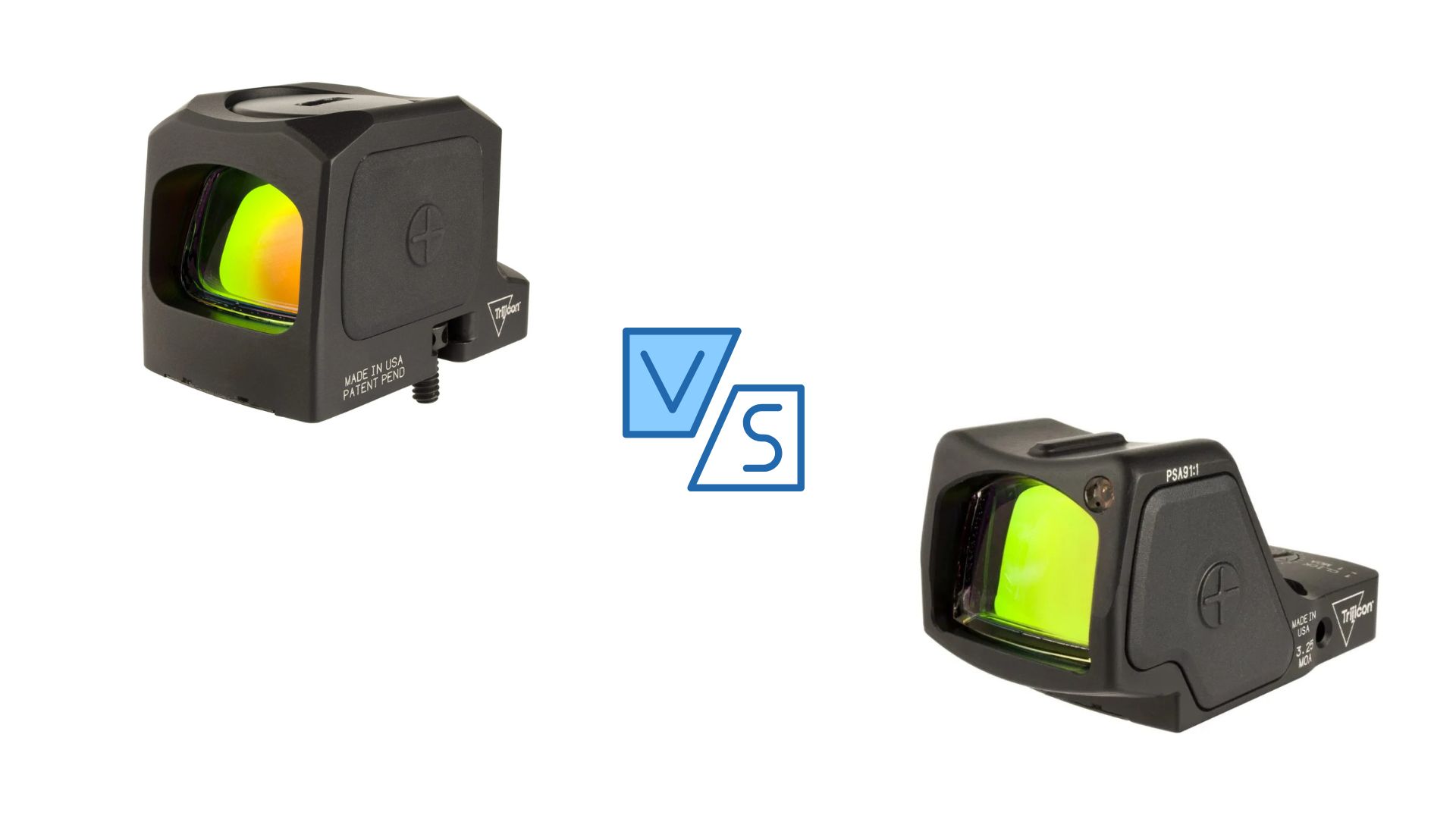
If you’re stuck deciding between the Trijicon RCR vs RMR HD, you’re not alone—and the answer isn’t simply “get the newer one.”
The RCR is a fully sealed, enclosed emitter built for real-world punishment. The RMR HD is a feature-packed open emitter with a smarter reticle and automatic brightness. Both cost the same, share the same RMR footprint, and come out of the same American factory. So what actually sets them apart? That’s what you’ll find out here.
Highlights
- The RCR is a fully sealed closed emitter; the RMR HD is an open emitter with a multi-reticle system.
- Both use the same RMR footprint—no new adapter plates or slide cuts needed.
- The RCR can run up to 6 years on a single CR2032 battery at medium brightness; the RMR HD can run up to 3 years on a single CR2032 battery at medium brightness.
- The 1 MOA reticle option is available only on the RMR HD—there’s no closed-emitter equivalent.
- Both are priced between $700 and $900 and are proudly made in the USA.
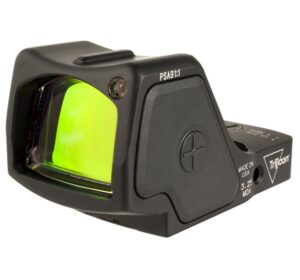
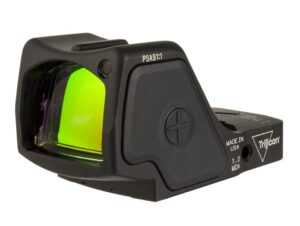

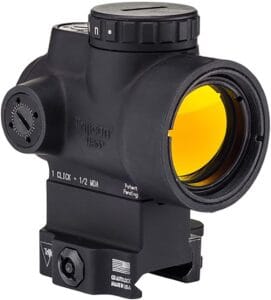
What Are the Trijicon RCR and RMR HD?
The Trijicon RMR HD—Evolution of a Legend
The original Trijicon RMR set the standard for pistol red dots. The original Trijicon RMR set the standard for pistol red dots and was so widely adopted by U.S. Special Operations and law enforcement that it became the benchmark every other optic is measured against; in 2018, USSOCOM officially selected the RMR Type 2 as its Handgun Reflex Sight under a $7.6 million contract. When Trijicon released the RMR HD in 2023, they didn’t replace the Type 2—they evolved it.
In Trijicon’s naming convention, “HD” designates optics featuring a multi‑reticle design; the RMR HD uses a 55 MOA segmented circle surrounding a center dot. The RMR HD was built on the foundation of the RMR Adjustable LED model, adding a larger window, a forward-facing light sensor for automatic brightness, and a top-loading battery. Physical design cues like the wider window and battery placement came from the SRO—but the multi-reticle design itself is unique to the HD line.
Two versions are available:
- Trijicon RMR HD 3.25 MOA Dot w/55-MOA Reticle: best for everyday shooters and defensive use
- Trijicon RMR HD 1-MOA Dot w/55-MOA Reticle: best for precision shooting and competition
The RMR HD didn’t push the Type 2 out of the catalog; it sits alongside it for shooters who want more features without leaving the RMR family.
The Trijicon RCR—Ruggedized Closed Reflex, Reinvented
The Trijicon RCR red dot launched alongside the RMR HD in 2023. RCR stands for Ruggedized Closed Reflex—and every word matters.
Military and law enforcement have widely adopted sealed, rugged optics for duty use, and there was clear demand for a sealed pistol red dot that could handle dirt, rain, and harsh handling.
Many previous enclosed‑emitter pistol red dots required proprietary adapter plates to mount, which created a compatibility headache for users already running RMR‑compatible slides; Trijicon designed the RCR specifically to avoid that issue. Trijicon solved this with a patented capstan screw system that lets the RCR mount directly to any standard RMR footprint slide with zero extra hardware.
The Trijicon RCR earned the NRA’s American Rifleman 2024 Golden Bullseye Award as Optic of the Year. The Trijicon RCR 3300001 Matte Black 3.25 MOA is one of the most purpose-built carry optics on the market.
Build Quality and Design: What’s Actually Different
Housing, Materials, and Structure
Both optics are built from 7075-T6 forged aluminum—the same alloy used in aircraft components and quality AR receivers. Both also share the RMR’s patented concave top surface, which channels impact forces away from the lens and internals when the optic takes a hit.
The visual differences are clear once you put them side by side:
- RMR HD: Features “owl ears” (raised side ridges) and an indexing ridge on top to help you center your dot from awkward positions. It has a slight front overhang, which can be relevant for ejection and brass clearance. Trijicon notes that the RMR HD’s front overhang can interfere with brass ejection on certain host pistols, depending on the ejection pattern, so users should always verify clearance on their specific gun before use.
- RCR: A boxier, squared-off profile with no front overhang. Rounded corners for holster compatibility and impact protection. Larger side buttons are easy to use with gloves.
Weight-wise, the RCR is 1.98 oz, and the RMR HD is 1.69 oz. Neither will change how your pistol handles, but it’s worth knowing that the RCR is slightly heavier.
Open Emitter vs. Closed Emitter
If you’re newer to red dot sights, here’s the quick version: an open emitter means the LED projecting your dot is exposed to the environment, while a closed emitter means it’s fully sealed inside the housing.
On the RMR HD, the emitter is open. Rain, mud, condensation, or pocket lint can reach it. Trijicon’s build quality reduces the practical impact of this exposure, but the LED is indeed exposed to the environment.
On the RCR, the emitter is completely enclosed. Nothing gets in—not rain, not lint, not sweat. For Trijicon concealed carry use specifically, this is a genuine advantage. When a gun lives in a holster all day in a warm or humid environment, a sealed emitter isn’t just a marketing spec—it’s a real-world edge.
Mounting System: The RCR’s Patent-Worthy Advantage
Both optics mount to any RMR-footprint slide with no adapter plates or slide modifications. Glock MOS, S&W M&P, FN, Walther PDP, Sig, and Springfield all support this footprint natively.
Both share the same deck height as the RMR Type 2 in most configurations, so your existing co‑witness irons will usually still work; small differences in slide cut and part tolerances can still affect perfect co‑witness. However, because the RMR HD is slightly longer overall (about 2.15″ vs. roughly 1.80″ for the RMR Type 2), you should verify holster fit and ejection‑port clearance before assuming a perfect swap from your current RMR.
RCR’s Patented Capstan Screw System
Most enclosed emitters can’t use standard top-down screws because the sealed housing blocks the mounting holes, which forces other brands to rely on model-specific adapter plates. Trijicon solved this with capstan screws tightened from the sides using the included 1/16″ hex allen wrench, which is designed to help prevent over‑torquing and make installation more forgiving.
Here’s what’s usually in the box:
- 1x CR2032 battery
- 1/16″ hex allen wrench
- #6-32 capstan screws (standard RMR footprint)
- #6-40 capstan screws (FN platforms)
- Capstan hex torque guide card
- Loctite 242/243 capsule
- Manual
The RCR works with most RMR-cut holsters, but the slightly taller housing is worth testing with your specific holster before going to carry.
RMR HD Mounting—Familiar and Fast
The RMR HD uses the same two-screw system as the RMR Type 2—standard #6-32 flat head Torx screws with the included T10 Torx key. If you’ve ever mounted a Type 2 RMR, this is identical. No learning curve, no surprises—just remember to check ejection port clearance given the slight front overhang.
Reticle Options: More Choices vs. Proven Simplicity
The RMR HD’s Multi-Reticle System
The biggest feature win for the RMR HD is its reticle. Its multi-reticle design gives you a 55 MOA segmented outer circle with a center dot, and you can toggle between dot-only and full-circle-plus-dot modes.
- 3.25 MOA center dot: Faster at speed, ideal for defensive and duty use
- 1 MOA center dot: Finer aiming point for competition or longer-distance pistol work
The 55 MOA outer ring acts as a visual funnel—your eye catches the large circle first, then locks onto the center dot. It’s a faster acquisition system once you’ve trained with it. The forward-facing light sensor auto-adjusts brightness to match the lighting at your target, not just the ambient light around you.
The RCR’s Single-Dot Approach
The Trijicon RCR red dot keeps it simple: a 3.25 MOA red dot with manual brightness only and always-on operation. No outer ring, no 1 MOA option, no auto brightness—by design.
Manual brightness means you’re always in control. No algorithm adjusting mid-draw, no risk of the dot being wrong when it counts. No motion‑sensing “shake‑awake” feature means it stays on as long as it has power, unlike some motion‑activated optics that shut off when idle.
This is exactly how military and law enforcement users want their optics to behave under stress—predictable, every single time.
Brightness, Night Vision, and Battery Life
| Feature | Trijicon RCR | Trijicon RMR HD |
|---|---|---|
| Total Settings | 10 | 9 Manual + Auto Mode |
| Auto Brightness Sub-Modes | — | Normal, High, Low |
| NV-Compatible Settings | 3 | 3 |
| Super-Bright Setting | Yes | Yes |
| Auto Brightness | No | Yes |
| Shake-Awake | No | No |
The RCR has three night‑vision‑compatible brightness settings, which are compatible with PVS‑14‑class night‑vision devices and matter to military, law enforcement, and serious civilian users. The RMR HD’s auto mode comes with three sub-modes (Normal, High, Low Auto) so you can tune how aggressively it responds to lighting changes.
Battery Life
Both optics use a top-loading CR2032 battery, so you never have to pull the optic off your slide to swap it—a major improvement over older RMR models, and a highlight in every Trijicon RCR review.
- RCR: Up to 6 years continuous at Setting 5
- RMR HD: Up to 3 years continuous at Setting 5 (dot‑only, under typical conditions).
The RMR HD’s more complex electronics—the multi-reticle system and auto brightness sensor—draw more power. The RCR’s simpler LED system runs leaner and longer. Run the math over a 10-year service life: that’s roughly two battery changes for the RCR versus four or more for the RMR HD. It’s a small maintenance advantage that genuinely adds up on a duty or carry gun.
Durability and Weather Resistance
Both optics are rated waterproof to 66 feet (20 meters) and operate from -40°F to +140°F. The patented concave housing channels impact force away from the lens on both sides.
Rain performance is where the gap is most evident. The RCR’s sealed housing keeps the sight picture clean in any downpour—nothing reaches the emitter. The RMR HD is highly weather‑resistant, but the open‑emitter path can be affected during sustained heavy rain or complete immersion. For Trijicon concealed carry or outdoor duty use in wet climates, the RCR’s sealed design is the clearer choice.
Full Specs Comparison
| Specification | Trijicon RCR | Trijicon RMR HD |
|---|---|---|
| Emitter Type | Closed (Enclosed) | Open |
| Reticle | 3.25 MOA Red Dot | 3.25 or 1 MOA Dot + 55 MOA Circle |
| Brightness Settings | 10 (3 NV, 1 Super Bright) | 9 Manual + Auto Mode (3 sub-modes) |
| Auto Brightness | No | Yes |
| Battery | CR2032, top-load | CR2032, top-load |
| Battery Life | ~6 years (Setting 5) | ~3 years (Setting 5, dot-only) |
| Housing | 7075-T6 Forged Aluminum | 7075-T6 Forged Aluminum |
| Mounting | RMR Footprint (Capstan Screw) | RMR Footprint (Torx Screw) |
| Waterproof | 66 ft (20 m) | 66 ft (20 m) |
| Operating Temp | -40°F to +140°F | -40°F to +140°F |
| Dimensions (L x W x H) | 1.80″ x 1.20″ x 1.17″ | 2.15″ x 1.27″ x 1.19″ |
| Weight | 1.98 oz | 1.69 oz |
| Made in USA | Yes | Yes |
| MSRP | ~$849 | ~$849 |
| NRA Award | 2024 Golden Bullseye | — |
The RMR HD is meaningfully longer (2.15″ vs. 1.80″). That extra length houses the wider electronics and a bigger window—not a dramatic difference in hand, but worth knowing when you’re picking holsters.
Who Should Buy the Trijicon RCR?
The RCR is the right call if any of these describe you:
- Daily concealed carry: Sealed housing blocks lint, sweat, and moisture in IWB carry scenarios
- Law enforcement or security work: Handles rain, vehicle ops, and physical altercations without issue
- You want total predictability: No auto brightness, no shake-awake; your setting stays your setting
- You run night vision: Three night‑vision‑compatible brightness settings are suitable for use with PVS‑14‑style night‑vision devices.
- Fewer maintenance cycles: Six years of battery life on a carry or duty gun is a real advantage
Who Should Buy the Trijicon RMR HD?
The RMR HD makes more sense if:
- You want reticle options: The 55 MOA ring and circle-dot toggle are genuinely faster once dialed in
- You need a 1 MOA dot: This option simply doesn’t exist in any closed-emitter RMR-footprint optic
- You’re upgrading from a Type 2 RMR: Same footprint, same holsters, same muscle memory
- You compete or shoot precision: Auto brightness and the 1 MOA dot are strong range advantages
- Auto brightness matters: Ideal when you regularly move between different lighting environments
What About the Trijicon MRO?
If your setup goes beyond a pistol, the Trijicon MRO Green Dot 1X25mm 2MOA Full Co-Witness Mount is worth knowing about.
The MRO is built for rifles and carbines—AR-15s, AKs, and PCCs. Its 25mm objective lens delivers a noticeably wider field of view than compact pistol optics. The full co‑witness mount is designed for use with standard AR‑height irons, and the 2 MOA green dot can be easier on the eyes during longer‑range sessions compared with smaller‑dot or red‑dot pistol optics. It’s the natural companion if you want matched Trijicon optics across your pistol and long gun.
Is Trijicon RCR Worth It?
The Trijicon RCR price and the RMR HD both fall in the $700-$900 range, so price alone won’t make this decision for you.
What you’re really choosing between is a sealed optic with longer battery life and simplified controls versus an open emitter with a smarter reticle and auto brightness. Both come from the same American manufacturer, share the same footprint, and are priced the same. That’s a choice between two solid philosophies—not a budget decision.
The long-term maintenance edge goes to the RCR. But the real value of either optic is Trijicon’s manufacturing standard—built in America to military and law enforcement specifications, designed to run for years without asking much in return.
Conclusion
The Trijicon RCR vs RMR HD comparison comes down to one question: do you need maximum environmental protection and battery life, or maximum reticle flexibility and smart brightness? The RCR is the better carry-and-duty optic—sealed, predictable, and nearly maintenance-free. The RMR HD is the more precise and longer-range optic, with more reticle options, auto-brightness, and a 1 MOA dot that is not available in any closed‑emitter, RMR‑footprint pistol red dot currently on the market.
Neither is a wrong choice. They’re purpose-built for different shooters with different needs, and both represent the best of American-made optics engineering.
If you ever need one of them, you can shop at Gold Trigger. You may also call us at 713-485-5773.
Disclaimer: The products discussed in this article are firearms optics and accessories intended for use with legally owned firearms. The information provided is for educational and informational purposes only. Always comply with all applicable federal, state, and local laws regarding the purchase, ownership, and use of firearms and related accessories. Firearm use involves inherent risks. Practice safe firearm handling at all times, keep firearms secured away from unauthorized individuals, and seek qualified professional training before using any optic in a defensive or duty application. Gold Trigger and the author assume no liability for the misuse of any product described herein. Results may vary. Always install and use products per the manufacturer’s instructions.
Comments