



How to Zero a Red Dot at 25 Yards: Pistol & AR-15 Guide
Published on: October 19, 2026
Reading Time: 6 mins
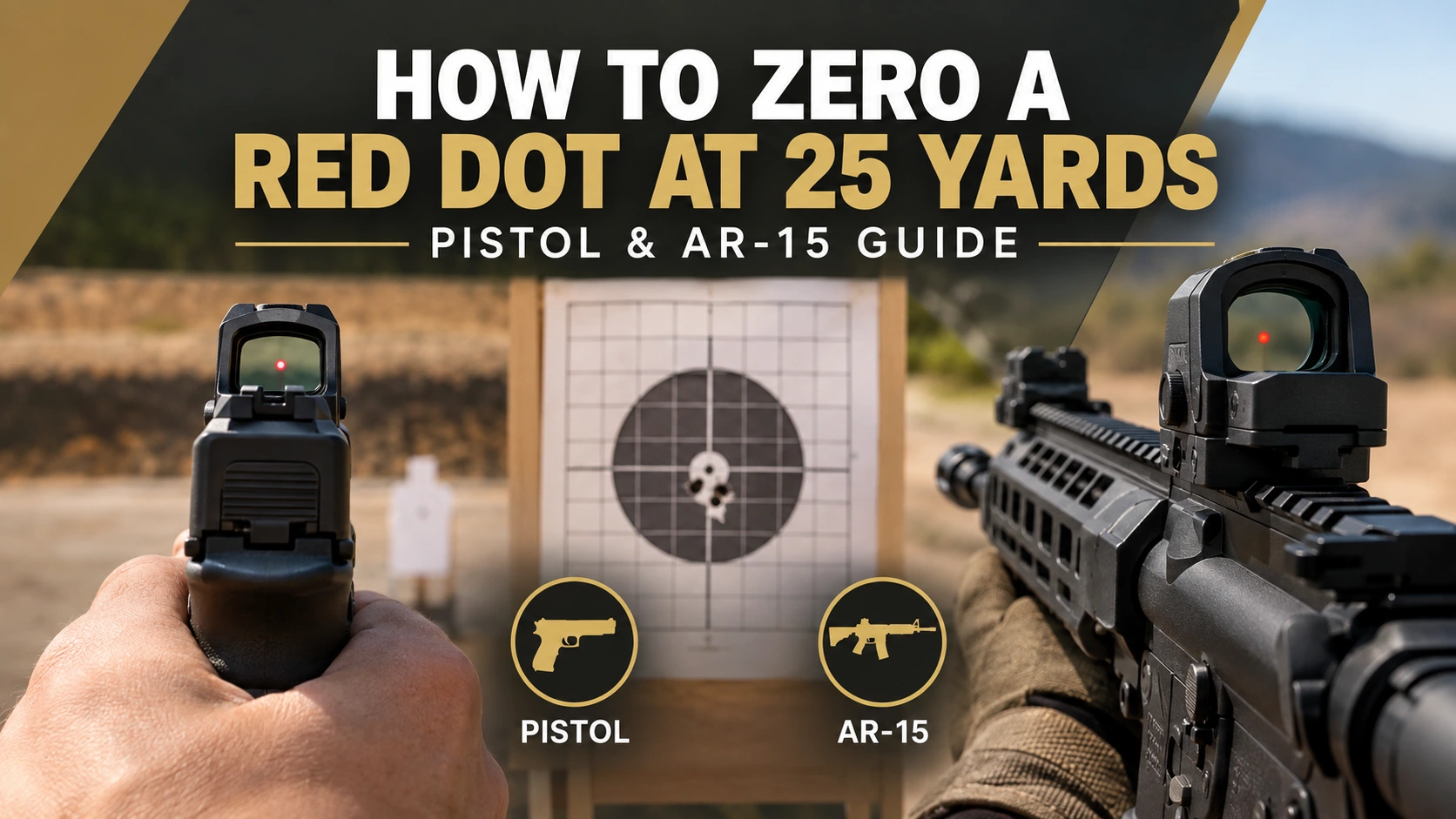
Want to zero a red dot at 25 yards? Fire a 3 to 5 shot group from a rest, measure how far its center sits from your aim point, and turn about 4 clicks per inch on a 1 MOA optic (8 on a 1/2 MOA optic).
Repeat until the group centers, then check it at a second distance. A 25-yard zero acts very differently on a pistol than on an AR-15, so we’ll cover both.
Still choosing a distance? Our complete red dot zeroing guide compares your options.
Highlights
- A 1 MOA click moves your impact about 1/4 inch at 25 yards.
- A 25-yard pistol zero stays within about an inch of the dot out to 50 yards.
- A true 25-yard AR-15 zero hits about 6 inches high at 100 yards.
- Want a 50-yard AR zero? Set your group about 1 inch low at 25 yards.
- 25 meters isn’t 25 yards, and the Army’s method uses an offset.
Why Choose a 25 Yard Zero?
Our main guide suggests 15 yards for most defensive pistols, but 25 yards is a strong alternative if you shoot farther than room distance. It keeps a 9mm close to the dot from 5 yards all the way out to 50.
Many ranges also have a 25-yard line, and holes are much easier to see and measure there than at 50.
On an AR-15, though, a true 25-yard zero usually isn’t what you want long term.
Gear Checklist and the Right Zero Target
Gather these before you head out:
- A properly mounted optic: Torque it to spec and use threadlocker if the maker calls for it.
- A stable rest: A sandbag or range bag works, since wobble at 25 yards can look like an optic problem.
- A grid target: One-inch squares and a small aim point let you measure instead of guess.
- Your real ammo: Different loads can land in different spots, so zero with what you carry or shoot most.
- Your optic’s click value: Most red dots move 1 MOA or 1/2 MOA per click, so check your manual.
A laser boresighter can get you on paper faster, but only live fire sets your real zero.
Red Dot Clicks at 25 Yards: The Quick Math
One MOA covers about 1.047 inches at 100 yards. At 25 yards, that shrinks to about 0.26 inches, or roughly a quarter inch per MOA.
| Optic click value | Movement per click at 25 yd | Clicks to move 1 inch |
|---|---|---|
| 1/2 MOA | About 0.13 in | About 8 |
| 1 MOA | About 0.26 in | About 4 |
Say your group lands 2 inches low and 1 inch left on a 1 MOA optic. You’d turn about 8 clicks up and 4 clicks right.
On most optics, the turret arrows show which way your impact will move. Jot your clicks on the target after each change to keep a simple zero log.
Step-by-Step: Zeroing at the 25-Yard Line
- Get on paper first: If you’re starting fresh, fire a shot or two at 10 yards so you know you’ll hit paper at 25.
- Measure the distance: Set your target at a measured 25 yards rather than pacing it off.
- Fire a group from a rest: Shoot 3 to 5 rounds at the same aim point, with the dot centered in the window to cut parallax.
- Find the group’s center: Ignore any single flyer and measure the center’s distance from your aim point.
- Make your adjustment: Use the click table above.
- Shoot again: Repeat until the group’s center sits on your aim point.
- Confirm at a second distance: See the confirmation section below.
How tight should your group be? For rifles, the Army has long accepted a group of about 4 cm (roughly 1.5 inches) at 25 meters.
Its newer zero target uses a tighter 4 MOA circle, only about 1.1 inches across. If your groups are much bigger, fix your rest and grip before touching the turrets.
Tight groups matter because small misses grow with distance. A quarter-inch error at 25 yards turns into about 1 inch at 100 yards and about 3 inches at 300.
What to Expect From a 25 Yard Red Dot Zero Pistol Setup
Your red dot sits above the barrel, so the bullet starts below your line of sight. It rises to meet the dot at your zero distance, then slowly drops.
| Distance | Impact vs. dot |
|---|---|
| 5 yards | About 0.7 in low |
| 15 yards | About 0.2 in low |
| 25 yards | On the dot |
| 50 yards | About 0.8 in low |
That means your pistol stays within about an inch of the dot from 5 to 50 yards. Up close, expect hits slightly low, by about the height of your optic over the bore.
For comparison, a 10-yard zero prints about 1 inch high at 25 yards, so a 25-yard zero stays flatter past 15 yards.
The 25 Yard Zero AR-15 Problem: High at 100
An AR red dot sits much higher over the bore, usually about 2.5 inches or more depending on your mount. To meet the dot at just 25 yards, the barrel has to angle upward more steeply.
With typical 5.56 ammo, a true 25-yard zero hits about 6 inches high at 100 yards. It peaks around 10 inches high near 200 yards and doesn’t drop back to the dot until about 350 to 360 yards.
Shooters report the same surprise. Measure from the center of your bore to the center of your optic, since that height changes these numbers.
A true 25-yard zero can still work for a 9mm carbine. A PCC zeroed at 25 yards stays within about 2 inches of the dot from 5 to 100 yards, though it hits closer to 2.5 inches low at arm’s length.
Setting a 50 Yard Zero at 25 Yards
The 50-yard zero is often called the most versatile choice for 5.56. Set it at 25 yards by aiming at center and adjusting until your group lands about 1 to 1.25 inches low.
That number is based on common 55 and 62-grain loads with a 2.6-inch sight height. Confirm at 50 yards when you can, and if you buy an offset target, check which zero and sight height it assumes.
25 Yards vs 25 Meters: Don’t Mix Them Up
Twenty-five meters equals about 27.3 yards, since a yard is exactly 0.9144 meters.
The Army’s well-known 25-meter zero is really a way to set a 300-meter zero using an offset, either marked on the zero target or set on the sights. Military trainers point out that a plain point-of-aim zero at 25 meters won’t give you that 300-meter result.
So if you borrow an Army-style method, use its matching target and offset, or you’ll end up with a different zero than you expect.
How to Confirm Your Zero
For a pistol, shoot a group at 7 yards and another at 50 if your range allows. For an AR, check at 50 and 100 yards if you can.
Either way, your hits should match the numbers above.
Recheck your zero whenever you:
- Remove and remount your optic.
- Switch to a different load.
- Notice your groups starting to drift.
Common Mistakes to Avoid
- Adjusting off one shot: Always work from the center of a group.
- Running the dot too bright: A blooming dot hides your true aim point, so see our brightness tips.
- Chasing a loose optic: If your zero keeps wandering, check the mount first.
Conclusion
Zeroing at 25 yards comes down to a solid rest, a grid target, about 4 clicks per inch on a 1 MOA optic (8 on 1/2 MOA), and a check at a second distance. On a pistol, it gives you a flat, forgiving zero from 5 to 50 yards.
On an AR-15, either accept hitting high at 100 yards or use the roughly 1-inch-low offset to set a 50-yard zero.
At Gold Trigger, we carry a selection of red dot sights. You may also call us at 713-485-5773.
Disclaimer: This article is for general information only and isn’t a substitute for professional firearms training. Ballistic figures are approximate and change with your firearm, ammunition, optic height, and conditions, so always confirm your zero with live fire. Follow the basic rules of firearm safety and wear eye and ear protection. You’re responsible for following local laws, and Gold Trigger isn’t liable for any misuse of this information.
Comments