



Circle Dot vs 6 MOA: Which Reticle Is Faster on Target?
Published on: October 14, 2026
Reading Time: 6 mins
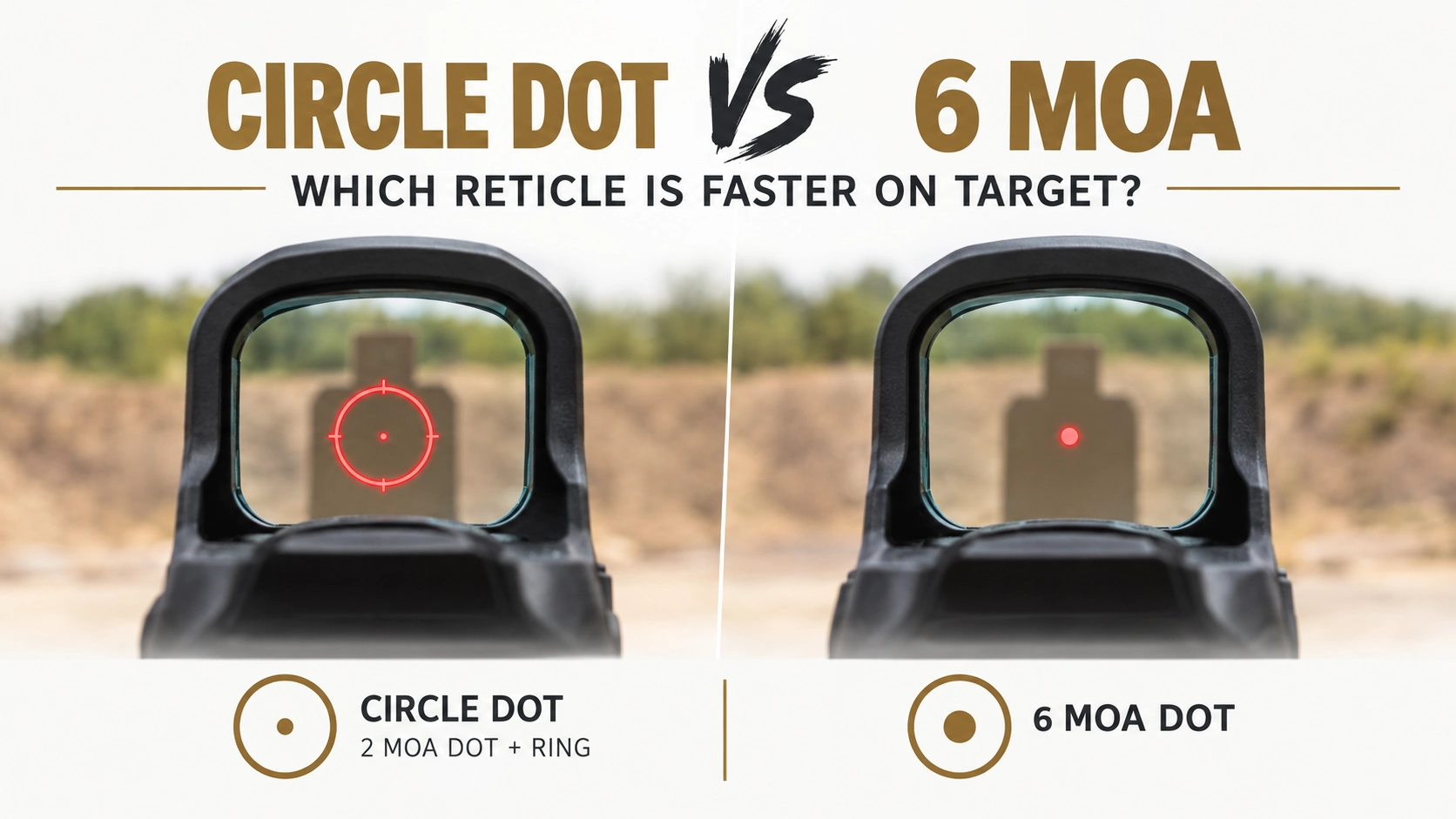
Stuck choosing between a circle dot vs 6 MOA reticle? A 6 MOA dot gives you one big, simple aiming point, while a circle dot pairs a tiny 2 MOA dot with a large ring that helps many shooters find it faster.
The circle dot is also more precise at longer distances. You pay for that with a busier view and shorter battery life when the ring is on.
Keep reading to find your fit, or start with our guide on how red dot sights work if you’re new to optics.
Highlights
- A 6 MOA dot is big, simple, and great for close-range pistol work.
- A circle dot pairs a fine 2 MOA dot with a ring for fast pickup.
- A circle dot is actually the more precise of the two.
- Circle modes drain your battery faster than dot-only mode.
Quick Comparison at a Glance
| Factor | 6 MOA Dot | Circle Dot (2 MOA dot + ring) |
|---|---|---|
| Pickup on the draw | Fast once it’s in view | Easier to find for many shooters |
| Precision past 25 yards | Good on torso-size targets | Finer aim point |
| Battery life | Long | Shorter with the ring on |
| Best for | Close-range carry and home defense | Rifles, PCCs, and fast pickup |
What Each Reticle Looks Like Through the Glass
The 6 MOA Red Dot: One Big, Bold Aiming Point
A 6 MOA dot is a single glowing dot that covers about 6.28 inches at 100 yards. Your eye jumps straight to it, which is why carry optics like the Holosun 407K use one.
At distance, though, a big dot hides more of a small target, so you’re aiming at an area, not a point.
The Circle Dot Reticle: A Ring for Speed, a Dot for Precision
A circle dot places a small center dot inside a large ring. On LED red dots, that center dot is usually 2 MOA, while holographic sights often use a 1 MOA dot.
Pistol optics usually use a 32 MOA ring, and rifle optics use a 65-68 MOA ring. This look first got famous on holographic sights.
Many circle-dot optics let you adjust the dot, the ring, or both, but some are fixed, so check the listing.
How Much Target Does a 32 MOA Circle Cover?
One MOA covers about 1.047 inches at 100 yards, and coverage grows with distance. Here’s our math for each reticle:
| Distance | 6 MOA dot | 2 MOA dot | 32 MOA ring | 65 MOA ring |
|---|---|---|---|---|
| 7 yards | 0.4 in | 0.15 in | 2.3 in | 4.8 in |
| 25 yards | 1.6 in | 0.5 in | 8.4 in | 17 in |
| 50 yards | 3.1 in | 1 in | 16.8 in | 34 in |
At 7 yards, a 32 MOA ring is about as wide as a playing card and fits easily inside the 8-inch chest circle on IDPA targets, so “ring on the chest, then press” works.
At 25 yards, a 6 MOA dot covers only about 1.6 inches of that circle, which is plenty precise for defensive work.
At 50 yards, the 2 MOA center dot is three times finer than a 6 MOA dot. So the idea that a circle dot is “less precise” doesn’t hold up, since the ring only helps you find the dot.
Speed vs Precision: Where Each Reticle Wins
Speed on the Draw and Transitions
When your pistol comes up a little off, part of the big ring often still shows in the window. The ring is more than five times wider than a 6 MOA dot, so it gives your eye a clue about where the dot is.
A lone dot can slip out of view, and hunting for it costs time. A repeatable draw helps with either reticle, since the dot shows up when you present the pistol the same way every time.
Once a 6 MOA dot is in view, it’s easy to see, even in bright sun where small dots wash out.
Precision at Distance
The 2 MOA center dot is the finer of the two aiming points. Past 25 yards, though, the ring grows large enough to cover nearby targets, so many shooters switch to dot-only mode.
A 6 MOA dot still works on torso-size targets out there but feels clumsy on small steel plates.
The Busy-Sight-Picture Problem
Some shooters find the ring distracting because it pulls their focus to the reticle. The fix works for both reticles: keep both eyes open, focus on your target, and let the reticle float over it.
Try This Side-by-Side Range Test
The best way to choose is to shoot both on the same day with a shot timer:
- Draw to first shot: Fire at a 3×5 card at 7 yards, 10 reps per reticle, and average your times.
- Bill Drill: From the holster, fire six shots at an IPSC target at 7 yards, keeping every hit in the A-zone.
- 25-yard group: Fire five careful shots and measure your group.
Use a separate 6 MOA optic for a fair test, since multi-reticle dot-only modes are usually 2 MOA. Whichever reticle is faster without costing hits is your answer.
Which Pistol Red Dot Reticle Fits How You Shoot?
Choosing the Right Dot Size for Home Defense and Carry
Both reticles work well at home-defense distances. Choose a 6 MOA dot for the simplest view and longer battery life than a circle dot with a ring.
Pick a circle dot if you often lose the dot on a fast draw, especially with the small windows on micro carry optics.
Picking a Circle Dot for Competition
In USPSA, Steel Challenge, and IDPA, the ring shines on fast, close stages and quick swings between steel. Still, plenty of competitors run a big single dot for its simplicity.
Rifles and PCCs: Where the 65 MOA Circle Shines
On a rifle or PCC, the circle dot clearly beats a 6 MOA dot. The ring is fast up close, and the 2 MOA dot covers only about 2 inches at 100 yards, compared with about 6 inches for a 6 MOA dot.
That’s why rifle red dots usually use 2-3 MOA dots.
Aging Eyes and Astigmatism
Astigmatism is a common eye condition that blurs or distorts vision. Through a red dot, it can turn a small dot into a smear or starburst.
A 6 MOA dot gives your eye more light to work with, and a ring often stays readable when the dot blooms, so many shooters with astigmatism run circle-only mode.
For some eyes, the ring itself can look doubled, since astigmatism can focus light at two points instead of one. Try both, and see our red-dot astigmatism guide.
Battery Life and the Multi-Reticle System (MRS)
Circle modes light up more of the reticle, so they use more power, and the big battery number on the box usually means dot-only mode.
For example, the Holosun 507K is rated up to 50,000 hours with only its dot on, but it runs much shorter with the ring on. Holographic ring-and-dot sights run even shorter, often around 600 hours versus tens of thousands for LED dots.
These features help your battery last longer:
- Motion activation: Wakes the optic when you move it (Holosun calls it Shake Awake).
- Solar backup: Keeps the reticle lit when there’s enough light.
- Side-loading battery trays: Let you swap batteries without removing the optic.
Frequently Asked Questions
Will switching reticle modes change my zero?
No. On a multi-reticle optic, the center dot stays in the same spot in every mode.
Does a circle dot work with a magnifier?
Yes. A magnifier enlarges your whole view, dot included, so the dot still covers the same part of the target.
Any blur on the dot gets easier to see, though, so a fine 2 MOA dot pairs best with one.
Conclusion
A 6 MOA dot gives you one bold, simple aiming point that’s easy to find up close. A circle dot helps many shooters find the dot faster and gives you a finer 2 MOA aim point for longer shots.
Go with 6 MOA for simple, close-range pistol work, or a multi-reticle circle dot if you want help finding the dot or run a rifle or PCC.
Ready to choose? Browse red dot sights at Gold Trigger and find the reticle that fits you. You can also call us at 713-485-5773.
Disclaimer: This article is for general information only, not firearms training or legal advice. Follow the manufacturer’s instructions, obey basic firearm safety rules, and train with a certified instructor before relying on any sight for self-defense. You’re responsible for following local laws, and Gold Trigger isn’t liable for any misuse of this information.
Comments