
M-LOK Flashlight Mounts Done Right: A Complete Guide

Published on: April 20, 2026
mlok flashlight mount

Reading time: 9 mins 43 sec

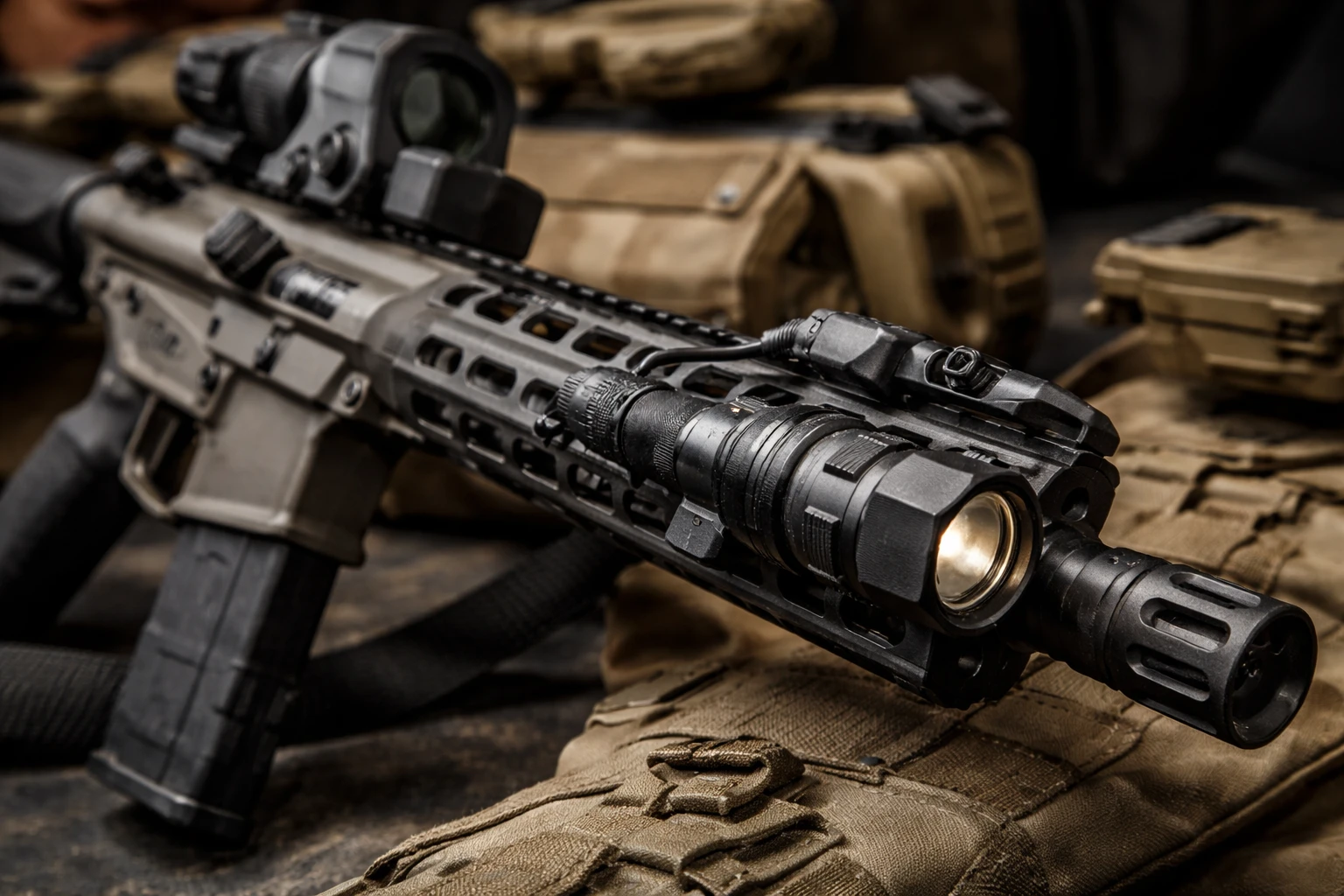
If you’re mounting a weapon light on a modern rifle, the MLOK flashlight setup is one of the smartest ways to do it—but only when you pair the right light with the right mount style. The wrong combination can leave your light wobbling under recoil, blocking your support hand, or sitting somewhere you can’t activate it when it actually matters.

This guide covers everything: How the M-LOK mounting system works, which mount style fits your build, which lights are worth your money, and exactly how to install everything correctly. Whether you’re building a home defense carbine or a duty rifle, you’ll leave with a clear plan—no guesswork.

Highlights

  • M-LOK is the dominant mounting standard on modern rifles—lighter and more streamlined than Picatinny rail.
  • There are four main MLOK light mount styles: inline, offset, QD, and ring-style—each serves a different purpose.
  • Some weapon lights come with an M-LOK mount included; premium lights usually don’t—you’ll buy the mount separately.
  • Proper torque and thread locker are non-negotiable if you want your light to stay put under recoil.
  • Where you position your M-LOK weapon light matters as much as which one you buy.

What Is the M-LOK Mounting System?

M-LOK stands for Modular Lock. It’s an attachment system developed and patented by Magpul Industries that uses rectangular slots cut directly into the handguard instead of a full-length continuous rail. You might see it spelled “MLOK,” “M-LOK,” or “m lok”—they all mean the same thing.

The mechanics are straightforward. Each accessory comes with a T-nut that slides into the slot at one angle, then rotates 90 degrees to lock behind the handguard wall. Tighten the screw, and you’re done. The result is a connection that’s both low-profile and snag-free—two things that matter a lot when you’re running a weapon light.

Before M-LOK, the main alternatives were Picatinny rail and KeyMod. Picatinny is still widely used. There are even debates about M-LOK vs Picatinny, but it adds weight and bulk, and flashlight mounts for it usually need a separate adapter. KeyMod was a serious competitor until NSWC Crane tested both systems for USSOCOM in 2016—and M-LOK won decisively, outperforming KeyMod in repeatability, drop retention, and failure load. That test is what pushed M-LOK into U.S. Special Operations programs and made it the de facto industry standard shortly after.

Today, the M-LOK mounting system ships on virtually every modern AR-15 and AR-10 handguard, many rifle chassis systems, and a growing number of AK-pattern and pistol-caliber carbine platforms. If you’re buying a new handguard right now, it almost certainly has M-LOK slots.

Types of M-LOK Light Mounts—Which Style Is Right for You?

Not all M-LOK light mounts are the same. There are four main categories, and choosing the wrong one is one of the most common mistakes buyers make.

1. Inline (Direct) M-LOK Scout Mounts

An inline mount positions your light parallel to the barrel—straight along the handguard at whatever clock position you choose: 12, 3, 6, or 9 o’clock. It’s the most streamlined setup you can run.

Inline mounts are built for Scout-footprint lights—that means SureFire M300/M600 series, Arisaka 300/600 bodies, and the Streamlight ProTac Rail Mount family. The light body tabs slot directly into the mount and lock in place.

  • Pros: Lowest profile of any mount style, strong retention, and clean cable routing.
  • Cons: You’re locked into one position relative to the bore, which can crowd your support hand on shorter handguards. You also get less flexibility to clear accessories already on the rail.

Popular options include the Arisaka Inline Scout Mount, the Magpul M-LOK Extended Cantilever Scout Mount, and the Midwest Industries Scout Light M-LOK Extended Mount.

2. M-LOK Offset Light Mounts

The M-LOK offset mount is the setup that many serious rifle builders gravitate toward. Instead of running the light parallel to the bore, an offset mount angles it at 45 degrees—placing it at roughly the 1:30 or 10:30 position when mounted on the side of the handguard.

Why does that matter? It keeps your 12 o’clock rail clear for optics and your 6 o’clock open for a foregrip or bipod. It also reduces “barrel shadow,” which is when a bottom-mounted light casts a dark cone directly below the muzzle—a real problem in team environments and tight spaces.

The Arisaka M-LOK Offset Scout Mount is one of the most well-known options in this category. It’s covered under U.S. Patent No. 11385026, measures less than 0.20″ thick, and is compatible with SureFire M300/M600 series, Modlite PLH/OKW, Streamlight ProTac Rail Mount 1, 2, and HL-X, and Olight Odin. The Magpul M-LOK Offset Light/Optic Mount and the KDG Kinect Offset Scout Mount are solid alternatives.

One thing to know: Not all handguards have M-LOK slots at the 1:30 or 10:30 positions. If yours doesn’t, Arisaka makes an M-LOK-to-M-LOK Adapter (MMA) that adds those offset positions—a smart fix before you start shopping for a new handguard entirely.

3. Quick-Detach (QD) M-LOK Mounts

A QD mount adds a tool-free release, letting you pull the light off in seconds. This is the right call if you’re sharing one light between platforms or want the option to transition to a handheld quickly.

The tradeoff is a slight increase in bulk and mechanical complexity. Build quality matters here—a cheap QD mechanism will lose tension over time. KDG backs their Kinect QD M-LOK Mounts with a lifetime warranty, which is a meaningful differentiator in this category. BOBRO Engineering also makes a well-regarded adjustable QD M-LOK Scout Light Mount.

4. Ring-Style & Universal M-LOK Mounts

If you already own a handheld flashlight and want to put it on a rifle without buying a whole new weapon light, ring-style mounts are your answer. These V-block or ring clamps accept cylindrical flashlight bodies—typically 1″ in diameter, or about 23.5–26mm. Always confirm your light body’s diameter before buying.

Ring mounts offer flexibility and lower cost, but they give up some security. They’re generally less stable than Scout-footprint designs, and there’s a real risk of rotation under sustained recoil. For casual range use, they’re fine. For a duty or home defense rifle, you’re better off with a purpose-built weapon light on a dedicated mount.

Top M-LOK Weapon Lights

Before you start shopping, here’s something that trips a lot of buyers up: some M-LOK weapon light packages come with a mount included, while others—especially premium options—sell the light and mount separately. Know which you’re getting before you order.

Budget-Friendly M-LOK Weapon Lights (Under $150)

  • Olight Odin S: 1,500 lumens, powered by a rechargeable 18650 battery, includes M-LOK mount. It’s one of the strongest value options at this price and ships ready to mount on an M-LOK rail.
  • Streamlight ProTac Rail Mount 2: 650 lumens, 23,000 candela, powered by two CR123A batteries, includes an M-LOK adapter. Don’t confuse this with the ProTac 2.0 Rail Mount—they’re different models with different outputs (more on that below).
LightMax LumensBatteryM-LOK Mount Included
Olight Odin S1,50018650 (rechargeable)Yes
Streamlight ProTac Rail Mount 2625CR123A (x2)Yes (adapter)

At this price point, confirm the light is rated for rifle recoil specifically. Not every budget light is built to survive sustained .223 or .308 fire without internal failure.

Mid-Range M-LOK Weapon Lights ($150–$300)

  • Olight Odin Mini: 1,250 lumens, compact form factor, includes an M-LOK mount, rechargeable via MCC3 magnetic cable. Worth noting: it runs on a proprietary 18500 battery—not a standard 18650—so you can’t swap in off-the-shelf cells. It’s still a great pick for smaller handguards where a larger light would crowd your grip.
  • Streamlight ProTac 2.0 Rail Mount HP: 2,000 lumens and 85,000 candela, USB-C rechargeable via the SL-B50 battery pack, includes an M-LOK mount. The high candela rating is what makes this stand out at this price—it throws a focused beam farther than most lights in its class, which matters for target identification at distance.
  • INFORCE ARC: Available in a compact 1,200-lumen body and an extended 1,400-lumen body, with M-LOK mount kits available. The manufacturer rates it for duty use, though that reflects their own internal testing rather than an independent certification.

Your tail cap or side switch placement will dictate where you position the light on the rail. Think about activation before you commit to a mounting location — it’s easier to plan this up front than to re-mount after the fact.

Premium M-LOK Weapon Lights ($300+)

When you move into premium territory, the conversation shifts from lumens to candela—raw brightness vs. focused beam intensity. For a full breakdown of what those numbers actually mean for your application, check out our complete weapon light guide.

  • SureFire Scout Light Pro Dual Fuel (M640DF): Outputs 1,200 lumens on CR123A batteries or 1,500 lumens on the SF18650B rechargeable battery. The M640DF ships with SureFire’s Low-Profile Mount (LPM), which attaches directly to M-LOK or Picatinny rails without any adapter needed. If you see the older M600DF listed somewhere, know it’s a different model — it uses a Picatinny-only thumbscrew clamp and needs a separate adapter for M-LOK use.
  • Modlite PLHv2 / OKW: Preferred by professional trainers for their extreme candela output. The PLHv2 delivers around 1,350 lumens and 54,000 candela—a beam that leaves most weapon lights in the dust at a distance. These use a Scout-footprint body but don’t include an M-LOK mount, so you’ll need to pair them with an Arisaka or KDG mount.
  • Arisaka 300 / 600 / 18650 Series: Built in the USA and designed to mate directly with Arisaka’s mounting ecosystem, so fitment is guaranteed out of the box.

How to Install an M-LOK Flashlight Mount — Step-by-Step

Before you touch anything, make sure your firearm is unloaded, and the action is clear. Verify this visually and physically. Every time.

Tools and Materials You’ll Need

  • Driver: Most standard M-LOK hardware uses a 1/8″ hex (Allen) wrench. Arisaka mounts specifically require a T20 Torx driver. Always check your mount’s manual before starting.
  • Torque wrench: Strongly recommended. Guessing on torque is how lights end up loose after 50 rounds.
  • Thread locker: Loctite 222 (purple) or Loctite 243 (blue) is the right call for small M-LOK fasteners. Standard Loctite 242 is formulated for larger ¼”+ fasteners. On the smaller screws used in M-LOK hardware, it can bond more aggressively than you want, making future removal unnecessarily difficult. Never use red (271)—it’s permanent and requires heat to break down, which can damage polymer handguards.
  • Manufacturer’s instruction sheet: Always read it. Torque specs vary by brand and handguard material.

Step 1. Choose Your Mounting Position

Think about clock positions: 12 o’clock is top, 6 o’clock is bottom, 3 and 9 are the sides. Where you put the light depends on how you activate it.

If you’re using a pressure pad, route the cable so it runs where your support thumb naturally lands. If you’re using the tail cap, make sure it’s accessible without shifting your grip. Dry-fit the mount first—hold it against the handguard and see how it feels with your normal shooting grip before committing.

Step 2. Insert the T-Nuts

Orient the T-nut so its tabs run parallel to the slot length, then slide it in. Once seated, rotate it 90 degrees so the tabs grip behind the slot walls. The bottom of the mount should sit flush against the handguard—if it doesn’t, the T-nut isn’t fully engaged. A raised T-nut won’t hold torque and can strip the threads.

Step 3. Align and Seat the Mount

Set the mount body over the T-nuts and thread the screws in by hand first—never start with a wrench. If you’re using a two-slot mount, make sure both T-nuts are engaged before you tighten either screw. The mount should sit flat with no rocking or gap.

Step 4. Torque to Spec and Apply Thread Locker

Torque values depend on your handguard material and mount brand:

  • Magpul spec: 35 in-lbs for metal handguards, 15 in-lbs for polymer
  • Arisaka spec: 30 in-lbs for M-LOK screws on metal handguards, 15 in-lbs for polymer

Apply a small drop of Loctite 222 or 243 to the screw threads before your final tightening. Rifle recoil creates constant vibration—even a properly torqued screw will back out eventually without thread locker. After tightening, try to rotate the mount by hand. It shouldn’t move at all.

Step 5. Attach the Light and Route the Cable

For Scout-footprint lights, align the body tabs with the mount and slide the light forward until it locks. For ring-mount lights, insert the body and tighten the clamp evenly.

If you’re using a pressure switch, route the cable away from the barrel, gas block, and suppressor body. Heat from those surfaces degrades cable insulation and causes switch failures. Use M-LOK cable management clips to keep everything tight and snag-free. Then run a function check—activate the light in both momentary and constant mode, and confirm nothing is interfering with your handguard, grip, or optic.

Common M-LOK Flashlight Mount Mistakes And How to Avoid Them

Even experienced builders make these. Here’s what to watch for:

  • Wrong footprint for the mount: Scout, SureFire Pro swivel, and ring-style mounts are not interchangeable. Confirm which footprint your light uses before you buy a mount.
  • Skipping the torque wrench: Eyeballing tightness is how lights shift under recoil. Get a torque wrench and use it.
  • No thread locker: Even a perfectly torqued screw will back out over time from vibration. Loctite 222 or 243 is cheap and takes 30 seconds to apply.
  • Poor cable routing: Running a pressure switch cable over your gas block or suppressor body will cook the insulation and eventually cause switch failure. Route underneath and clip it down.
  • Offset mount installed backwards: Arisaka offset mounts have a specific direction. Reverse it, and your light ends up at the wrong clock position and may contact the handguard.
  • Ignoring handguard compatibility: Some handguards (Aero Precision Enhanced Gen 2, SIG MPX, MCX Virtus) don’t accept the standard Arisaka Offset Scout Mount profile. Check Arisaka’s current compatibility list at arisakadefense.com before you order — it’s updated regularly.

Conclusion

Getting your M-LOK flashlight setup right comes down to three decisions: the right mount style for your use case, the right light for your budget, and a proper installation that’ll hold up under real-world conditions. Inline mounts keep things tight and clean; offset mounts maximize rail space and reduce shadow; QD mounts give you flexibility; and ring-style mounts let you repurpose a light you already own.

From there, it’s the details that make or break it—correct torque, the right thread locker for small fasteners, smart cable routing, and a mounting position that works with how you actually shoot.

If you want to go deeper on choosing the right weapon light beyond M-LOK compatibility—output specs, battery types, candela vs. lumens, and what actually matters for your application—our weapon light buying guide has everything in one place.

You can browse our catalogue or call us at 713-485-5773.

Disclaimer: The products and installation instructions on this page are intended for lawful use by responsible adults in full compliance with all applicable federal, state, and local laws and regulations. Weapon-mounted lights are accessories for legally owned firearms. Always verify that your firearm is completely unloaded and the action is cleared before performing any installation or maintenance. Improper installation of firearm accessories can result in equipment failure, personal injury, or property damage. When in doubt, consult a qualified gunsmith. Gold Trigger is not responsible for damages, injuries, or legal consequences resulting from improper use, installation, or failure to comply with applicable laws. The use of weapon-mounted lights during hunting may be regulated or restricted in your state—verify the laws in your jurisdiction before use.

Comments

Leave a Reply

Your email address will not be published. Required fields are marked *

M-LOK Flashlight Mounts Done Right: A Complete Guide

mlok flashlight mount

Reading time: 9 mins 43 sec

If you’re mounting a weapon light on a modern rifle, the MLOK flashlight setup is one of the smartest ways to do it—but only when you pair the right light with the right mount style. The wrong combination can leave your light wobbling under recoil, blocking your support hand, or sitting somewhere you can’t activate it when it actually matters.

This guide covers everything: How the M-LOK mounting system works, which mount style fits your build, which lights are worth your money, and exactly how to install everything correctly. Whether you’re building a home defense carbine or a duty rifle, you’ll leave with a clear plan—no guesswork.

Highlights

  • M-LOK is the dominant mounting standard on modern rifles—lighter and more streamlined than Picatinny rail.
  • There are four main MLOK light mount styles: inline, offset, QD, and ring-style—each serves a different purpose.
  • Some weapon lights come with an M-LOK mount included; premium lights usually don’t—you’ll buy the mount separately.
  • Proper torque and thread locker are non-negotiable if you want your light to stay put under recoil.
  • Where you position your M-LOK weapon light matters as much as which one you buy.

What Is the M-LOK Mounting System?

M-LOK stands for Modular Lock. It’s an attachment system developed and patented by Magpul Industries that uses rectangular slots cut directly into the handguard instead of a full-length continuous rail. You might see it spelled “MLOK,” “M-LOK,” or “m lok”—they all mean the same thing.

The mechanics are straightforward. Each accessory comes with a T-nut that slides into the slot at one angle, then rotates 90 degrees to lock behind the handguard wall. Tighten the screw, and you’re done. The result is a connection that’s both low-profile and snag-free—two things that matter a lot when you’re running a weapon light.

Before M-LOK, the main alternatives were Picatinny rail and KeyMod. Picatinny is still widely used. There are even debates about M-LOK vs Picatinny, but it adds weight and bulk, and flashlight mounts for it usually need a separate adapter. KeyMod was a serious competitor until NSWC Crane tested both systems for USSOCOM in 2016—and M-LOK won decisively, outperforming KeyMod in repeatability, drop retention, and failure load. That test is what pushed M-LOK into U.S. Special Operations programs and made it the de facto industry standard shortly after.

Today, the M-LOK mounting system ships on virtually every modern AR-15 and AR-10 handguard, many rifle chassis systems, and a growing number of AK-pattern and pistol-caliber carbine platforms. If you’re buying a new handguard right now, it almost certainly has M-LOK slots.

Types of M-LOK Light Mounts—Which Style Is Right for You?

Not all M-LOK light mounts are the same. There are four main categories, and choosing the wrong one is one of the most common mistakes buyers make.

1. Inline (Direct) M-LOK Scout Mounts

An inline mount positions your light parallel to the barrel—straight along the handguard at whatever clock position you choose: 12, 3, 6, or 9 o’clock. It’s the most streamlined setup you can run.

Inline mounts are built for Scout-footprint lights—that means SureFire M300/M600 series, Arisaka 300/600 bodies, and the Streamlight ProTac Rail Mount family. The light body tabs slot directly into the mount and lock in place.

  • Pros: Lowest profile of any mount style, strong retention, and clean cable routing.
  • Cons: You’re locked into one position relative to the bore, which can crowd your support hand on shorter handguards. You also get less flexibility to clear accessories already on the rail.

Popular options include the Arisaka Inline Scout Mount, the Magpul M-LOK Extended Cantilever Scout Mount, and the Midwest Industries Scout Light M-LOK Extended Mount.

2. M-LOK Offset Light Mounts

The M-LOK offset mount is the setup that many serious rifle builders gravitate toward. Instead of running the light parallel to the bore, an offset mount angles it at 45 degrees—placing it at roughly the 1:30 or 10:30 position when mounted on the side of the handguard.

Why does that matter? It keeps your 12 o’clock rail clear for optics and your 6 o’clock open for a foregrip or bipod. It also reduces “barrel shadow,” which is when a bottom-mounted light casts a dark cone directly below the muzzle—a real problem in team environments and tight spaces.

The Arisaka M-LOK Offset Scout Mount is one of the most well-known options in this category. It’s covered under U.S. Patent No. 11385026, measures less than 0.20″ thick, and is compatible with SureFire M300/M600 series, Modlite PLH/OKW, Streamlight ProTac Rail Mount 1, 2, and HL-X, and Olight Odin. The Magpul M-LOK Offset Light/Optic Mount and the KDG Kinect Offset Scout Mount are solid alternatives.

One thing to know: Not all handguards have M-LOK slots at the 1:30 or 10:30 positions. If yours doesn’t, Arisaka makes an M-LOK-to-M-LOK Adapter (MMA) that adds those offset positions—a smart fix before you start shopping for a new handguard entirely.

3. Quick-Detach (QD) M-LOK Mounts

A QD mount adds a tool-free release, letting you pull the light off in seconds. This is the right call if you’re sharing one light between platforms or want the option to transition to a handheld quickly.

The tradeoff is a slight increase in bulk and mechanical complexity. Build quality matters here—a cheap QD mechanism will lose tension over time. KDG backs their Kinect QD M-LOK Mounts with a lifetime warranty, which is a meaningful differentiator in this category. BOBRO Engineering also makes a well-regarded adjustable QD M-LOK Scout Light Mount.

4. Ring-Style & Universal M-LOK Mounts

If you already own a handheld flashlight and want to put it on a rifle without buying a whole new weapon light, ring-style mounts are your answer. These V-block or ring clamps accept cylindrical flashlight bodies—typically 1″ in diameter, or about 23.5–26mm. Always confirm your light body’s diameter before buying.

Ring mounts offer flexibility and lower cost, but they give up some security. They’re generally less stable than Scout-footprint designs, and there’s a real risk of rotation under sustained recoil. For casual range use, they’re fine. For a duty or home defense rifle, you’re better off with a purpose-built weapon light on a dedicated mount.

Top M-LOK Weapon Lights

Before you start shopping, here’s something that trips a lot of buyers up: some M-LOK weapon light packages come with a mount included, while others—especially premium options—sell the light and mount separately. Know which you’re getting before you order.

Budget-Friendly M-LOK Weapon Lights (Under $150)

  • Olight Odin S: 1,500 lumens, powered by a rechargeable 18650 battery, includes M-LOK mount. It’s one of the strongest value options at this price and ships ready to mount on an M-LOK rail.
  • Streamlight ProTac Rail Mount 2: 650 lumens, 23,000 candela, powered by two CR123A batteries, includes an M-LOK adapter. Don’t confuse this with the ProTac 2.0 Rail Mount—they’re different models with different outputs (more on that below).
LightMax LumensBatteryM-LOK Mount Included
Olight Odin S1,50018650 (rechargeable)Yes
Streamlight ProTac Rail Mount 2625CR123A (x2)Yes (adapter)

At this price point, confirm the light is rated for rifle recoil specifically. Not every budget light is built to survive sustained .223 or .308 fire without internal failure.

Mid-Range M-LOK Weapon Lights ($150–$300)

  • Olight Odin Mini: 1,250 lumens, compact form factor, includes an M-LOK mount, rechargeable via MCC3 magnetic cable. Worth noting: it runs on a proprietary 18500 battery—not a standard 18650—so you can’t swap in off-the-shelf cells. It’s still a great pick for smaller handguards where a larger light would crowd your grip.
  • Streamlight ProTac 2.0 Rail Mount HP: 2,000 lumens and 85,000 candela, USB-C rechargeable via the SL-B50 battery pack, includes an M-LOK mount. The high candela rating is what makes this stand out at this price—it throws a focused beam farther than most lights in its class, which matters for target identification at distance.
  • INFORCE ARC: Available in a compact 1,200-lumen body and an extended 1,400-lumen body, with M-LOK mount kits available. The manufacturer rates it for duty use, though that reflects their own internal testing rather than an independent certification.

Your tail cap or side switch placement will dictate where you position the light on the rail. Think about activation before you commit to a mounting location — it’s easier to plan this up front than to re-mount after the fact.

Premium M-LOK Weapon Lights ($300+)

When you move into premium territory, the conversation shifts from lumens to candela—raw brightness vs. focused beam intensity. For a full breakdown of what those numbers actually mean for your application, check out our complete weapon light guide.

  • SureFire Scout Light Pro Dual Fuel (M640DF): Outputs 1,200 lumens on CR123A batteries or 1,500 lumens on the SF18650B rechargeable battery. The M640DF ships with SureFire’s Low-Profile Mount (LPM), which attaches directly to M-LOK or Picatinny rails without any adapter needed. If you see the older M600DF listed somewhere, know it’s a different model — it uses a Picatinny-only thumbscrew clamp and needs a separate adapter for M-LOK use.
  • Modlite PLHv2 / OKW: Preferred by professional trainers for their extreme candela output. The PLHv2 delivers around 1,350 lumens and 54,000 candela—a beam that leaves most weapon lights in the dust at a distance. These use a Scout-footprint body but don’t include an M-LOK mount, so you’ll need to pair them with an Arisaka or KDG mount.
  • Arisaka 300 / 600 / 18650 Series: Built in the USA and designed to mate directly with Arisaka’s mounting ecosystem, so fitment is guaranteed out of the box.

How to Install an M-LOK Flashlight Mount — Step-by-Step

Before you touch anything, make sure your firearm is unloaded, and the action is clear. Verify this visually and physically. Every time.

Tools and Materials You’ll Need

  • Driver: Most standard M-LOK hardware uses a 1/8″ hex (Allen) wrench. Arisaka mounts specifically require a T20 Torx driver. Always check your mount’s manual before starting.
  • Torque wrench: Strongly recommended. Guessing on torque is how lights end up loose after 50 rounds.
  • Thread locker: Loctite 222 (purple) or Loctite 243 (blue) is the right call for small M-LOK fasteners. Standard Loctite 242 is formulated for larger ¼”+ fasteners. On the smaller screws used in M-LOK hardware, it can bond more aggressively than you want, making future removal unnecessarily difficult. Never use red (271)—it’s permanent and requires heat to break down, which can damage polymer handguards.
  • Manufacturer’s instruction sheet: Always read it. Torque specs vary by brand and handguard material.

Step 1. Choose Your Mounting Position

Think about clock positions: 12 o’clock is top, 6 o’clock is bottom, 3 and 9 are the sides. Where you put the light depends on how you activate it.

If you’re using a pressure pad, route the cable so it runs where your support thumb naturally lands. If you’re using the tail cap, make sure it’s accessible without shifting your grip. Dry-fit the mount first—hold it against the handguard and see how it feels with your normal shooting grip before committing.

Step 2. Insert the T-Nuts

Orient the T-nut so its tabs run parallel to the slot length, then slide it in. Once seated, rotate it 90 degrees so the tabs grip behind the slot walls. The bottom of the mount should sit flush against the handguard—if it doesn’t, the T-nut isn’t fully engaged. A raised T-nut won’t hold torque and can strip the threads.

Step 3. Align and Seat the Mount

Set the mount body over the T-nuts and thread the screws in by hand first—never start with a wrench. If you’re using a two-slot mount, make sure both T-nuts are engaged before you tighten either screw. The mount should sit flat with no rocking or gap.

Step 4. Torque to Spec and Apply Thread Locker

Torque values depend on your handguard material and mount brand:

  • Magpul spec: 35 in-lbs for metal handguards, 15 in-lbs for polymer
  • Arisaka spec: 30 in-lbs for M-LOK screws on metal handguards, 15 in-lbs for polymer

Apply a small drop of Loctite 222 or 243 to the screw threads before your final tightening. Rifle recoil creates constant vibration—even a properly torqued screw will back out eventually without thread locker. After tightening, try to rotate the mount by hand. It shouldn’t move at all.

Step 5. Attach the Light and Route the Cable

For Scout-footprint lights, align the body tabs with the mount and slide the light forward until it locks. For ring-mount lights, insert the body and tighten the clamp evenly.

If you’re using a pressure switch, route the cable away from the barrel, gas block, and suppressor body. Heat from those surfaces degrades cable insulation and causes switch failures. Use M-LOK cable management clips to keep everything tight and snag-free. Then run a function check—activate the light in both momentary and constant mode, and confirm nothing is interfering with your handguard, grip, or optic.

Common M-LOK Flashlight Mount Mistakes And How to Avoid Them

Even experienced builders make these. Here’s what to watch for:

  • Wrong footprint for the mount: Scout, SureFire Pro swivel, and ring-style mounts are not interchangeable. Confirm which footprint your light uses before you buy a mount.
  • Skipping the torque wrench: Eyeballing tightness is how lights shift under recoil. Get a torque wrench and use it.
  • No thread locker: Even a perfectly torqued screw will back out over time from vibration. Loctite 222 or 243 is cheap and takes 30 seconds to apply.
  • Poor cable routing: Running a pressure switch cable over your gas block or suppressor body will cook the insulation and eventually cause switch failure. Route underneath and clip it down.
  • Offset mount installed backwards: Arisaka offset mounts have a specific direction. Reverse it, and your light ends up at the wrong clock position and may contact the handguard.
  • Ignoring handguard compatibility: Some handguards (Aero Precision Enhanced Gen 2, SIG MPX, MCX Virtus) don’t accept the standard Arisaka Offset Scout Mount profile. Check Arisaka’s current compatibility list at arisakadefense.com before you order — it’s updated regularly.

Conclusion

Getting your M-LOK flashlight setup right comes down to three decisions: the right mount style for your use case, the right light for your budget, and a proper installation that’ll hold up under real-world conditions. Inline mounts keep things tight and clean; offset mounts maximize rail space and reduce shadow; QD mounts give you flexibility; and ring-style mounts let you repurpose a light you already own.

From there, it’s the details that make or break it—correct torque, the right thread locker for small fasteners, smart cable routing, and a mounting position that works with how you actually shoot.

If you want to go deeper on choosing the right weapon light beyond M-LOK compatibility—output specs, battery types, candela vs. lumens, and what actually matters for your application—our weapon light buying guide has everything in one place.

You can browse our catalogue or call us at 713-485-5773.

Disclaimer: The products and installation instructions on this page are intended for lawful use by responsible adults in full compliance with all applicable federal, state, and local laws and regulations. Weapon-mounted lights are accessories for legally owned firearms. Always verify that your firearm is completely unloaded and the action is cleared before performing any installation or maintenance. Improper installation of firearm accessories can result in equipment failure, personal injury, or property damage. When in doubt, consult a qualified gunsmith. Gold Trigger is not responsible for damages, injuries, or legal consequences resulting from improper use, installation, or failure to comply with applicable laws. The use of weapon-mounted lights during hunting may be regulated or restricted in your state—verify the laws in your jurisdiction before use.

Leave a Reply

Your email address will not be published. Required fields are marked *

Shopping cart0
There are no products in the cart!