



How to Choose the Best Weapon Light in 2026
Published on: April 16, 2026
Reading time: 6 mins 41 sec
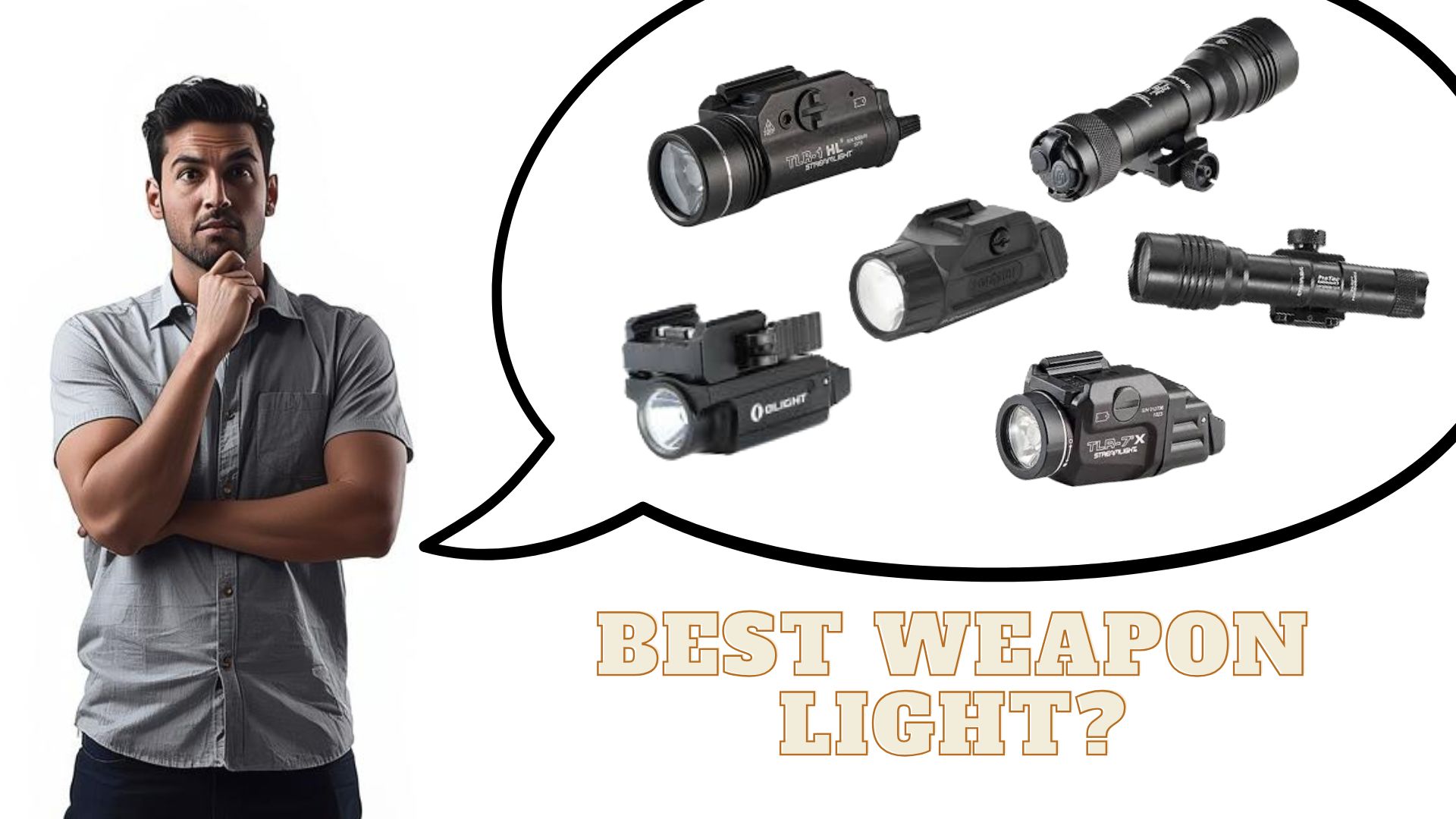
Buying a weapon light seems easy—until the one you ordered doesn’t fit any holster made for your pistol. It’s one of the most avoidable first-time buyer mistakes out there.
Three things keep going wrong: Shoppers chase lumens without understanding candela, pistol buyers skip holster compatibility, and people buy a pistol-sized light for a rifle. A $300 light on the wrong platform is still the wrong light.
The five-question framework below solves all three before you spend a dollar.
Highlights
- Five questions will narrow the weapon light market down to your perfect match.
- Candela matters more than lumens for real-world performance.
- Pistol buyers must confirm holster compatibility before purchasing.
- Match your battery type to how you store your firearm.
- Most civilian buyers only need to spend $100–$200 for reliable performance.
Your Weapon Light Guide: The 5-Question Framework
Think of this as a decision funnel. Each question narrows the field until you’re left with options that actually fit your firearm, your use case, and your life. Answer them in order.
Question 1: What Platform Are You Mounting This On?
Platform is everything. Every other decision—size, output, switch type, mount style—flows from your answer here.
A pistol has constraints that no other platform has. The light directly affects your draw, your master grip, and whether your holster will accept the combination at all. On a rifle or carbine, you have more rail space and can run a larger, higher-output light. Your ergonomic priority shifts from paddle placement to support-hand switch access.
A few things to remember:
- Pistol: Always verify your exact make and model in the manufacturer’s compatibility chart, especially if you’re running a subcompact or slimline frame. “Universal rail” is a marketing phrase, not a guarantee.
- Rifle/Carbine: When the light is mounted too far back relative to your muzzle device, the device can protrude past the light and cast a shadow into the beam path. Mount as far forward as comfortable switch access allows.
- Multi-platform use: A single light that serves as both a pistol and a rifle is almost always a compromise that shortchanges both platforms.
Question 2: What’s Your Primary Use Case?
Don’t look at a single spec until you’ve answered this. Your use case sets the output floor, the beam profile, and even the battery strategy.
- Home defense (indoors) means you need spill and flood, not long-range throw. Ultra-high-candela lights with tight hotspot patterns can cause significant wall-splash in small, reflective indoor spaces at close range. Beam profile — how light is distributed across the hotspot and spill — matters just as much as raw candela.
- Concealed carry (EDC) makes size the real constraint. If the light makes your holster print or slows your draw, it’s the wrong choice no matter how bright it is.
- Duty and patrol put you up against photonic barriers: tinted car windows, oncoming headlights, and streetlights that wash out a weak beam. High candela isn’t optional here.
- Rural property and nighttime hunting demand long-range identification at 50 to 100+ yards, which requires both high candela and a tight throw. Runtime becomes a real concern when you’re covering ground.
Use this table as a quick reference:
| Use Case | Lumens | Candela | Battery |
|---|---|---|---|
| Home Defense Pistol | 500–1,000 | 20k–50k (50k+ recommended) | CR123A or dual-fuel |
| EDC Concealed Carry | 500–800 | 10k–25k | CR123A or rechargeable |
| Home Defense Rifle | 1,000–1,250 | 80k–100k+ | Dual-fuel 18650 |
| Duty/Patrol Pistol | 800–1,000+ | 40k–66k+ | CR123A |
| Hunting/Rural Outdoor | 1,000–1,500 | 60k–100k+ | 18650 |
Question 3: How Much Light Do You Actually Need?
This is where most buyers get tripped up. It all comes down to two different measurements: lumen vs candela.
Lumens measure total light output—how much light leaves the lens in all directions. Candela measures peak beam intensity in a specific direction—how concentrated the beam is at a distance. Both matter, but they tell you different things. The lumen requirements for your use case aren’t just about the number on the box.
Here’s the trap: A light with 1,500 lumens but low candela can be outperformed at distance by an 800-lumen light with high candela, because the latter concentrates its output more tightly. Candela predicts real-world reach and penetration through ambient light. Lumens alone don’t.
There’s also a spec honesty issue. The ANSI/NEMA FL1 standard measures lumen output at 30 seconds after activation—the peak number on the box is a burst rating, not a sustained one. Step-down timing varies widely: Some lights throttle within 60–90 seconds at max output, others hold peak brightness for 5–15 minutes. Always check the runtime graph, not just the headline figure.
Practical minimums to keep in mind:
- Absolute defensive floor: 500 lumens
- Pistol and home defense: 500–1,000 lm / 20,000–50,000 cd (50,000+ recommended)
- Rifle and patrol: 1,000–1,500 lm / 80,000–100,000+ cd
- EDC compact: 500–800 lm / 10,000–25,000 cd
Question 4: Which Switch Type Fits How You Train?
Under stress, your hands do what they’ve been trained to do. A switch you haven’t practiced with becomes a liability. This is an ergonomics-first decision.
The three main switch types:
- Momentary-only (press and hold): Light activates only while your finger is pressing — the professional standard for defensive use. Promotes light discipline, prevents accidental constant-on.
- Constant-on (clicky): One press locks the light on. Useful for extended searches, but carries real risk of accidental activation under adrenaline.
- Dual-mode: Partial press = momentary; full press = constant-on. Used by most major pistol lights. Versatile, but requires specific training to avoid accidentally locking on when you meant momentary.
For pistols, ambidextrous paddle activation is the standard—it lets you fire the light without changing your grip. For rifles, a forward pressure pad lets your support hand activate the light without reaching back. Just know that cable damage and connector pullout are the most common pressure pad failure points; always have a tailcap backup. Rail-mounted auxiliary switches eliminate the cable and are an increasingly popular option.
One thing most buyers skip: test any switch with your actual training grip, not a casual desk press. Some lights marketed as ambidextrous have noticeably weaker activation on the non-dominant side.
Question 5: What Battery Setup Fits Your Lifestyle?
The right battery isn’t the most powerful one—it’s the one that matches how you store and use your firearm.
The main battery types:
- CR123A (disposable lithium): Long shelf life, zero maintenance, and available at hardware stores and big-box retailers everywhere. Right for staged home defense firearms that sit untouched for months. A dead rechargeable at 2 a.m. defeats the whole purpose.
- 18650 (rechargeable lithium-ion): Lower long-term cost, convenient for daily-use firearms. Modern USB-C charging makes maintenance easy. Note: CR123A cells are stocked at most hardware stores, pharmacies, and big-box retailers nationwide—including rural areas. While 18650 cells are available at major retailers like Walmart and Best Buy, CR123A still wins for emergency or rural sourcing convenience.
- Dual-fuel: Accepts both CR123A and 18650. The default recommendation is for buyers who haven’t established a clear routine yet.
Mounting Options: What You Need to Know Before You Install
Getting the mount right matters just as much as picking the right light.
Start by identifying your rail type. Pistols most commonly use manufacturer-specific proprietary rails (Glock, Sig Sauer, Springfield, and others each have their own format). Rifles typically use Picatinny or M-LOK—check your owner’s manual before ordering anything.
For rifles with M-LOK handguards, a dedicated M-LOK light mount beats a Picatinny adapter block every time. It’s slimmer, more recoil-resistant, and removes an extra failure point. On quick-detach versus permanent mounts: QD offers flexibility for swapping between firearms, while a permanent mount is more secure and typically lighter. For a primary defensive firearm, permanent mounting wins.
After installation, torque the mount to spec and do a retention check. A light that shifts even slightly after a few hundred rounds means the beam no longer covers the same area as your muzzle—and that degrades threat identification, especially at distance.
For pistol buyers: confirm holster compatibility before you purchase the light, not after. Established lights have extensive compatible holster ecosystems. Many newer or budget lights have few or zero compatible holsters, leaving you with a gun-and-light combo that has no viable carry solution.
Build Quality: The Spec Sheet Doesn’t Tell the Full Story
Quality weapon lights are built from hard-anodized 6061-T6 aircraft aluminum—lightweight, structurally strong, and an excellent heat conductor that helps manage the thermal load at high output.
Water resistance follows the IP (Ingress Protection) rating system:
- IPX4: Splash resistant from any direction—the minimum for tactical use
- IPX6: Survives high-pressure water jets—good for most field conditions
- IPX7: Temporary submersion to 1 meter for 30 minutes
- IPX8: Continuous submersion at a manufacturer-specified depth
Note that the “X” in IPX means dust protection wasn’t tested. If dustproofing matters, look for a full IP rating—IP67 or IP68—rather than IPX alone.
Recoil rating is the spec most budget buyers miss. A light that passes a drop test can still fail after a few hundred rounds of heavy-caliber fire. Quality lights reference IEC 60068-2-27 shock testing standards or provide documented round-count certifications. The LED itself almost never fails—most are rated for 50,000 to 100,000+ hours. What fails is the driver circuitry and the switch, which is why brand reputation and warranty support matter more than peak spec numbers.
Choosing Weapon Light Budget Tiers: The Honest Breakdown
Under $75—Entry-Level: You’ll get 300–600 lumens and basic switch function. What you give up: documented recoil durability, reliable weatherproofing, and any real holster ecosystem. Fine for training. Not suitable as a primary defensive light.
$75–$150—Mid-Range Sweet Spot: This is where most civilian buyers should land. You get 500–1,000 lumens, solid recoil ratings, IPX6+ weatherproofing, and real switch options. The trade-off is typically peak candela and limited holster support.
$150–$300—Professional Grade: Duty-proven construction, leading output, and an established holster ecosystem. The right range for any primary defensive firearm or serious home defense build. Note: top-tier lights in this category often approach or exceed $300 at retail.
$300+—Specialist/Premium: Maximum candela (100,000+), modular systems, IR capability, and specialist beam engineering for LE, military, and NVG use. Most civilians don’t need this tier.
The honest recommendation for most civilian home defense buyers is a quality light in the $100–$200 range that fits your specific rail, carries an IPX6+ rating, and uses a dual-mode paddle switch that will reliably do everything you need.
Conclusion
Choosing the best weapon light is a five-decision process: platform, use case, output specs, switch type, and battery setup. Work through them in order, and the right shortlist appears without the confusion of chasing spec numbers that don’t match your situation.
Ready to find the right light for your setup? Explore our lights collection. You may also call us at 713-485-5773.
Disclaimer: The information in this article is for educational purposes only. All weapon light purchases must comply with applicable federal, state, and local laws. It is your sole responsibility to understand the laws in your jurisdiction before purchasing or using any product. A weapon light is not a substitute for professional firearms training. Gold Trigger makes no warranty regarding the suitability of any product for a specific application. Always handle firearms safely and according to established safety rules.
Comments