
Reflex Sights: The Optic Behind Nearly Every Red Dot

Published on: November 11, 2026
Reflex Sights: The Optic Behind Nearly Every Red Dot

Reading time: 8 mins

A reflex sight is a non-magnifying optic that bounces light, usually from a tiny LED, off a specially coated lens. The result is a glowing dot that seems to sit right on your target while you keep both eyes open.

If you own a red dot, you almost certainly already own a reflex sight. Still, labels like “holographic” and even “holographic scope” get slapped on look-alike products, which can make shopping confusing.

In this blog, you’ll learn how reflex sights work, what each name really means, and five quick checks to run before you buy.

Highlights

  • A reflex sight bounces light off a coated lens to put a dot on your target.
  • Nearly every red dot on the market runs on the reflex principle.
  • Holographic optics use a laser and a hologram instead.
  • The blue or green tint in your lens comes from the same coating that creates the dot.

What Is a Reflex Sight? (The Short Answer)

A reflex sight, also called a reflector sight, pairs a light source with a partly see-through mirror. Together, they create an aiming dot that appears right on your target.

Every true reflex sight shares three traits:

  • No magnification: It’s a 1x sight, so your target looks just as big as it does to your bare eye.
  • Both-eyes-open shooting: You keep your full view of what’s happening around you.
  • One focal plane: You only line up the dot and the target, instead of juggling rear and front sights like with iron sights.

The name comes from “reflector,” since the lens reflects the dot back toward your eye. It has nothing to do with how fast your reflexes are.

Irish telescope maker Howard Grubb invented the reflector sight and patented it in 1900.

In 1975, Aimpoint released the first LED red dot reflector sight. The optics haven’t changed much since then, but the electronics have, and some sights now run for years on a single battery.

How a Reflex Sight Works Inside the Glass

Three parts do all the work: a light, a coated lens, and a carefully shaped curve. Here’s how they team up.

The Emitter: Where the Dot Is Born

Inside the housing sits a tiny light called the emitter. In most sights, it’s an LED that shines back onto the lens, not out toward your target.

Not every reflex sight needs a battery, though. Trijicon‘s Dual-Illuminated RMR models light the dot with fiber optics and tritium instead.

Because nothing from the emitter reaches your target, a reflex sight works nothing like a laser sight. Some sights still leak a faint glow out the front, which is why premium makers advertise a low “forward signature.”

The Coated Lens: A Mirror You Can See Through

The lens has a slight curve and a special coating. That coating reflects most of the LED’s color back to you while letting most other light pass through.

Picture a shop window: you see your reflection and the store behind it. That’s the “reflex” in reflex sight.

Why the Dot Seems to Float on the Target

The curve sends the dot’s light back to your eye in nearly parallel rays. As a result, your eye treats the dot as if it’s far away, out where your target is.

So you can focus on the target and still see a sharp dot. It’s also why a small head movement barely shifts the dot at normal distances.

Just keep in mind that “parallax-free” is partly a sales term. The military’s Aimpoint CompM2 is parallax-free at about 50 yards, but up close, the error can equal the radius of its window.

Why Your Lens Looks Blue, Green, or Gold

The coating that bounces red light back to you also blocks some red light from the scene, which tints your view blue.

Green-dot and gold-dot sights use coatings matched to their own colors, so their tints look different. A stronger coating gives you a brighter dot, but it also adds more tint.

For range shooting, a light tint barely matters. For hunters at dawn or dusk, it can matter, because the tint reduces the light reaching your eye.

Holographic optics skip this coating entirely. That lets their windows let more light through than a reflex lens.

Sorting Out the Names: Reflex, Red Dot, and Holographic

With the glass explained, the labels get much easier to sort out.

Is Every Red Dot Sight a Reflex Sight?

For practical purposes, yes. Red dots are considered a type of reflex sight, whether they’re open, enclosed, or tube-style.

Some websites say “red dot” means a tube sight and “reflex” means an open one, but brands don’t follow that rule.

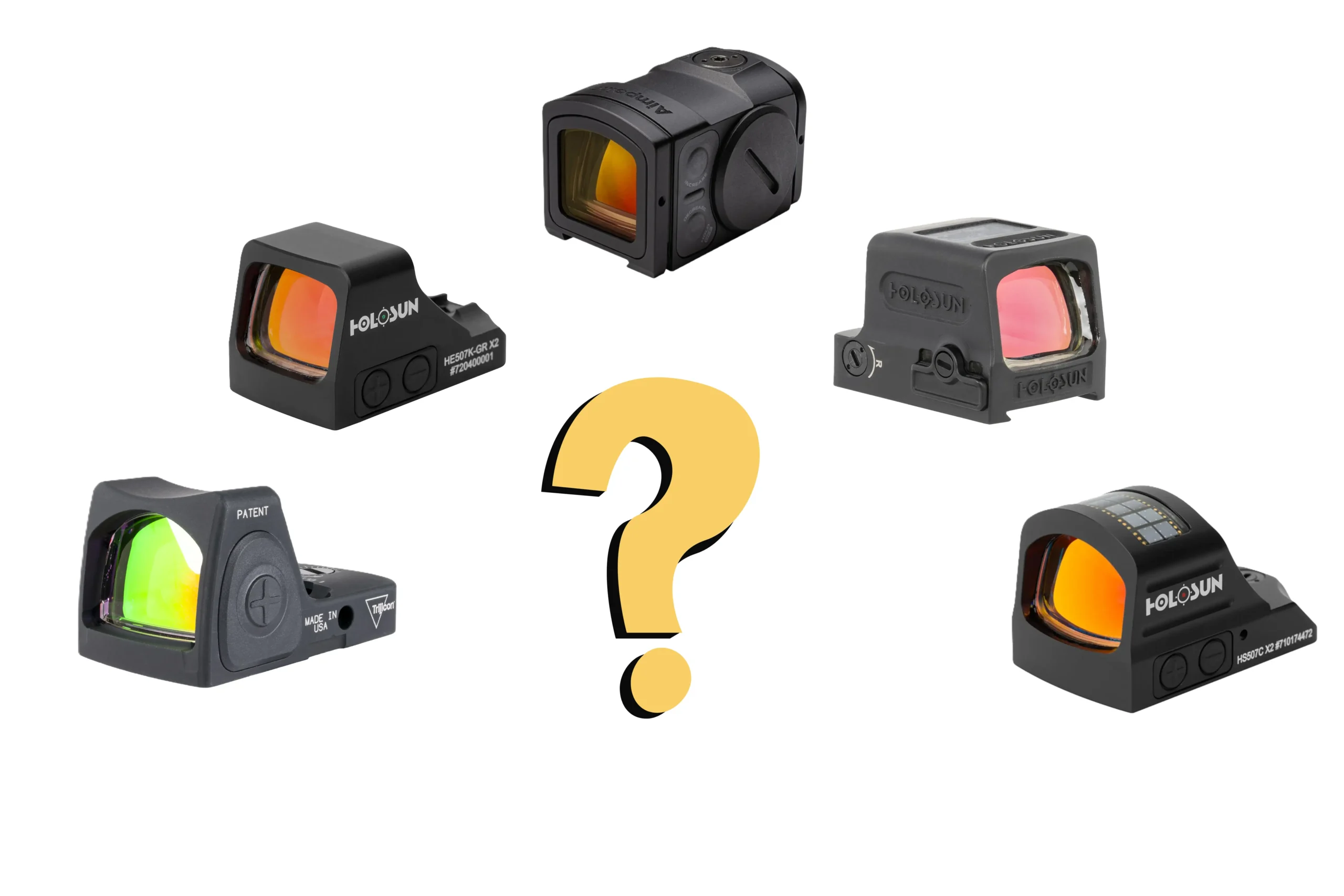
Holosun’s EPS, short for “Enclosed Pistol Sight,” is sold as a reflex optic. Aimpoint also calls its enclosed Acro a red dot reflex sight.

The easy way to keep it straight: “reflex” tells you how the sight works, while “red dot” tells you what you see.

Are Holographic Sights Part of the Reflex Family?

Not really, even though people often lump them together. A holographic sight uses a laser and a recorded hologram to rebuild the reticle, rather than bouncing an LED dot off a coated lens.

The mix-up makes sense, since both show a glowing reticle in a window and neither one magnifies. For a full head-to-head, read our holographic sight vs red dot blog.

Is There Such a Thing as a Holographic Scope?

Not technically. “Scope” usually means a telescopic sight with magnifying lenses inside, and true holographic sights don’t have any.

If you want magnification, the real answer is a holographic sight with a flip-to-side magnifier behind it.

Only a few companies make true holographic sights. EOTech was the only one until Vortex joined in 2017, and DOT launched its EHS-1 in 2025.

Watch Out for “Holographic Reflex” Bargain Sights

Because so few companies make the real thing, true holographic sights cost considerably more than red dots. That means a cheap “holographic reflex” sight is almost always an ordinary LED reflex sight with a buzzword attached.

Be careful if you spot these red flags together:

  • “Holographic” and “reflex” in the same product name
  • A battery life claim in the tens of thousands of hours, since true holographic sights typically run about 600 to 1,500 hours
  • Several switchable reticles at a rock-bottom price
  • No known brand and no stated recoil rating

For a quick test, cover most of the window with a card. A true holographic sight still shows the full reticle through whatever glass is left.

Here’s a quick side-by-side cheat sheet:

Reflex SightHolographic SightPrism Sight
How the reticle is madeLight (usually LED) bounced off a coated lensA laser rebuilds a hologramEtched into a glass prism
MagnificationNone (1x)None (1x)Usually fixed, 1x–5x
Eye reliefNearly unlimitedNearly unlimitedLimited
If the power diesDot goes out (except battery-free models)Reticle goes outEtched reticle stays visible
Often mislabeled as“Red dot”“Holographic scope““Prism red dot”

One Principle, Four Packages

The reflex principle never changes, but the housing, window size, and mount change with the gun it’s built for.

PackageTypical GunBuilt ForLearn More
Open micro reflexPistols, concealed carrySmallest, lightest profileMicro Red Dot Sights
Enclosed micro reflexDuty and carry pistolsSealed emitter that blocks rain, lint, and dirtOpen vs Closed Emitter
Full-size open reflex (like the Holosun HS510C)AR-15s, shotgunsBig window, wide viewAR Sights Explained
Tube-style reflexRifles, shotgunsTough sealed body, magnifier-friendlyRed Dot Types

5 Hands-On Checks Before You Buy a Reflex Sight

These five checks show you how a sight really performs. Always run them with the sight off the gun or with an unloaded firearm pointed in a safe direction.

1. The Head-Wiggle Test

Rest the sight on something steady and put the dot on a fixed point 15 to 25 yards away. Then, slowly move your head around the window.

A little dot movement up close is normal on every reflex sight. Watch instead for warping or a fishbowl look near the edges, which points to lower-grade glass.

2. The White-Wall Tint Test

Look through the window at a plain white wall, then compare it to what you see with the naked eye. Ask yourself if that color shift would bother you, especially if you hunt in low light.

3. The Both-Eyes-Open Test

Raise the gun with both eyes open and focus on the target, not the dot. The dot should pop onto the target without you searching for it.

If you keep closing one eye, check which eye is dominant. A bigger window also helps on the draw, but it adds size.

4. The Phone-Camera Astigmatism Check

Snap a photo of the dot through the window at medium-high brightness. If the dot looks round in the photo but blurry to you, the problem is your vision, not the sight.

It can save you from returning a perfectly good optic. Our red dot astigmatism guide walks you through the best fixes.

5. The Full-Sun Brightness Test

On a bright day, turn the brightness all the way up and aim at a bright background. The dot should stay easy to see.

A little bloom at max brightness is normal, but a dot that washes out completely is a warning sign. Our brightness settings guide helps you dial it in afterward.

Is a Reflex Sight Right for You?

A reflex sight is usually the right pick if:

  • You want the fastest 1x aiming for home defense, competition, or range days.
  • You care about long battery life and a lightweight design.
  • You shoot a pistol, since holographic optics are generally too bulky for slides.

A holographic sight may suit you better if you run a rifle with a magnifier, since its very fine center dot stays precise when magnified. Some shooters with mild astigmatism also find its reticle looks cleaner.

A prism sight may be the better choice if your astigmatism is stronger or you want a reticle that still works with no power at all.

Reflex Sight FAQs

Can a reflex sight be used at 100 yards?

Yes, especially on a rifle. The U.S. military’s M68 red dot lets soldiers engage targets out to 300 meters.

Do reflex sights magnify?

No, true reflex sights are 1x. If an optic magnifies, it’s a scope, a prism sight, or a reflex sight paired with a magnifier.

Do reflex sights work with night vision?

Many do, as long as they have night-vision brightness settings. Aimpoint’s Acro P-2, for example, has four.

Why does my dot disappear when I tilt my head?

You’ve moved outside the area where the dot is visible. “Unlimited eye relief” refers to distance from the sight, not extreme angles, so check your mount height and cheek weld.

Conclusion

A reflex sight puts a dot on your target by bouncing light, usually from an LED, off a coated lens. That’s why nearly every red dot counts as one, while holographic sights rely on a laser and a hologram instead.

Ready to upgrade your setup? Browse Gold Trigger’s red dot sight collection to compare top brands and find the right fit for your gun.

Disclaimer: This article is for general education only, not professional, legal, or safety advice. Always treat every firearm as loaded, confirm it’s unloaded before working on any optic, follow the maker’s instructions, and never point a firearm at anything you aren’t willing to destroy. Firearm, optic, and hunting laws vary by location, so know and follow yours. Gold Trigger assumes no liability for the use or misuse of this information.

Comments

Leave a Reply

Your email address will not be published. Required fields are marked *

Reflex Sights: The Optic Behind Nearly Every Red Dot

Reflex Sights: The Optic Behind Nearly Every Red Dot

Reading time: 8 mins

A reflex sight is a non-magnifying optic that bounces light, usually from a tiny LED, off a specially coated lens. The result is a glowing dot that seems to sit right on your target while you keep both eyes open.

If you own a red dot, you almost certainly already own a reflex sight. Still, labels like “holographic” and even “holographic scope” get slapped on look-alike products, which can make shopping confusing.

In this blog, you’ll learn how reflex sights work, what each name really means, and five quick checks to run before you buy.

Highlights

  • A reflex sight bounces light off a coated lens to put a dot on your target.
  • Nearly every red dot on the market runs on the reflex principle.
  • Holographic optics use a laser and a hologram instead.
  • The blue or green tint in your lens comes from the same coating that creates the dot.

What Is a Reflex Sight? (The Short Answer)

A reflex sight, also called a reflector sight, pairs a light source with a partly see-through mirror. Together, they create an aiming dot that appears right on your target.

Every true reflex sight shares three traits:

  • No magnification: It’s a 1x sight, so your target looks just as big as it does to your bare eye.
  • Both-eyes-open shooting: You keep your full view of what’s happening around you.
  • One focal plane: You only line up the dot and the target, instead of juggling rear and front sights like with iron sights.

The name comes from “reflector,” since the lens reflects the dot back toward your eye. It has nothing to do with how fast your reflexes are.

Irish telescope maker Howard Grubb invented the reflector sight and patented it in 1900.

In 1975, Aimpoint released the first LED red dot reflector sight. The optics haven’t changed much since then, but the electronics have, and some sights now run for years on a single battery.

How a Reflex Sight Works Inside the Glass

Three parts do all the work: a light, a coated lens, and a carefully shaped curve. Here’s how they team up.

The Emitter: Where the Dot Is Born

Inside the housing sits a tiny light called the emitter. In most sights, it’s an LED that shines back onto the lens, not out toward your target.

Not every reflex sight needs a battery, though. Trijicon‘s Dual-Illuminated RMR models light the dot with fiber optics and tritium instead.

Because nothing from the emitter reaches your target, a reflex sight works nothing like a laser sight. Some sights still leak a faint glow out the front, which is why premium makers advertise a low “forward signature.”

The Coated Lens: A Mirror You Can See Through

The lens has a slight curve and a special coating. That coating reflects most of the LED’s color back to you while letting most other light pass through.

Picture a shop window: you see your reflection and the store behind it. That’s the “reflex” in reflex sight.

Why the Dot Seems to Float on the Target

The curve sends the dot’s light back to your eye in nearly parallel rays. As a result, your eye treats the dot as if it’s far away, out where your target is.

So you can focus on the target and still see a sharp dot. It’s also why a small head movement barely shifts the dot at normal distances.

Just keep in mind that “parallax-free” is partly a sales term. The military’s Aimpoint CompM2 is parallax-free at about 50 yards, but up close, the error can equal the radius of its window.

Why Your Lens Looks Blue, Green, or Gold

The coating that bounces red light back to you also blocks some red light from the scene, which tints your view blue.

Green-dot and gold-dot sights use coatings matched to their own colors, so their tints look different. A stronger coating gives you a brighter dot, but it also adds more tint.

For range shooting, a light tint barely matters. For hunters at dawn or dusk, it can matter, because the tint reduces the light reaching your eye.

Holographic optics skip this coating entirely. That lets their windows let more light through than a reflex lens.

Sorting Out the Names: Reflex, Red Dot, and Holographic

With the glass explained, the labels get much easier to sort out.

Is Every Red Dot Sight a Reflex Sight?

For practical purposes, yes. Red dots are considered a type of reflex sight, whether they’re open, enclosed, or tube-style.

Some websites say “red dot” means a tube sight and “reflex” means an open one, but brands don’t follow that rule.

Holosun’s EPS, short for “Enclosed Pistol Sight,” is sold as a reflex optic. Aimpoint also calls its enclosed Acro a red dot reflex sight.

The easy way to keep it straight: “reflex” tells you how the sight works, while “red dot” tells you what you see.

Are Holographic Sights Part of the Reflex Family?

Not really, even though people often lump them together. A holographic sight uses a laser and a recorded hologram to rebuild the reticle, rather than bouncing an LED dot off a coated lens.

The mix-up makes sense, since both show a glowing reticle in a window and neither one magnifies. For a full head-to-head, read our holographic sight vs red dot blog.

Is There Such a Thing as a Holographic Scope?

Not technically. “Scope” usually means a telescopic sight with magnifying lenses inside, and true holographic sights don’t have any.

If you want magnification, the real answer is a holographic sight with a flip-to-side magnifier behind it.

Only a few companies make true holographic sights. EOTech was the only one until Vortex joined in 2017, and DOT launched its EHS-1 in 2025.

Watch Out for “Holographic Reflex” Bargain Sights

Because so few companies make the real thing, true holographic sights cost considerably more than red dots. That means a cheap “holographic reflex” sight is almost always an ordinary LED reflex sight with a buzzword attached.

Be careful if you spot these red flags together:

  • “Holographic” and “reflex” in the same product name
  • A battery life claim in the tens of thousands of hours, since true holographic sights typically run about 600 to 1,500 hours
  • Several switchable reticles at a rock-bottom price
  • No known brand and no stated recoil rating

For a quick test, cover most of the window with a card. A true holographic sight still shows the full reticle through whatever glass is left.

Here’s a quick side-by-side cheat sheet:

Reflex SightHolographic SightPrism Sight
How the reticle is madeLight (usually LED) bounced off a coated lensA laser rebuilds a hologramEtched into a glass prism
MagnificationNone (1x)None (1x)Usually fixed, 1x–5x
Eye reliefNearly unlimitedNearly unlimitedLimited
If the power diesDot goes out (except battery-free models)Reticle goes outEtched reticle stays visible
Often mislabeled as“Red dot”“Holographic scope““Prism red dot”

One Principle, Four Packages

The reflex principle never changes, but the housing, window size, and mount change with the gun it’s built for.

PackageTypical GunBuilt ForLearn More
Open micro reflexPistols, concealed carrySmallest, lightest profileMicro Red Dot Sights
Enclosed micro reflexDuty and carry pistolsSealed emitter that blocks rain, lint, and dirtOpen vs Closed Emitter
Full-size open reflex (like the Holosun HS510C)AR-15s, shotgunsBig window, wide viewAR Sights Explained
Tube-style reflexRifles, shotgunsTough sealed body, magnifier-friendlyRed Dot Types

5 Hands-On Checks Before You Buy a Reflex Sight

These five checks show you how a sight really performs. Always run them with the sight off the gun or with an unloaded firearm pointed in a safe direction.

1. The Head-Wiggle Test

Rest the sight on something steady and put the dot on a fixed point 15 to 25 yards away. Then, slowly move your head around the window.

A little dot movement up close is normal on every reflex sight. Watch instead for warping or a fishbowl look near the edges, which points to lower-grade glass.

2. The White-Wall Tint Test

Look through the window at a plain white wall, then compare it to what you see with the naked eye. Ask yourself if that color shift would bother you, especially if you hunt in low light.

3. The Both-Eyes-Open Test

Raise the gun with both eyes open and focus on the target, not the dot. The dot should pop onto the target without you searching for it.

If you keep closing one eye, check which eye is dominant. A bigger window also helps on the draw, but it adds size.

4. The Phone-Camera Astigmatism Check

Snap a photo of the dot through the window at medium-high brightness. If the dot looks round in the photo but blurry to you, the problem is your vision, not the sight.

It can save you from returning a perfectly good optic. Our red dot astigmatism guide walks you through the best fixes.

5. The Full-Sun Brightness Test

On a bright day, turn the brightness all the way up and aim at a bright background. The dot should stay easy to see.

A little bloom at max brightness is normal, but a dot that washes out completely is a warning sign. Our brightness settings guide helps you dial it in afterward.

Is a Reflex Sight Right for You?

A reflex sight is usually the right pick if:

  • You want the fastest 1x aiming for home defense, competition, or range days.
  • You care about long battery life and a lightweight design.
  • You shoot a pistol, since holographic optics are generally too bulky for slides.

A holographic sight may suit you better if you run a rifle with a magnifier, since its very fine center dot stays precise when magnified. Some shooters with mild astigmatism also find its reticle looks cleaner.

A prism sight may be the better choice if your astigmatism is stronger or you want a reticle that still works with no power at all.

Reflex Sight FAQs

Can a reflex sight be used at 100 yards?

Yes, especially on a rifle. The U.S. military’s M68 red dot lets soldiers engage targets out to 300 meters.

Do reflex sights magnify?

No, true reflex sights are 1x. If an optic magnifies, it’s a scope, a prism sight, or a reflex sight paired with a magnifier.

Do reflex sights work with night vision?

Many do, as long as they have night-vision brightness settings. Aimpoint’s Acro P-2, for example, has four.

Why does my dot disappear when I tilt my head?

You’ve moved outside the area where the dot is visible. “Unlimited eye relief” refers to distance from the sight, not extreme angles, so check your mount height and cheek weld.

Conclusion

A reflex sight puts a dot on your target by bouncing light, usually from an LED, off a coated lens. That’s why nearly every red dot counts as one, while holographic sights rely on a laser and a hologram instead.

Ready to upgrade your setup? Browse Gold Trigger’s red dot sight collection to compare top brands and find the right fit for your gun.

Disclaimer: This article is for general education only, not professional, legal, or safety advice. Always treat every firearm as loaded, confirm it’s unloaded before working on any optic, follow the maker’s instructions, and never point a firearm at anything you aren’t willing to destroy. Firearm, optic, and hunting laws vary by location, so know and follow yours. Gold Trigger assumes no liability for the use or misuse of this information.

Leave a Reply

Your email address will not be published. Required fields are marked *

Shopping cart0
There are no products in the cart!