



Holographic Sight vs Red Dot: Which Wins?
Published on: September 2, 2026
Reading time: 6 mins
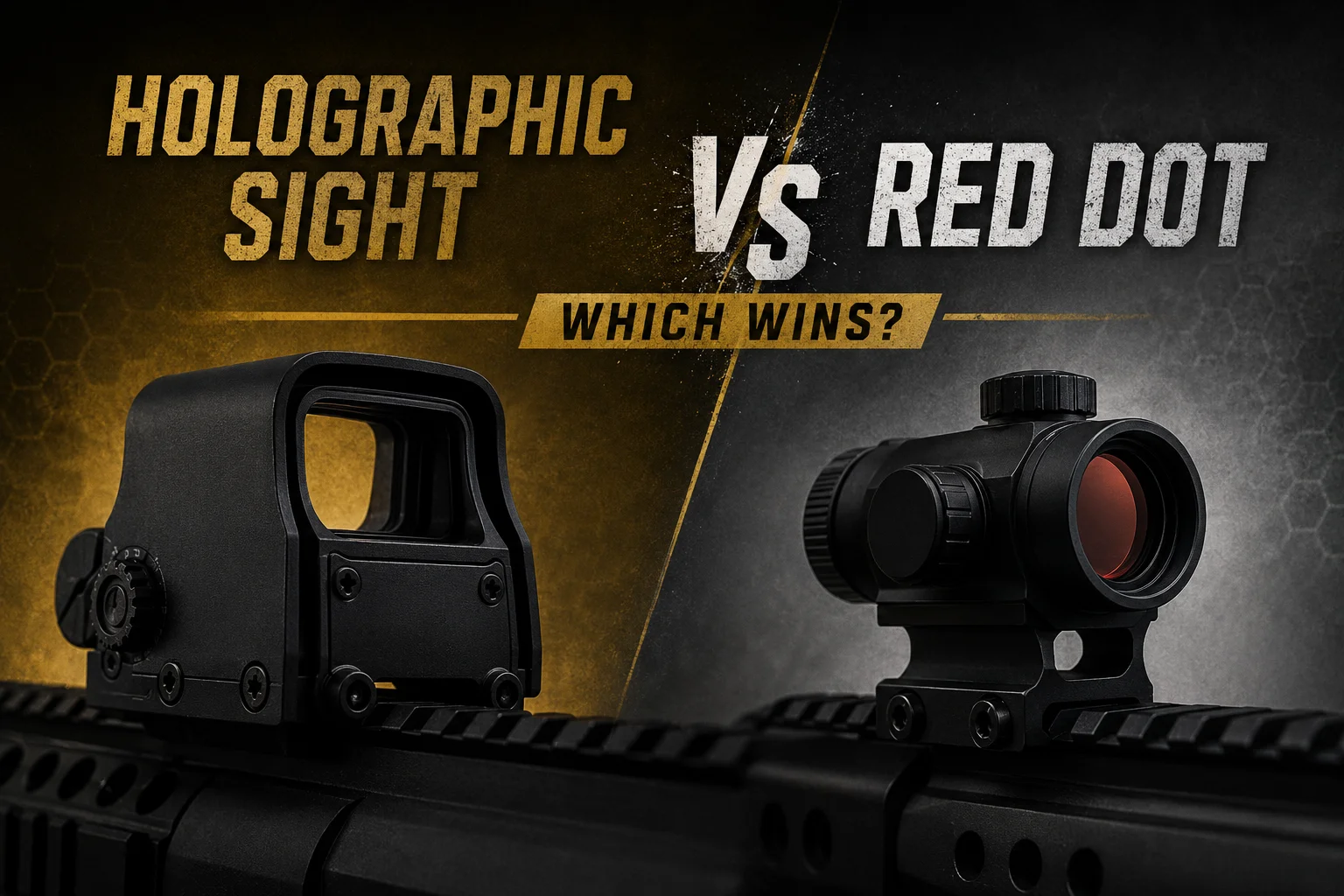
A red dot usually wins on price, weight, and battery life, while a holographic sight usually wins on low-light clarity and magnifier pairing. Which one is “better” depends on what you’re using it for.
Let’s break down exactly why, so you can pick the right one for your rifle.
Highlights
- A red dot can run for years on one battery, while a holographic sight often needs a fresh one every few weeks of heavy use.
- Holographic sights use lasers and mirrors instead of a simple LED, a big reason they cost more.
- A magnifier won’t make a holographic reticle grow with your target, but a red dot’s reticle can look bigger.
- Your best pick comes down to your use case, not which sight sounds cooler.
The Quick Verdict on Holographic Sight vs Red Dot
Here’s the fast breakdown before we go deeper.
- Price: Red dots start around $50. Holographic sights usually start around $450 and can climb past $800.
- Battery life: Red dots can run for years. Holographic sights typically run for weeks to a few months of steady use.
- Weight: Red dots are lighter, often by several ounces once mounted.
- Low light: Holographic sights are generally seen as stronger here, though this isn’t true for every model.
- Magnifiers: Holographic reticles stay the same size when magnified. Red dot reticles can appear larger.
- Best for: Red dots suit everyday range use and home defense. Holographic sights suit magnifier setups and low-light-heavy roles.
This holographic sight vs red dot comparison isn’t about crowning one winner. It’s about matching the sight to the job you actually need it for.
How Each Sight Actually Works
Before you compare specs, it helps to know what’s actually happening inside each optic.
How a Red Dot Sight Works
A red dot sight uses a small LED to shine a dot onto a curved, coated lens, which reflects it back to your eye. This simple design is a big reason it sips so little battery power.
Red dots get marketed as “parallax-free,” which is a slight simplification. They’re only truly parallax-free at very long range, but keeping the dot centered in the window keeps any close-range error small enough that it doesn’t matter in practice.
The dot’s size is measured in MOA, or minutes of angle. One MOA works out to a little over an inch at 100 yards, so a smaller MOA number gives you a smaller, more precise dot.
How a Holographic Sight Works
A holographic sight works differently. It uses a laser diode and mirrors to record a hologram of the reticle onto glass, which is why the reticle looks like it’s floating in front of you instead of reflecting off the lens.
This process stays close to fully parallax-free at real shooting distances. That’s a big part of why special operations units still favor it for fast, off-center shooting.
The tradeoff is power. Generating a hologram takes more energy than lighting a single LED, which is why battery life takes a hit.
Red Dot vs Holographic Sight: A Head-to-Head Comparison
Now let’s get into the details that actually affect your buying decision.
Price and Value
Entry-level red dots run about $50 to $150, an easy first optic for most budgets.
Holographic sights sit in a different bracket, with well-known models commonly priced between $450 and $800 or more.
Battery Life
This is where the gap is bigger than most buyers expect. Many red dots are rated for around 50,000 hours, roughly five years on a single battery.
Holographic sights tell a different story. They’re often rated between 600 and 2,500 hours instead, meaning far more frequent swaps if you shoot often.
If you want a “set it and forget it” optic, battery life should weigh heavily in your decision.
Durability and Reliability
Both sight types are built to take a beating, but “military-grade” doesn’t always mean the same thing across brands and models.
Some holographic sights have had documented issues with shifting zero in extreme heat or cold, so tough conditions aren’t automatically a given just because a sight looks rugged.
That doesn’t mean every holographic sight is unreliable today, since manufacturers have made real improvements over the years. It just means “holographic sights are always tougher” isn’t a fair blanket claim, so it’s worth checking current reviews and specs before you trust either type in harsh conditions.
Low-Light Performance
Holographic sights are generally seen as clearer in dim conditions, since the reticle stays sharp rather than relying on a reflected dot.
That said, it isn’t universal. Some high-end red dots hold up just as well after dark.
Weight and Rifle Balance
A compact red dot with its mount can weigh well under five ounces. A full-size holographic sight can weigh more than double that once mounted.
That difference slows down how fast you can swing from target to target.
Magnifier Compatibility
Here’s a detail most buyers miss. Pair a magnifier with a holographic sight, and only your target grows larger, since the reticle is a hologram recorded independently of any magnification behind it.
Pair a magnifier with a standard red dot, and the dot can appear to grow along with your target. For precision-focused setups, that’s a real factor worth knowing before you buy.
Which One Should You Choose?
There’s no universal winner here. It comes down to your rifle, your budget, and how you actually plan to use it.
Pick a Red Dot If…
- You want a lightweight, budget-friendly optic
- You’re building your first AR-15 or home-defense rifle
- You want years of battery life without thinking about it
- You mostly shoot at the range or for casual practice
Pick a Holographic Sight If…
- You’re pairing your rifle with a magnifier
- Low-light performance is a top priority for you
- You want a wider reticle window for fast target acquisition
- You’re comfortable with more frequent battery changes and a higher price tag
If a red dot sounds like your answer, you might want to research which red dot sight best suits your needs.
Holographic vs Red Dot Sight Myths, Busted
A few claims get repeated so often that people assume they’re fact.
- Myth: Holographic sights are always more accurate. Accuracy comes down to your zero and skill, not the sight category, so a well-zeroed red dot can be just as accurate as a well-zeroed holographic sight.
- Myth: Red dots can’t be used with night vision. Many modern red dots, including several Aimpoint models, include dedicated night-vision brightness settings built right in.
- Myth: A higher price always means better performance. It usually just buys more features, like NV compatibility or a magnifier-friendly reticle, not automatically “better for you.”
Frequently Asked Questions
Is a holographic sight better than a red dot for home defense?
Not necessarily. A red dot’s long battery life and lighter weight make it a practical, low-maintenance choice for a rifle you might not touch for months at a time.
Do holographic sights drain batteries faster than red dots?
Yes, typically. The laser-and-mirror design uses more power than a red dot’s single LED, so expect shorter runtimes.
Can I use a magnifier behind a red dot the same way as a holographic sight?
You can, but the dot may appear to grow with your target, unlike a holographic reticle, which stays the same size.
Is a holographic sight worth it for hunting?
Usually not the first pick. Holographic sights were built mainly for tactical and close-quarters use, and their price and battery demands rarely make sense for a hunting rifle.
Which sight is better in bright daylight?
Both perform well in daylight. The bigger differences show up in low light, battery life, and price, not daytime brightness.
Conclusion
There’s no single “best” sight in a red dot vs holographic sight matchup. Red dots win on price, weight, and battery life, while holographic sights offer real advantages in low light and with a magnifier.
Your rifle’s job should drive this decision more than brand hype. A home-defense gun that sits loaded for months calls for different priorities than a duty rifle used daily in changing conditions.
Whichever direction you lean, Gold Trigger carries a selection of red dot sights and optics built for real-world use. Browse our red dot sight collection to find the optic that fits your shooting style.
You can also call us at 713-485-5773.
Disclaimer: This article is for informational purposes only and doesn’t constitute professional, legal, or safety advice. Always follow all applicable local, state, and federal firearms laws, and use any optic strictly according to the manufacturer’s instructions and proper firearm safety practices. Pricing, battery life, and weight figures are approximate, based on publicly available data at the time of writing, and are subject to change by manufacturers, so always verify current specs before purchasing.
Comments