Holosun vs Trijicon: Which Red Dot Brand Wins in 2026?

Published on: August 19, 2026
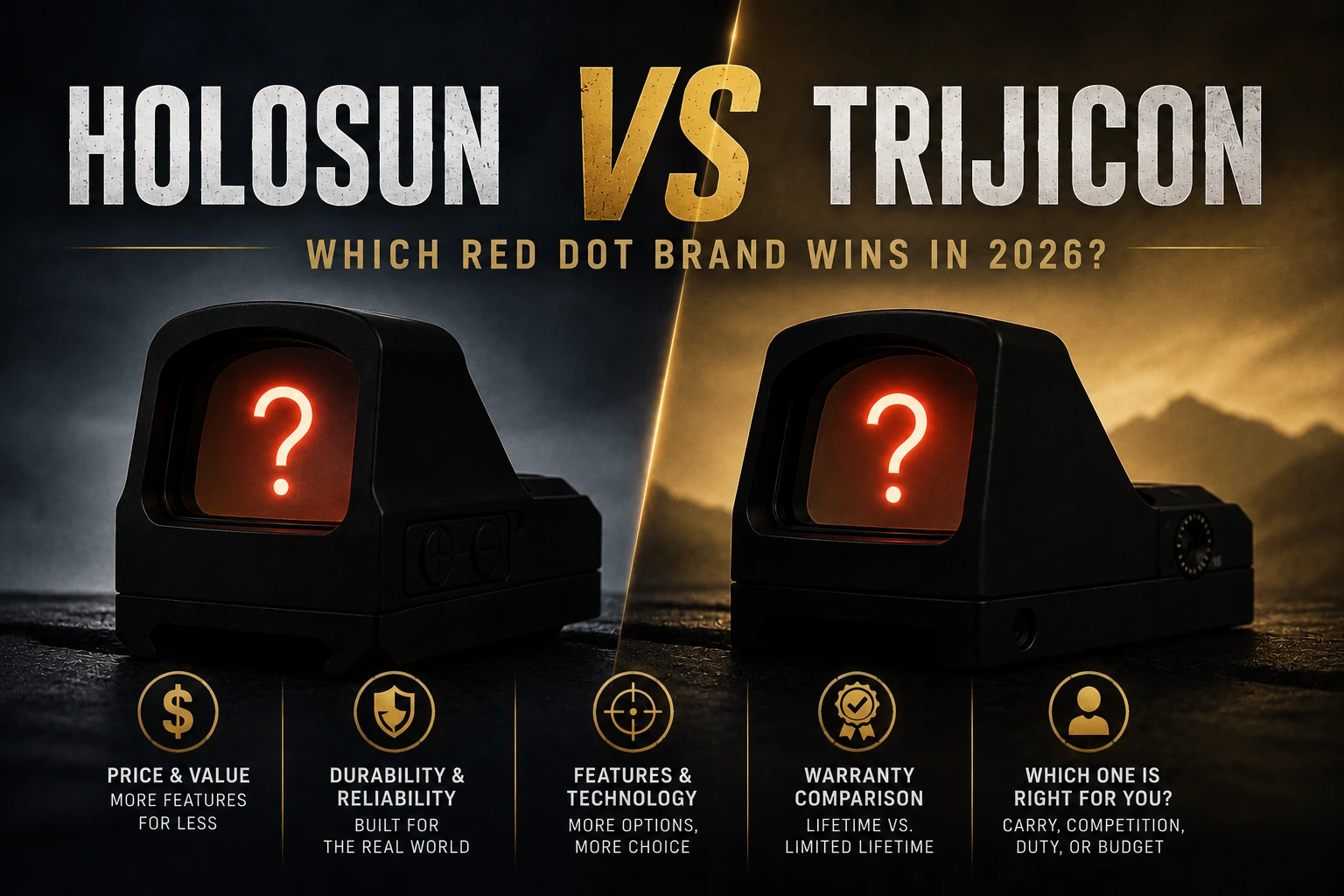
Holosun vs Trijicon red dot sight comparison with silhouetted optics and question marks

Reading time: 9 mins

If you’re stuck picking between a Holosun vs Trijicon red dot, here’s the short version: Holosun packs in more features for less money. Trijicon costs more, but it’s backed by decades of proven, hard-use reliability.

That’s the honest one-line answer. It still doesn’t tell you which brand actually fits your gun, your budget, or how you plan to use it.

Most articles either pit one single model against another, or bury the real brand-level answer inside a giant “top 10 optics” list. This guide skips all that and gives you the direct comparison you came here for.

If you already know which specific models you’re cross-shopping, you’ll find links to our deeper model reviews sprinkled throughout this guide.

Are you looking for a HOLOSUN Red Dot Sight?

Gold Trigger offers a selection of Holosun Red Dot Sights at competitive pricing!

Highlights

  • Holosun wins on price and features; Trijicon wins on proven, hard-use reliability.
  • Trijicon builds its red dots in the USA; Holosun designs in California but manufactures in China.
  • The U.S. Special Operations Command chose the Trijicon RMR Type 2 for handgun duty use in 2018.
  • Holosun’s warranty covers the housing and glass for life, with the LED covered for 10 years.
  • Your best pick comes down to how you’ll actually use the optic: carry, competition, duty, or budget.

Holosun vs Trijicon Red Dot Sight at a Glance

Here’s the quick side-by-side before we dig into the details. This is the part you can screenshot and send to your range buddy.

HolosunTrijicon
Founded20131981
Design/HQ locationWalnut/City of Industry, CaliforniaWixom, Michigan
ManufacturingPrimarily ChinaPrimarily Michigan and California, USA
Typical price range$180–$450$420–$1,020
WarrantyLifetime on housing/glass, 10 years on LEDLimited lifetime, with specific terms by component
Signature featureMulti-Reticle System, Shake Awake, solar backupPatented impact-deflecting housing

If you only remember one line from this table, remember this: Holosun packs in more tech for less cash, and Trijicon leans on decades of proven toughness.

Company Background: Who Are Holosun and Trijicon, Really?

Knowing where each brand came from actually explains a lot about why they’re priced and built the way they are today.

Trijicon’s Origin and Reputation

Trijicon has been building sighting systems since 1981, and it’s still headquartered in Wixom, Michigan. The company built its name on tritium night sights and the ACOG rifle scope long before it ever made a pistol red dot.

The RMR wasn’t even designed for pistols at first. Trijicon built it in 2009 as a fast, close-quarters companion for rifles running an ACOG, tough enough to survive being dropped off a carbine from height. Shooters later figured out it worked just as well bolted straight onto a pistol slide, and that discovery is basically what kicked off the entire pistol red dot craze.

That reputation for toughness isn’t just marketing talk, either. The RMR footprint uses a patented housing shape specifically designed to divert impact force away from the lens, which is a big reason it became the go-to choice for hard use.

That track record paid off in a big way in 2018, when the U.S. Special Operations Command selected the Trijicon RMR Type 2 as its official handgun reflex sight. That’s about as strong an endorsement as a pistol optic can get.

Holosun’s Origin and Rapid Rise

Holosun is a much younger company, entering the market in 2013. Its design and sales team is based in California, though the actual optics are manufactured overseas in China.

That manufacturing setup is often misunderstood. Being made overseas doesn’t automatically mean a product is low quality; it just means Holosun can pack in more features at a lower price point than a fully domestic manufacturer usually can.

Holosun’s real strength isn’t patented technology. It’s speed. The brand built its name by rolling out features fast, like Shake Awake motion activation and solar backup, years before some competitors caught up.

Why This Matters to You

Here’s the simple version: Trijicon moves slowly and prices high because it’s protecting a decades-long reputation for surviving abuse. Holosun moves fast and prices low because it’s competing on features and value.

Neither approach is wrong; they’re just built for different priorities, and that difference shows up in everything below.

Price and Value: What Are You Actually Paying For?

Let’s talk numbers. Based on the pricing we track across the market, Holosun’s pistol optics typically land between $180 and $450 depending on the model. Trijicon runs noticeably higher, from around $420 up to just over $1,000 for enclosed-emitter models like the RCR and RMR HD.

So what does that extra Trijicon money buy you? Mostly proven glass quality, the patented housing design, and decades of institutional trust from military and law enforcement buyers. Every Trijicon product also goes through what the company calls its Science of Brilliant testing process, a rigorous internal quality standard applied across the entire lineup.

What does Holosun give you for less? Usually a multi-reticle system, solar backup, Shake Awake, and side-loading batteries—features that used to be reserved for premium optics only.

A word of caution on the “cheaper is worse” myth: it just doesn’t hold up like it used to. Holosun’s mid-tier models now include features that Trijicon’s current lineup doesn’t offer at any price point.

Durability and Reliability: The Core of the Debate

This is where most buyers get stuck, so let’s break it down honestly on both sides.

Trijicon’s Track Record

Trijicon’s reputation comes from real testing. The RMR Type 2 is rated waterproof to 20 meters, and its patented housing is built specifically to survive drops and impacts without cracking the lens.

Holosun’s Real-World Reliability

Holosun has closed a lot of ground here, especially with its newer X2 and K-series generations, which fixed several usability issues found in earlier models.

Warranty Comparison

Warranty terms are more nuanced than a flat “lifetime” claim on either side, so here’s exactly what you’re getting:

  • Holosun: lifetime coverage on the metal housing and glass for the original owner, with the LED illumination system covered for 10 years.
  • Trijicon: a limited lifetime warranty overall, with the RMR’s tritium lamp specifically covered for 15 years and its electronics covered for 5 years from the manufacture date.

Both brands split their coverage between the housing and the electronics rather than offering one flat number, so it’s worth reading the fine print before you assume “lifetime” means everything.

Feature Comparison: Which Pistol Optic Packs More Tech?

Holosun’s feature list is genuinely hard to beat at this price point on any pistol optic:

  • Multi-Reticle System, which lets you switch between a dot, a circle, or both
  • Shake Awake, which turns the optic on when it senses motion and off when it doesn’t
  • Solar failsafe backup power
  • Side-loading batteries, so you don’t have to remove the optic to swap one
  • A headline battery life claim of 50,000 hours on most models

Trijicon counters with simplicity. Fewer buttons and fewer features generally mean fewer things that can break, and its RMR Type 2 still runs up to 4 years on a single battery at mid-brightness.

Both brands also now offer astigmatism-friendly green-dot options, so that’s no longer a brand-specific advantage either way.

RMR Footprint and Mounting: Does It Even Matter?

Here’s some good news: this decision usually isn’t a mounting headache. Trijicon’s RMR design became the industry-standard mounting pattern in 2009, and roughly 20 other manufacturers have since adopted it, including most Holosun pistol optics.

That means most pistols cut for one brand’s RMR-pattern optic will accept the other, either directly or with a simple adapter plate.

If you want the full breakdown of footprints and which one fits your slide, our RMR vs RMSc guide covers that in detail.

Holosun vs Trijicon by Use Case

The right brand really depends on what you’re actually going to do with your pistol. Here’s how we’d break it down.

Everyday Concealed Carry

If you carry daily and want the best value, Holosun’s enclosed-emitter models are hard to beat. If you’d rather pay more for maximum simplicity and a longer track record, Trijicon is the safer bet.

Duty and Professional Use

For military and law enforcement buyers, Trijicon still holds the edge in official procurement, thanks largely to that 2018 USSOCOM contract.

Holosun is gaining real traction as a duty optic, too, though its adoption in that space is still smaller and more limited compared to Trijicon’s institutional track record.

Competition Shooting

Competitive shooters have genuinely embraced Holosun’s larger-window models, but Trijicon’s SRO still wins with plenty of serious competitors thanks to its glass clarity.

Budget-Conscious First-Time Buyers

If this is your first pistol optic, Holosun is the practical, no-shame entry point in 2026. Budget doesn’t mean compromised anymore.

Our Holosun 507C X2 review and Holosun 407COMP guide are great places to start comparing specific models.

Common Myths, Debunked

  • “Holosun is just a cheap Trijicon clone.” Not accurate. Holosun’s edge isn’t copying Trijicon; it’s shipping features like Shake Awake and multi-reticle systems faster than legacy brands can.
  • “Trijicon glass is always way better.” True at the very top end, but overstated for most mid-tier comparisons. Testing and reviewer consensus show the gap has narrowed a lot.
  • “You can’t use Holosun for duty work.” Not true anymore, though adoption is still smaller and more limited than Trijicon’s decades-long track record with the military and police.

Frequently Asked Questions

Is Holosun as good as Trijicon?

For most everyday shooters, yes. Holosun’s mid-tier models now match or beat Trijicon on features. Trijicon still leads on proven, hard-use toughness and institutional trust.

Which brand has a better warranty?

Both offer strong lifetime coverage on the housing, but split their electronics coverage differently. Holosun covers the LED for 10 years, while Trijicon covers RMR electronics for 5 years and the tritium lamp for 15.

Can I put a Holosun on a Trijicon RMR-cut slide?

In most cases, yes. Most Holosun pistol optics share the RMR footprint, so they’ll fit directly or with a simple adapter plate.

Which brand should a first-time buyer choose?

If budget matters most, start with Holosun. If you want to buy once and never think about it again, Trijicon is worth the premium.

Conclusion

There’s no single winner in the Holosun vs Trijicon debate, and that’s the honest truth most articles won’t tell you upfront. Holosun gives you more tech for less money, while Trijicon gives you decades of proven, hard-use reliability that’s earned real military trust.

Your actual answer depends on what you’re using the optic for. Carry, competition, duty, and budget all point toward slightly different picks, so use the breakdown above to match your situation instead of just chasing the “popular” name.

If you’re looking for a red dot sight, Gold Trigger can help. Browse our red dot sight selection or call us at 713-485-5773.

Disclaimer: This article is for informational and educational purposes only and reflects publicly available product data, manufacturer specifications, and general reviewer consensus as of 2026. Product specifications, pricing, and availability are subject to change without notice, so always verify current specs directly with the manufacturer before purchasing. Firearm optics are safety-critical equipment; always follow manufacturer installation instructions, applicable firearm safety laws, and seek professional gunsmith assistance for mounting and zeroing if you’re unsure. Gold Trigger assumes no liability for equipment failure, misuse, or improper installation due to the use of this blog.

Comments

Leave a Reply

Your email address will not be published. Required fields are marked *

Holosun vs Trijicon: Which Red Dot Brand Wins in 2026?

Holosun vs Trijicon red dot sight comparison with silhouetted optics and question marks

Reading time: 9 mins

If you’re stuck picking between a Holosun vs Trijicon red dot, here’s the short version: Holosun packs in more features for less money. Trijicon costs more, but it’s backed by decades of proven, hard-use reliability.

That’s the honest one-line answer. It still doesn’t tell you which brand actually fits your gun, your budget, or how you plan to use it.

Most articles either pit one single model against another, or bury the real brand-level answer inside a giant “top 10 optics” list. This guide skips all that and gives you the direct comparison you came here for.

If you already know which specific models you’re cross-shopping, you’ll find links to our deeper model reviews sprinkled throughout this guide.

Are you looking for a HOLOSUN Red Dot Sight?

Gold Trigger offers a selection of Holosun Red Dot Sights at competitive pricing!

Highlights

  • Holosun wins on price and features; Trijicon wins on proven, hard-use reliability.
  • Trijicon builds its red dots in the USA; Holosun designs in California but manufactures in China.
  • The U.S. Special Operations Command chose the Trijicon RMR Type 2 for handgun duty use in 2018.
  • Holosun’s warranty covers the housing and glass for life, with the LED covered for 10 years.
  • Your best pick comes down to how you’ll actually use the optic: carry, competition, duty, or budget.

Holosun vs Trijicon Red Dot Sight at a Glance

Here’s the quick side-by-side before we dig into the details. This is the part you can screenshot and send to your range buddy.

HolosunTrijicon
Founded20131981
Design/HQ locationWalnut/City of Industry, CaliforniaWixom, Michigan
ManufacturingPrimarily ChinaPrimarily Michigan and California, USA
Typical price range$180–$450$420–$1,020
WarrantyLifetime on housing/glass, 10 years on LEDLimited lifetime, with specific terms by component
Signature featureMulti-Reticle System, Shake Awake, solar backupPatented impact-deflecting housing

If you only remember one line from this table, remember this: Holosun packs in more tech for less cash, and Trijicon leans on decades of proven toughness.

Company Background: Who Are Holosun and Trijicon, Really?

Knowing where each brand came from actually explains a lot about why they’re priced and built the way they are today.

Trijicon’s Origin and Reputation

Trijicon has been building sighting systems since 1981, and it’s still headquartered in Wixom, Michigan. The company built its name on tritium night sights and the ACOG rifle scope long before it ever made a pistol red dot.

The RMR wasn’t even designed for pistols at first. Trijicon built it in 2009 as a fast, close-quarters companion for rifles running an ACOG, tough enough to survive being dropped off a carbine from height. Shooters later figured out it worked just as well bolted straight onto a pistol slide, and that discovery is basically what kicked off the entire pistol red dot craze.

That reputation for toughness isn’t just marketing talk, either. The RMR footprint uses a patented housing shape specifically designed to divert impact force away from the lens, which is a big reason it became the go-to choice for hard use.

That track record paid off in a big way in 2018, when the U.S. Special Operations Command selected the Trijicon RMR Type 2 as its official handgun reflex sight. That’s about as strong an endorsement as a pistol optic can get.

Holosun’s Origin and Rapid Rise

Holosun is a much younger company, entering the market in 2013. Its design and sales team is based in California, though the actual optics are manufactured overseas in China.

That manufacturing setup is often misunderstood. Being made overseas doesn’t automatically mean a product is low quality; it just means Holosun can pack in more features at a lower price point than a fully domestic manufacturer usually can.

Holosun’s real strength isn’t patented technology. It’s speed. The brand built its name by rolling out features fast, like Shake Awake motion activation and solar backup, years before some competitors caught up.

Why This Matters to You

Here’s the simple version: Trijicon moves slowly and prices high because it’s protecting a decades-long reputation for surviving abuse. Holosun moves fast and prices low because it’s competing on features and value.

Neither approach is wrong; they’re just built for different priorities, and that difference shows up in everything below.

Price and Value: What Are You Actually Paying For?

Let’s talk numbers. Based on the pricing we track across the market, Holosun’s pistol optics typically land between $180 and $450 depending on the model. Trijicon runs noticeably higher, from around $420 up to just over $1,000 for enclosed-emitter models like the RCR and RMR HD.

So what does that extra Trijicon money buy you? Mostly proven glass quality, the patented housing design, and decades of institutional trust from military and law enforcement buyers. Every Trijicon product also goes through what the company calls its Science of Brilliant testing process, a rigorous internal quality standard applied across the entire lineup.

What does Holosun give you for less? Usually a multi-reticle system, solar backup, Shake Awake, and side-loading batteries—features that used to be reserved for premium optics only.

A word of caution on the “cheaper is worse” myth: it just doesn’t hold up like it used to. Holosun’s mid-tier models now include features that Trijicon’s current lineup doesn’t offer at any price point.

Durability and Reliability: The Core of the Debate

This is where most buyers get stuck, so let’s break it down honestly on both sides.

Trijicon’s Track Record

Trijicon’s reputation comes from real testing. The RMR Type 2 is rated waterproof to 20 meters, and its patented housing is built specifically to survive drops and impacts without cracking the lens.

Holosun’s Real-World Reliability

Holosun has closed a lot of ground here, especially with its newer X2 and K-series generations, which fixed several usability issues found in earlier models.

Warranty Comparison

Warranty terms are more nuanced than a flat “lifetime” claim on either side, so here’s exactly what you’re getting:

  • Holosun: lifetime coverage on the metal housing and glass for the original owner, with the LED illumination system covered for 10 years.
  • Trijicon: a limited lifetime warranty overall, with the RMR’s tritium lamp specifically covered for 15 years and its electronics covered for 5 years from the manufacture date.

Both brands split their coverage between the housing and the electronics rather than offering one flat number, so it’s worth reading the fine print before you assume “lifetime” means everything.

Feature Comparison: Which Pistol Optic Packs More Tech?

Holosun’s feature list is genuinely hard to beat at this price point on any pistol optic:

  • Multi-Reticle System, which lets you switch between a dot, a circle, or both
  • Shake Awake, which turns the optic on when it senses motion and off when it doesn’t
  • Solar failsafe backup power
  • Side-loading batteries, so you don’t have to remove the optic to swap one
  • A headline battery life claim of 50,000 hours on most models

Trijicon counters with simplicity. Fewer buttons and fewer features generally mean fewer things that can break, and its RMR Type 2 still runs up to 4 years on a single battery at mid-brightness.

Both brands also now offer astigmatism-friendly green-dot options, so that’s no longer a brand-specific advantage either way.

RMR Footprint and Mounting: Does It Even Matter?

Here’s some good news: this decision usually isn’t a mounting headache. Trijicon’s RMR design became the industry-standard mounting pattern in 2009, and roughly 20 other manufacturers have since adopted it, including most Holosun pistol optics.

That means most pistols cut for one brand’s RMR-pattern optic will accept the other, either directly or with a simple adapter plate.

If you want the full breakdown of footprints and which one fits your slide, our RMR vs RMSc guide covers that in detail.

Holosun vs Trijicon by Use Case

The right brand really depends on what you’re actually going to do with your pistol. Here’s how we’d break it down.

Everyday Concealed Carry

If you carry daily and want the best value, Holosun’s enclosed-emitter models are hard to beat. If you’d rather pay more for maximum simplicity and a longer track record, Trijicon is the safer bet.

Duty and Professional Use

For military and law enforcement buyers, Trijicon still holds the edge in official procurement, thanks largely to that 2018 USSOCOM contract.

Holosun is gaining real traction as a duty optic, too, though its adoption in that space is still smaller and more limited compared to Trijicon’s institutional track record.

Competition Shooting

Competitive shooters have genuinely embraced Holosun’s larger-window models, but Trijicon’s SRO still wins with plenty of serious competitors thanks to its glass clarity.

Budget-Conscious First-Time Buyers

If this is your first pistol optic, Holosun is the practical, no-shame entry point in 2026. Budget doesn’t mean compromised anymore.

Our Holosun 507C X2 review and Holosun 407COMP guide are great places to start comparing specific models.

Common Myths, Debunked

  • “Holosun is just a cheap Trijicon clone.” Not accurate. Holosun’s edge isn’t copying Trijicon; it’s shipping features like Shake Awake and multi-reticle systems faster than legacy brands can.
  • “Trijicon glass is always way better.” True at the very top end, but overstated for most mid-tier comparisons. Testing and reviewer consensus show the gap has narrowed a lot.
  • “You can’t use Holosun for duty work.” Not true anymore, though adoption is still smaller and more limited than Trijicon’s decades-long track record with the military and police.

Frequently Asked Questions

Is Holosun as good as Trijicon?

For most everyday shooters, yes. Holosun’s mid-tier models now match or beat Trijicon on features. Trijicon still leads on proven, hard-use toughness and institutional trust.

Which brand has a better warranty?

Both offer strong lifetime coverage on the housing, but split their electronics coverage differently. Holosun covers the LED for 10 years, while Trijicon covers RMR electronics for 5 years and the tritium lamp for 15.

Can I put a Holosun on a Trijicon RMR-cut slide?

In most cases, yes. Most Holosun pistol optics share the RMR footprint, so they’ll fit directly or with a simple adapter plate.

Which brand should a first-time buyer choose?

If budget matters most, start with Holosun. If you want to buy once and never think about it again, Trijicon is worth the premium.

Conclusion

There’s no single winner in the Holosun vs Trijicon debate, and that’s the honest truth most articles won’t tell you upfront. Holosun gives you more tech for less money, while Trijicon gives you decades of proven, hard-use reliability that’s earned real military trust.

Your actual answer depends on what you’re using the optic for. Carry, competition, duty, and budget all point toward slightly different picks, so use the breakdown above to match your situation instead of just chasing the “popular” name.

If you’re looking for a red dot sight, Gold Trigger can help. Browse our red dot sight selection or call us at 713-485-5773.

Disclaimer: This article is for informational and educational purposes only and reflects publicly available product data, manufacturer specifications, and general reviewer consensus as of 2026. Product specifications, pricing, and availability are subject to change without notice, so always verify current specs directly with the manufacturer before purchasing. Firearm optics are safety-critical equipment; always follow manufacturer installation instructions, applicable firearm safety laws, and seek professional gunsmith assistance for mounting and zeroing if you’re unsure. Gold Trigger assumes no liability for equipment failure, misuse, or improper installation due to the use of this blog.

Leave a Reply

Your email address will not be published. Required fields are marked *

Shopping cart0
There are no products in the cart!