



Red Dot Battery Life: How Long Do They Last?
Published on: August 10, 2026
Reading time: 6 mins
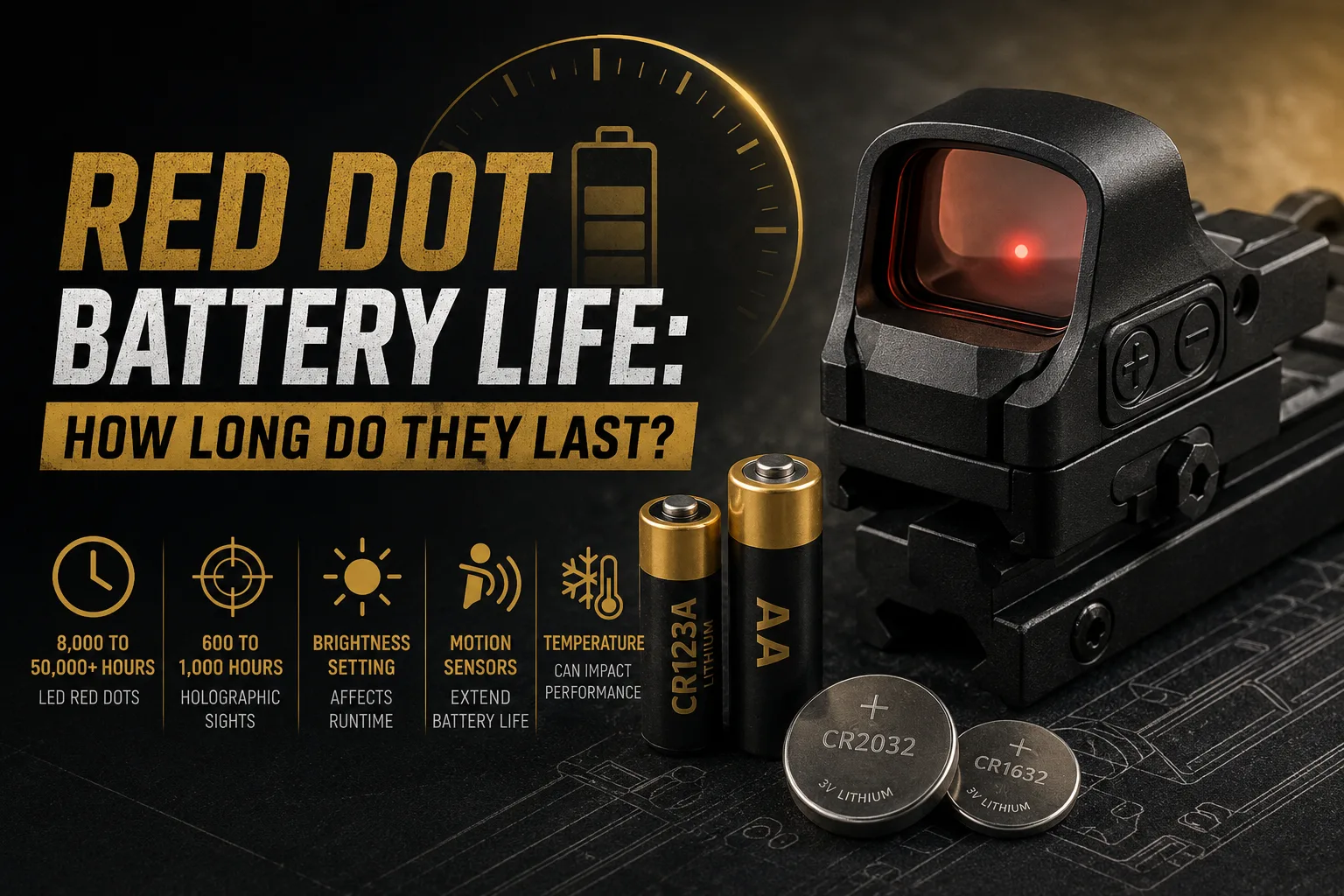
So, how long does red dot battery life really last? Most LED reflex sights are rated for 8,000 to 50,000+ hours on a moderate brightness setting, which works out to years of everyday use.
Holographic sights are thirstier. They typically run 600 to 1,000 hours, since their laser and mirror system needs more power than a simple LED.
Here’s the catch, though. The number on the box is a controlled lab result, not a guarantee for your gun.
Your real-world runtime depends on your brightness setting, your optic’s sensors, and even the weather. That’s how red dot sights work. Stick around, and you’ll learn exactly what drains a battery faster, how to estimate your own optic’s remaining life, and what to do the moment yours starts to fade.
Highlights
- LED red dots commonly last 8,000 to 50,000+ hours; holographic sights run closer to 600 to 1,000.
- Your brightness setting affects battery life more than almost anything else.
- CR2032 and CR1632 coin cells power most compact optics, while AA cells show up in some rifle sights.
- Cold weather can cause a temporary voltage dip, though it usually passes once the optic warms back up.
- A flickering or dimming dot is your cue to swap the battery before it fully dies.
Quick Answer: How Long Does a Red Dot Battery Last?
LED reflex sights on a pistol or rifle usually run one to four years of everyday use on a single coin cell, and some rated setups can stretch well past that.
Holographic sights run shorter, typically 600 to 1,000 hours. Leave one on nonstop at max brightness, and you’re looking at a few weeks, not months.
Solar-assisted optics add a small panel on top of the housing that shares the power load with the battery. This can meaningfully stretch your runtime in bright conditions, though the battery is still doing the heavy lifting indoors or at night.
The single biggest reason your mileage will vary from the box number? Your brightness setting. Turn that dial up, and you’ll burn through battery life noticeably faster than the rated hours suggest.
Why Red Dot Battery Life Varies So Much
Companies usually test their battery life claims under one specific brightness setting, in a controlled, room-temperature environment, with a fresh cell. That’s a useful benchmark, but it’s not the same as how you actually run your optic.
Here’s what really moves the needle:
- Brightness setting. Cranking your dot to full daylight brightness burns through power noticeably faster than a moderate setting does.
- LED vs. holographic tech. A single LED sips power. A holographic sight’s laser diode and mirror system drink it, since that setup needs more complex driving electronics to produce its reticle.
- Motion sensors. Shake-awake and auto-sleep features can multiply your effective battery life several times over, since your optic isn’t burning power while it sits in a safe.
- Temperature. Extreme cold can cause a temporary voltage dip in almost any battery chemistry, though performance usually bounces back once things warm up. Not every optic is built for the same temperature range, so check your specific model before you rely on it somewhere brutally cold.
- Battery quality and age. A name-brand lithium cell will simply outperform a bargain-bin one, and any battery loses a little capacity just sitting on a shelf.
Treat the rated number as a ceiling, not a promise. Your actual runtime will land somewhere below it, depending on how you use your optic.
Battery Life by Red Dot Type
Not every red dot sips power the same way, so here’s what to expect by category.
Pistol-mounted micro dots usually run on a CR1632 or CR2032 cell. Real-world reports put these anywhere from one to four years, depending on the brand and your brightness setting.
Rifle and AR reflex sights often use a bigger CR2032 or an AA battery, and these commonly claim 8,000 to 50,000+ rated hours. In practice, that plays out as several years of everyday use before you need a fresh cell.
Holographic sights trade battery life for a distinct sight picture. Expect 600 to 1,000 hours on a standard setup, though some newer models are rated up to 1,500 hours on a medium setting.
Solar-assisted optics blend a small solar panel with a standard battery, and manufacturers often advertise very high hour ratings for these models. Treat any specific solar number as a bonus on top of your base battery life rather than a guarantee, since real-world sunlight, angle, and use all affect how much that panel actually helps.
Battery Types and Sizes: What’s Powering Your Optic
Before you can plan around your red dot battery life, it helps to know what’s actually inside your optic.
- CR2032: The most common cell in compact optics, at about 20mm wide with roughly 225mAh of capacity.
- CR1632: A smaller cousin to the CR2032, at about 16mm wide with roughly 140mAh. You’ll find it in some ultra-compact pistol dots, and it needs more frequent swaps.
- AA: Used in a handful of rifle reflex sights. A lithium AA cell holds far more capacity than a coin cell, which is why AA-powered optics often claim the longest runtimes.
- CR123A: A common choice for holographic sights, since their laser diode needs more power than a coin cell can comfortably supply.
Where your battery sits matters, too. Some optics load from the bottom, which means pulling the sight off your gun and rechecking your zero. Others load from the side, so you can swap cells without touching your zero at all.
Either way, keep a spare of the exact cell type in your range bag. Loose batteries can short out against keys or metal objects in a pocket, so store spares in their original packaging or a small case, not loose in a bag.
How to Estimate Your Own Optic’s Remaining Battery Life
Guessing your red dot’s remaining battery life isn’t hard once you know what to check.
- Look up your model’s hours at your actual setting. Most manufacturers publish a full table of hours by brightness level, not just one headline number.
- Track your install date. Write it on a piece of tape on the optic, or set a reminder on your phone.
- Watch for a low-battery indicator. Some optics flash the reticle at low power, though this feature varies by brand and model.
- Do simple math. A sight rated for 50,000 hours at your setting, run eight hours a week, works out to well over 100 years of theoretical life. Real-world factors like standby drain and shelf life mean you’ll swap the battery long before that math ever runs out.
The easiest habit is replacing the battery on a fixed schedule, like once a year, instead of waiting for a failure at the worst possible time.
Signs Your Red Dot Battery Is Dying
Your optic usually gives you a warning before it quits completely. Watch for:
- A dimming dot that won’t get brighter, even at your highest setting.
- Flickering, especially right after a shot or under vibration.
- A slow or delayed wake-up from your motion sensor.
- A dot that won’t light up in the cold but works fine once it warms up.
If you notice any of these, swap in a spare right away. And if your optic needed to come off the gun for the swap, double-check your zero before you trust it again.
Tips to Maximize Your Red Dot’s Battery Life
A few small habits go a long way toward stretching your battery life:
- Run the lowest brightness setting that still gives you a clear, usable dot.
- Use auto-shutoff or motion-sensing features instead of leaving your optic on around the clock.
- Store spare batteries in a cool, dry spot, away from ammunition and other metal objects.
- Avoid leaving batteries in extreme heat or cold, like a hot car trunk or an unheated garage.
- Consider a solar-assisted optic if you want extra peace of mind on top of your regular battery.
Conclusion
Red dot battery life comes down to a handful of simple factors: your brightness setting, your optic’s technology, motion sensors, temperature, and battery quality. Once you understand those, the manufacturer’s rated hours make a lot more sense, and so does your own real-world experience.
Whether you’re running a pistol micro dot, a rifle reflex sight, or a holographic optic, the same habits apply. Keep your brightness reasonable, keep a spare battery on hand, and swap it out before it ever leaves you in the dark.
Looking for a red dot sight? Check out Gold Trigger’s lineup of red dot sights. You can also call us at 713-485-5773.
Disclaimer: This article is for general informational and educational purposes only and isn’t professional, legal, or safety advice. Battery life figures are estimates based on publicly available specifications and general field reports, and actual performance will vary by optic model, brightness setting, environmental conditions, and battery quality. Always check your specific red dot sight’s owner’s manual for the manufacturer’s recommended battery type, replacement interval, and maintenance steps. Optics used for personal defense, duty, or competition should be regularly inspected, function-tested, and zero-verified by you or a qualified professional. Never rely solely on this article when prepping an optic for self-defense, duty, or other high-stakes use. Gold Trigger isn’t liable for equipment failure, malfunction, or harm arising from reliance on this content.
Comments