
Types of Reticles Explained: Which One Fits You?

Published on: August 5, 2026
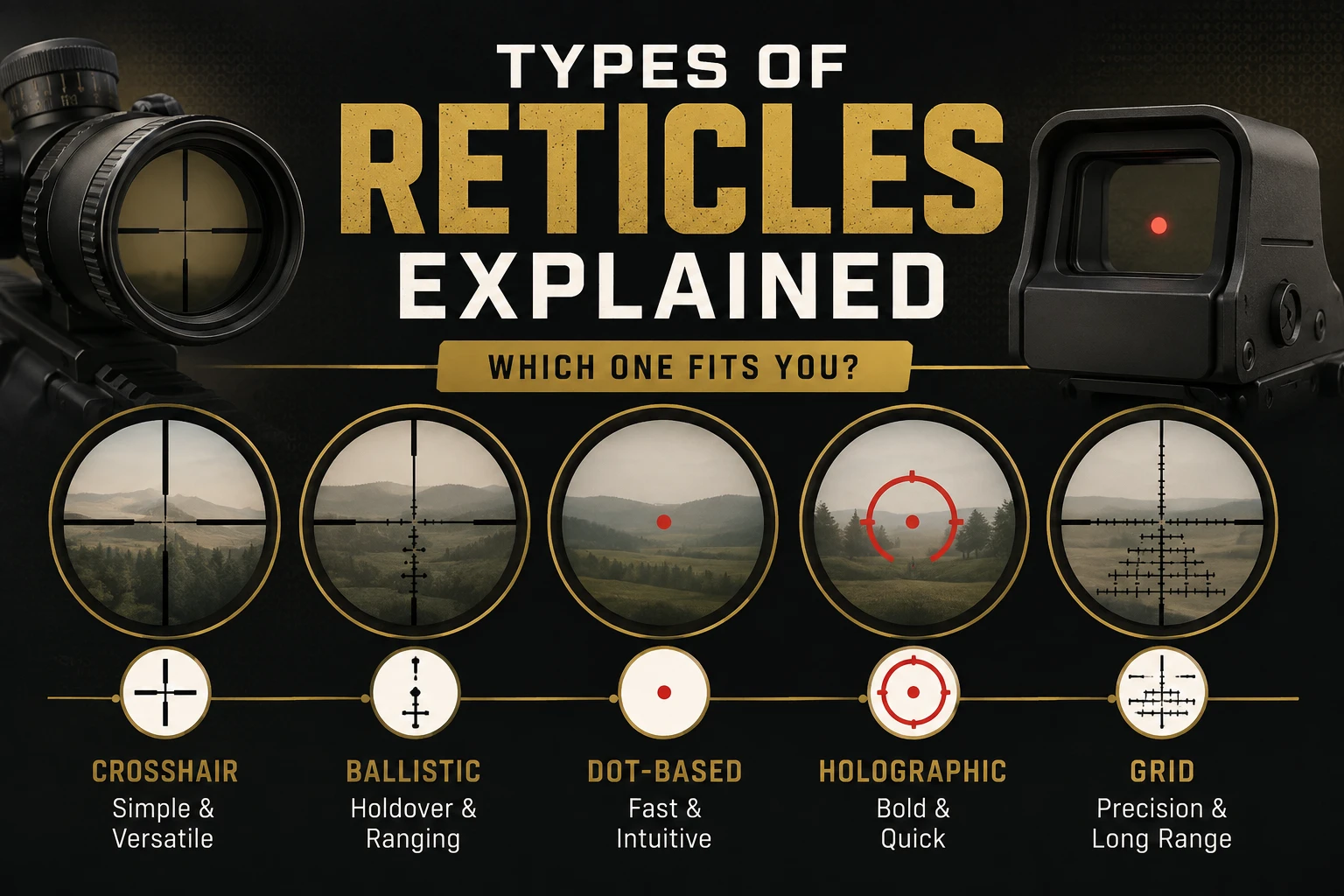
Comparison of common reticle types including crosshair, ballistic, dot-based, holographic, and grid reticles alongside a rifle scope and red dot sight.

Reading time: 8 mins

If you’ve ever looked through a scope or red dot and wondered why the aiming pattern looks the way it does, you’re really asking about types of reticles. It’s a common question to ask when wondering how red dot sights work.

This guide groups most reticles into five families—crosshair, ballistic, dot-based, holographic, and grid. Each one solves a different problem, whether that’s speed, precision, or built-in ranging.

Below, you’ll find every major type, a concept most guides skip, and a simple way to match a reticle to how you shoot.

Highlights

  • Reticles fall into five families: crosshair, ballistic, dot-based, holographic, and grid.
  • MOA and MRAD are measurement units, not reticle types.
  • FFP and SFP determine whether your holdover marks stay accurate as you zoom.
  • Red dots use their own reticle options, like dot, circle-dot, or switchable MRS.
  • The best reticle depends on your shooting discipline, not personal taste alone.

What Is a Reticle, and Why Does It Matter?

A reticle is the pattern you see through an optic—a crosshair, a dot, or a set of measuring marks, etched into glass, wrapped from wire, or projected by light. Its main job is simple: give your eye one fixed spot to aim at.

Some reticles do more than that, though. A good ranging reticle lets you estimate distance or hold over for bullet drop without touching your turrets, and the reticle you need depends on your optic, since a red dot uses different options than a magnified rifle scope. We’ll cover both below.

The Core Reticle Categories at a Glance

Before going deep, here’s a quick map of the whole family:

  • Crosshair-based—simple, general-purpose patterns like the duplex.
  • Ballistic—built-in holdover or ranging tools, like BDC and mil-dot.
  • Dot-based—dot, circle-dot, and switchable patterns on red dots and reflex sights.
  • Holographic—ring, dot, and chevron patterns from laser holography.
  • Grid (Christmas Tree)—a full grid of holdover points for long-range precision.

MOA and MRAD aren’t reticle types by themselves. They’re measurement units used inside ballistic reticles, and you’ll see them mentioned throughout this guide.

Traditional Crosshair-Based Reticles

Duplex Reticle

The duplex reticle is the classic pattern most people picture first. Its outer posts are thick, and they taper into a thin center.

The thick posts help your eye find the center fast, and the thin center crosshair keeps your aim precise. It’s a solid all-around choice for hunting and general use, though it has no built-in ranging or holdover marks.

A fine crosshair (or “plex”) reticle trims that design down further. Thinner lines cover less of your target, which is why benchrest and F-Class shooters often lean toward them.

German #4 Reticle

The German #4 reticle looks like a duplex that’s missing its top post. Three thick posts—left, right, and bottom—meet near the center, while the top stays open and thin.

That layout still holds up well against dark backgrounds, since three thick posts are plenty to catch your eye in low light. Just don’t confuse it with a duplex—the open top is what sets it apart.

Christmas Tree (Grid) Reticle

A grid reticle adds a full “tree” of holdover points below center, letting you hold for elevation and wind without touching your turrets.

Long-range and PRS shooters lean on this often, though it’s not universally loved—some competitive shooters actually prefer a cleaner reticle, since a busy grid can block your view of where a shot landed.

If you want less clutter, ask about simpler holdover reticles first.

Ranging and Ballistic Reticles

BDC Reticle

A BDC reticle (Bullet Drop Compensator) uses hash marks below the center crosshair, with each mark standing for a different distance. It’s a fast way to hold over without dialing a turret, but it’s only accurate for the exact load it was calibrated to.

Switch ammo, and the marks won’t line up the same way anymore.

Mil-Dot Reticle

Mil-dot reticles space their dots one milliradian apart, so if you know roughly how big a target is, you can estimate its distance. It takes more practice than a duplex, but it’s one of the most versatile options for long-range shooting.

Some reticles skip dots and use horizontal bars instead. You “bracket” a target of known size between the bars to estimate distance, a simple backup for hunters without a laser rangefinder.

Dot-Based Reticles for Red Dots and Reflex Sights

Red dots and reflex sights don’t use crosshairs. Instead, they rely on a handful of dot-style patterns built for speed.

Single Dot Reticle and MOA Sizing

A single dot reticle is measured in MOA, the same unit scopes use for turret clicks. Smaller dots give a finer aim point for distance work, while larger dots are easier to spot fast under pressure.

Shooters chasing speed in fast-paced competition often lean toward a 5-to-8 MOA dot. Neither size is “better”—it comes down to speed versus precision.

Circle-Dot Reticle

A circle-dot reticle pairs a small center dot with a larger outer ring. The ring helps your eye find the sight fast, and the dot lets you aim precisely once you’re on target.

Smaller reflex sights usually run a tighter ring than full-size ones, simply because they have less window to work with.

Multi-Reticle Systems (MRS)

Some modern reflex sights let you switch reticle patterns with a button press: dot-only, circle-only, or circle-dot combined. That feature is called a Multi-Reticle System, or MRS, and it’s become one of the more genuinely useful reflex sight upgrades of the past few years.

Chevron and Triangle Reticles

Instead of a dot, some holographic and prism sights use a pointed chevron. The tip gives you a precise aim point without a dot covering up small or distant targets.

Holographic Reticle Patterns

Holographic sights don’t use a simple LED dot. Instead, they project a reticle through laser holography, which can combine rings, dots, and chevrons in one pattern.

A common design pairs a wide outer ring with a small center dot, giving you a fast pickup up close and a precise aim point at distance.

One quirk worth knowing: holographic reticles can look slightly textured up close, since the image comes from a recorded light interference pattern rather than a single point of light. That texture isn’t a flaw, just how the technology works.

FFP vs. SFP: The Reticle Concept Most Guides Skip

Here’s a concept that matters a lot but rarely gets explained well. In a First Focal Plane (FFP) reticle, the reticle grows and shrinks as you zoom, so your holdover and ranging marks stay accurate no matter what magnification you’re using.

In a Second Focal Plane (SFP) reticle, the reticle stays the same size the whole time you zoom. Its ranging marks are only accurate at one specific magnification, and that isn’t the same across every brand, so check your scope’s manual before trusting the marks.

FFP suits shooters who range or hold over at changing magnifications, like PRS or tactical shooters. SFP suits hunters who mostly shoot at one power and want a reticle that never changes size. One more note: this debate doesn’t apply to red dots at all, since they don’t zoom.

How Reticles Are Built

Reticles are made a few ways: etched into glass, wrapped from fine wire, built from fiber-optic strands, or projected by an LED or laser.

Etched reticles tend to hold up well since there’s no separate wire to shift or snap loose if you drop your optic, and holographic reticles have their own edge—since the pattern is recorded across the entire viewing window instead of one single point, you can often still see it even if part of the front lens gets damaged.

Illuminated vs. Non-Illuminated Reticles

Illumination is an add-on feature, not its own reticle type. You can illuminate a duplex, a mil-dot, or almost any pattern here—it helps you see your aim point in low light, and the trade-off is battery dependence and a slightly higher price.

Reticle Color: Red vs. Green

Red and green illumination show up differently depending on your background.

Green tends to stand out well against gray or urban settings, which is one reason some shooters find it easier to pick up quickly during the day.

Color preference is personal, too, so compare both in person before you decide.

How to Choose the Right Reticle for Your Shooting Discipline

The right reticle depends on what you actually shoot, not just what looks good. Here’s a simple starting point:

  • Big game or general hunting—duplex or BDC
  • Varmint or predator hunting—fine crosshair or a small, illuminated dot
  • Home defense—single dot or circle-dot on a red dot/reflex sight
  • Long-range precision or PRS—Christmas Tree grid, or a clean FFP mil-dot reticle
  • Competition (3-gun, pistol)—MRS circle-dot, illuminated
  • Duty or tactical use—mil-dot or another MRAD-based reticle, illuminated

Once you know your reticle style, match it to the right optic. A red dot won’t give you a magnified scope’s ranging tools, and a heavy tactical scope isn’t built for fast pistol work.

Common Reticle Mistakes to Avoid

  • Picking a reticle too fine to see fast in low light or against a moving target.
  • Buying an SFP scope and expecting the ranging marks to work at every zoom level.
  • Mixing up your reticle’s unit with your turret’s unit—an MOA reticle with MRAD turrets is a common, costly mismatch.
  • Skipping a zero check at your reticle’s rated distance before trusting its holdover marks in the field.

Frequently Asked Questions

What is the most common type of reticle?

The duplex, thanks to its simple, fast-aiming design.

What’s the difference between MOA and MRAD?

Both are angular units used in reticles and turrets. MOA is common in the U.S.; MRAD (mils) is common in military and long-range shooting.

Do red dot sights use different reticle types?

Yes, most use a single dot, a circle-dot, or a switchable MRS pattern.

Is a duplex or mil-dot reticle better for beginners?

Duplex is easier, since mil-dot takes practice and range-estimation math.

Can I change the reticle on my optic?

It depends. Fixed etched or wire reticles can’t be swapped, but MRS-equipped reflex sights let you switch patterns electronically.

Conclusion

There’s no single “best” reticle. The types of reticles covered here range from the simple duplex to advanced ballistic grids, each built to solve a different problem: fast aiming, precise ranging, or holding over for distance.

Match your reticle to both your optic and your shooting discipline, whether that’s a red dot for home defense or an FFP mil-dot scope for long-range work.

If you’re looking for a red dot sight, Gold Trigger offers a premium selection. You can also call us at 713-485-5773.

Disclaimer: The information in this guide is for educational purposes only and does not constitute professional advice. Reticle selection should account for your firearm, intended use, and applicable local, state, and federal laws. Always practice proper firearm safety and verify your zero before relying on any reticle for precision or ranging in the field. Gold Trigger recommends consulting a qualified professional or certified instructor when selecting or zeroing an optic. The use of firearms and related accessories carries inherent risks, and users assume full responsibility for safe handling and operation. This guide does not replace manufacturer instructions or professional training.

Comments

Leave a Reply

Your email address will not be published. Required fields are marked *

Types of Reticles Explained: Which One Fits You?

Comparison of common reticle types including crosshair, ballistic, dot-based, holographic, and grid reticles alongside a rifle scope and red dot sight.

Reading time: 8 mins

If you’ve ever looked through a scope or red dot and wondered why the aiming pattern looks the way it does, you’re really asking about types of reticles. It’s a common question to ask when wondering how red dot sights work.

This guide groups most reticles into five families—crosshair, ballistic, dot-based, holographic, and grid. Each one solves a different problem, whether that’s speed, precision, or built-in ranging.

Below, you’ll find every major type, a concept most guides skip, and a simple way to match a reticle to how you shoot.

Highlights

  • Reticles fall into five families: crosshair, ballistic, dot-based, holographic, and grid.
  • MOA and MRAD are measurement units, not reticle types.
  • FFP and SFP determine whether your holdover marks stay accurate as you zoom.
  • Red dots use their own reticle options, like dot, circle-dot, or switchable MRS.
  • The best reticle depends on your shooting discipline, not personal taste alone.

What Is a Reticle, and Why Does It Matter?

A reticle is the pattern you see through an optic—a crosshair, a dot, or a set of measuring marks, etched into glass, wrapped from wire, or projected by light. Its main job is simple: give your eye one fixed spot to aim at.

Some reticles do more than that, though. A good ranging reticle lets you estimate distance or hold over for bullet drop without touching your turrets, and the reticle you need depends on your optic, since a red dot uses different options than a magnified rifle scope. We’ll cover both below.

The Core Reticle Categories at a Glance

Before going deep, here’s a quick map of the whole family:

  • Crosshair-based—simple, general-purpose patterns like the duplex.
  • Ballistic—built-in holdover or ranging tools, like BDC and mil-dot.
  • Dot-based—dot, circle-dot, and switchable patterns on red dots and reflex sights.
  • Holographic—ring, dot, and chevron patterns from laser holography.
  • Grid (Christmas Tree)—a full grid of holdover points for long-range precision.

MOA and MRAD aren’t reticle types by themselves. They’re measurement units used inside ballistic reticles, and you’ll see them mentioned throughout this guide.

Traditional Crosshair-Based Reticles

Duplex Reticle

The duplex reticle is the classic pattern most people picture first. Its outer posts are thick, and they taper into a thin center.

The thick posts help your eye find the center fast, and the thin center crosshair keeps your aim precise. It’s a solid all-around choice for hunting and general use, though it has no built-in ranging or holdover marks.

A fine crosshair (or “plex”) reticle trims that design down further. Thinner lines cover less of your target, which is why benchrest and F-Class shooters often lean toward them.

German #4 Reticle

The German #4 reticle looks like a duplex that’s missing its top post. Three thick posts—left, right, and bottom—meet near the center, while the top stays open and thin.

That layout still holds up well against dark backgrounds, since three thick posts are plenty to catch your eye in low light. Just don’t confuse it with a duplex—the open top is what sets it apart.

Christmas Tree (Grid) Reticle

A grid reticle adds a full “tree” of holdover points below center, letting you hold for elevation and wind without touching your turrets.

Long-range and PRS shooters lean on this often, though it’s not universally loved—some competitive shooters actually prefer a cleaner reticle, since a busy grid can block your view of where a shot landed.

If you want less clutter, ask about simpler holdover reticles first.

Ranging and Ballistic Reticles

BDC Reticle

A BDC reticle (Bullet Drop Compensator) uses hash marks below the center crosshair, with each mark standing for a different distance. It’s a fast way to hold over without dialing a turret, but it’s only accurate for the exact load it was calibrated to.

Switch ammo, and the marks won’t line up the same way anymore.

Mil-Dot Reticle

Mil-dot reticles space their dots one milliradian apart, so if you know roughly how big a target is, you can estimate its distance. It takes more practice than a duplex, but it’s one of the most versatile options for long-range shooting.

Some reticles skip dots and use horizontal bars instead. You “bracket” a target of known size between the bars to estimate distance, a simple backup for hunters without a laser rangefinder.

Dot-Based Reticles for Red Dots and Reflex Sights

Red dots and reflex sights don’t use crosshairs. Instead, they rely on a handful of dot-style patterns built for speed.

Single Dot Reticle and MOA Sizing

A single dot reticle is measured in MOA, the same unit scopes use for turret clicks. Smaller dots give a finer aim point for distance work, while larger dots are easier to spot fast under pressure.

Shooters chasing speed in fast-paced competition often lean toward a 5-to-8 MOA dot. Neither size is “better”—it comes down to speed versus precision.

Circle-Dot Reticle

A circle-dot reticle pairs a small center dot with a larger outer ring. The ring helps your eye find the sight fast, and the dot lets you aim precisely once you’re on target.

Smaller reflex sights usually run a tighter ring than full-size ones, simply because they have less window to work with.

Multi-Reticle Systems (MRS)

Some modern reflex sights let you switch reticle patterns with a button press: dot-only, circle-only, or circle-dot combined. That feature is called a Multi-Reticle System, or MRS, and it’s become one of the more genuinely useful reflex sight upgrades of the past few years.

Chevron and Triangle Reticles

Instead of a dot, some holographic and prism sights use a pointed chevron. The tip gives you a precise aim point without a dot covering up small or distant targets.

Holographic Reticle Patterns

Holographic sights don’t use a simple LED dot. Instead, they project a reticle through laser holography, which can combine rings, dots, and chevrons in one pattern.

A common design pairs a wide outer ring with a small center dot, giving you a fast pickup up close and a precise aim point at distance.

One quirk worth knowing: holographic reticles can look slightly textured up close, since the image comes from a recorded light interference pattern rather than a single point of light. That texture isn’t a flaw, just how the technology works.

FFP vs. SFP: The Reticle Concept Most Guides Skip

Here’s a concept that matters a lot but rarely gets explained well. In a First Focal Plane (FFP) reticle, the reticle grows and shrinks as you zoom, so your holdover and ranging marks stay accurate no matter what magnification you’re using.

In a Second Focal Plane (SFP) reticle, the reticle stays the same size the whole time you zoom. Its ranging marks are only accurate at one specific magnification, and that isn’t the same across every brand, so check your scope’s manual before trusting the marks.

FFP suits shooters who range or hold over at changing magnifications, like PRS or tactical shooters. SFP suits hunters who mostly shoot at one power and want a reticle that never changes size. One more note: this debate doesn’t apply to red dots at all, since they don’t zoom.

How Reticles Are Built

Reticles are made a few ways: etched into glass, wrapped from fine wire, built from fiber-optic strands, or projected by an LED or laser.

Etched reticles tend to hold up well since there’s no separate wire to shift or snap loose if you drop your optic, and holographic reticles have their own edge—since the pattern is recorded across the entire viewing window instead of one single point, you can often still see it even if part of the front lens gets damaged.

Illuminated vs. Non-Illuminated Reticles

Illumination is an add-on feature, not its own reticle type. You can illuminate a duplex, a mil-dot, or almost any pattern here—it helps you see your aim point in low light, and the trade-off is battery dependence and a slightly higher price.

Reticle Color: Red vs. Green

Red and green illumination show up differently depending on your background.

Green tends to stand out well against gray or urban settings, which is one reason some shooters find it easier to pick up quickly during the day.

Color preference is personal, too, so compare both in person before you decide.

How to Choose the Right Reticle for Your Shooting Discipline

The right reticle depends on what you actually shoot, not just what looks good. Here’s a simple starting point:

  • Big game or general hunting—duplex or BDC
  • Varmint or predator hunting—fine crosshair or a small, illuminated dot
  • Home defense—single dot or circle-dot on a red dot/reflex sight
  • Long-range precision or PRS—Christmas Tree grid, or a clean FFP mil-dot reticle
  • Competition (3-gun, pistol)—MRS circle-dot, illuminated
  • Duty or tactical use—mil-dot or another MRAD-based reticle, illuminated

Once you know your reticle style, match it to the right optic. A red dot won’t give you a magnified scope’s ranging tools, and a heavy tactical scope isn’t built for fast pistol work.

Common Reticle Mistakes to Avoid

  • Picking a reticle too fine to see fast in low light or against a moving target.
  • Buying an SFP scope and expecting the ranging marks to work at every zoom level.
  • Mixing up your reticle’s unit with your turret’s unit—an MOA reticle with MRAD turrets is a common, costly mismatch.
  • Skipping a zero check at your reticle’s rated distance before trusting its holdover marks in the field.

Frequently Asked Questions

What is the most common type of reticle?

The duplex, thanks to its simple, fast-aiming design.

What’s the difference between MOA and MRAD?

Both are angular units used in reticles and turrets. MOA is common in the U.S.; MRAD (mils) is common in military and long-range shooting.

Do red dot sights use different reticle types?

Yes, most use a single dot, a circle-dot, or a switchable MRS pattern.

Is a duplex or mil-dot reticle better for beginners?

Duplex is easier, since mil-dot takes practice and range-estimation math.

Can I change the reticle on my optic?

It depends. Fixed etched or wire reticles can’t be swapped, but MRS-equipped reflex sights let you switch patterns electronically.

Conclusion

There’s no single “best” reticle. The types of reticles covered here range from the simple duplex to advanced ballistic grids, each built to solve a different problem: fast aiming, precise ranging, or holding over for distance.

Match your reticle to both your optic and your shooting discipline, whether that’s a red dot for home defense or an FFP mil-dot scope for long-range work.

If you’re looking for a red dot sight, Gold Trigger offers a premium selection. You can also call us at 713-485-5773.

Disclaimer: The information in this guide is for educational purposes only and does not constitute professional advice. Reticle selection should account for your firearm, intended use, and applicable local, state, and federal laws. Always practice proper firearm safety and verify your zero before relying on any reticle for precision or ranging in the field. Gold Trigger recommends consulting a qualified professional or certified instructor when selecting or zeroing an optic. The use of firearms and related accessories carries inherent risks, and users assume full responsibility for safe handling and operation. This guide does not replace manufacturer instructions or professional training.

Leave a Reply

Your email address will not be published. Required fields are marked *

Shopping cart0
There are no products in the cart!