
Red Dot vs Iron Sights: Which Is a Better Pistol Sight?

Published on: May 6, 2026
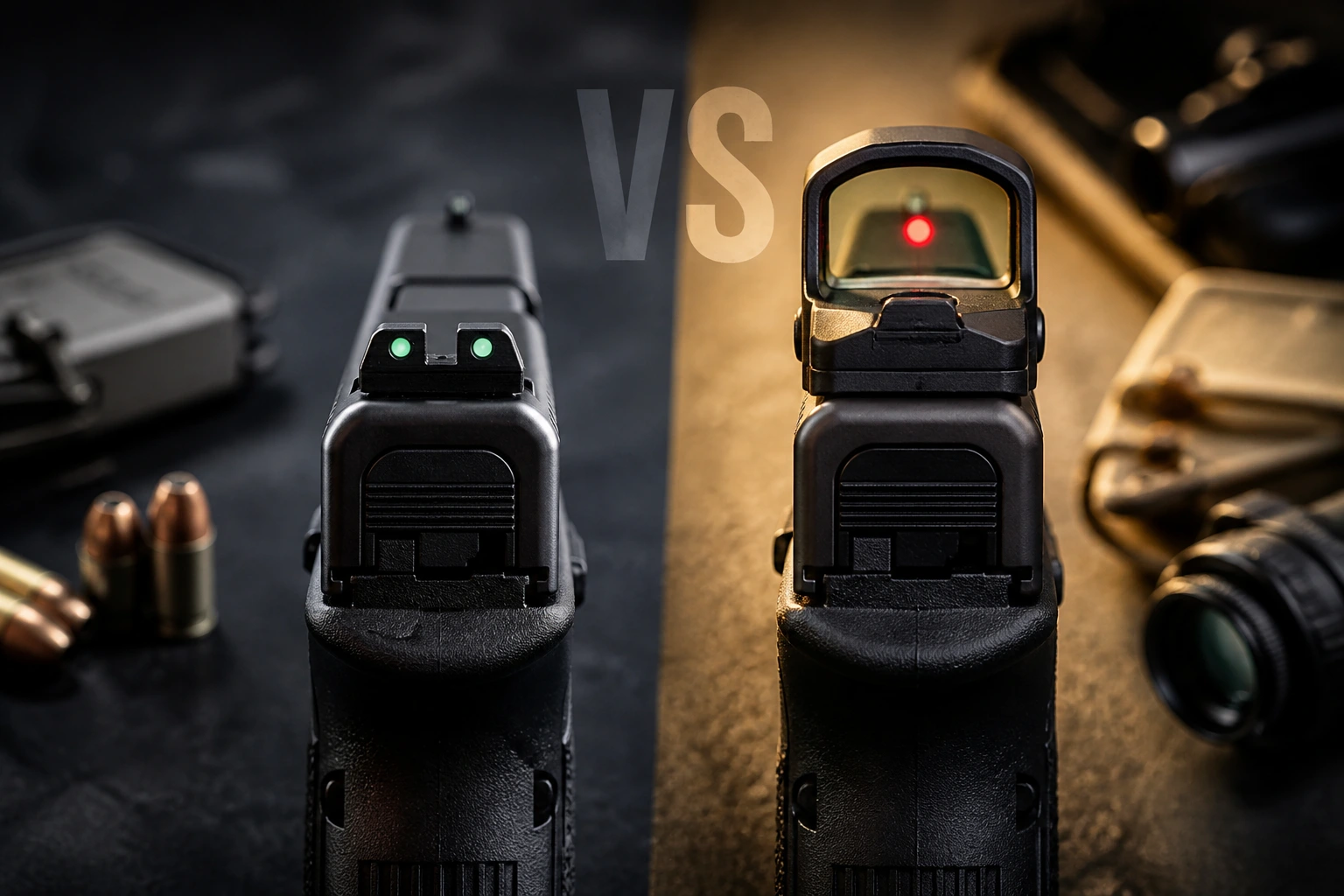
iron sight vs red dot

Reading time: 8 mins 53 sec

When it comes to pistol sights, your sights are the link between your intent and your shot—and in a defensive situation, that gap can cost you everything.

So, which do you choose—the battle-tested reliability of iron sights, or the fast, target-focused advantage of pistol red dot sights? Both have a real place in self-defense shooting. The right choice depends on your skill level, your vision, how you carry, and how much you’re willing to train.

This guide breaks it all down so you can make a clear, informed decision—not just follow the trend.

Highlights

  • Iron sights are reliable, come standard on every pistol, and require zero electronics to function.
  • Red dot sights put the dot and target on the same focal plane, making acquisition faster—especially for aging eyes.
  • Night sights (tritium) are the single best iron sight upgrade for low-light self-defense.
  • Fiber optic sights are bright in daylight but go completely dark without ambient light.
  • Neither system replaces training—a well-drilled shooter with irons beats an untrained shooter with a red dot every time.

What Are Iron Sights and How Do They Work?

Iron sights are the original sighting system on handguns, and they’ve been the standard for well over a century. Every defensive pistol ships with them from the factory.

The system is simple: a front post sits near the muzzle, and a rear notch sits closer to you. To aim, you align both so the tops are level and there’s equal space on both sides of the front post—the shooting world calls this “equal height, equal light.”

Your eye can only focus on one thing at a time. When you focus on the front sight—which is what you’re supposed to do—the target and rear sight will look slightly blurry. That’s not a flaw; it’s just how your eyes work.

Types of Iron Sights Worth Knowing

Not all iron sights are the same. Here are the types that matter most for self-defense:

  • Standard black sights—Come stock on most pistols. Reliable, but nearly invisible in low light.
  • Night sights (tritium)—Contain a sealed glass vial of tritium gas, a radioactive isotope of hydrogen. As tritium decays, it releases beta particles that excite a phosphor coating, producing a continuous glow—no batteries, no charging, always on. Tritium has a half-life of 12.3 years, so brightness gradually fades. Most manufacturers warrant their night sights to remain effectively bright for 10–12 years before replacement is recommended.
  • Fiber optic sights—Use a thin rod to gather and channel ambient light, creating a brilliantly bright aiming point in daylight. The key caveat: fiber optic sights don’t generate their own light. When ambient light disappears, so does your sight picture.

The core advantage of all iron sights: they’re purely mechanical. Nothing to power, nothing to break electronically, nothing to fail.

What Are Pistol Red Dot Sights and How Do They Work?

A pistol red dot sight (also called an MRDS—miniature red dot sight—or carry optic) uses a small LED that projects light onto a curved, partially reflective lens. The lens bounces the dot back toward your eye while letting the image of the target pass straight through.

The result? You see a glowing dot sitting right on your target, with both on the same focal plane. There’s no three-point sight alignment to manage—just dot on threat, press the trigger.

To learn more about how these optics are built and what features to look for, check out our guide on how red dot sights work.

Open vs. Enclosed Emitters

There are two main styles to know:

  • Open emitter—Lighter and lower-profile, but the lens is exposed to debris, rain, and dust.
  • Enclosed emitter—The lens is fully sealed, offering better protection in harsh conditions. Slightly heavier, but a better choice for concealed carry environments.

One important note: a red dot is not a laser. The dot is only visible to you through the optic—not to anyone on the other side.

The Case for Iron Sights in Self-Defense

Iron sights aren’t old news—they’re still the right choice for a large portion of defensive shooters.

Here’s why they hold up:

  • Zero battery dependency. They work in any condition, forever.
  • Exceptional durability. They’re pinned or milled into the slide. The only real failure mode is physically bending one, which is extremely rare.
  • Universal familiarity. Every pistol ships with irons. No modification, no extra investment.
  • Draw stroke simplicity. No optic housing means fewer snag points on your cover garment.
  • Cost. Iron sights come standard. A quality red dot adds $150–$700+ to your setup.

Where Iron Sights Struggle

The three-focal-plane problem is the biggest limitation. Your eye can’t focus on the rear sight, the front sight, and the target all at once—and under adrenaline, that juggling act gets harder, not easier.

Standard black sights are also nearly invisible in low light. If you can’t see your sights, you can’t aim.

Upgrading to tritium night sights solves the visibility problem without any electronics. But even glowing sights don’t fix the focal-plane challenge—you still have to focus on the front post while the target goes blurry.

There’s another factor worth knowing: presbyopia. Symptoms typically begin in the early-to-mid 40s and continue progressing through roughly age 60. As the eye’s lens stiffens over time, shifting focus to a front sight post becomes genuinely difficult—and no amount of training fixes that.

Getting More From Your Iron Sights

If you’re committed to irons, these upgrades matter:

  • Swap to tritium night sights—the single highest-value upgrade for any carry pistol.
  • Consider a fiber optic front sight for daytime practice. Just remember, it goes dark without ambient light.
  • Train the flash sight picture—a proven technique for fast, close-range defensive shooting.
  • Dry-fire daily—five minutes of front-sight focus drills builds muscle memory faster than most range sessions.

The Case for Red Dots in Self-Defense

The defensive shooting community has moved significantly toward pistol red dot sights—and for good reason.

When you bring a red-dot-equipped pistol up to the target, you focus on the threat. The dot appears on that same plane. There’s no sight picture to construct, no focal shift to execute, no three-point alignment to manage.

Here’s what that means in practice:

  • Faster target acquisition at all ranges, not just close distances.
  • Both-eyes-open shooting for full situational awareness—critical when multiple threats are possible.
  • Better low-light performance—an illuminated dot is visible where black iron sights disappear.
  • A major advantage for aging or imperfect eyes—once presbyopia makes front-sight focus difficult, a red dot removes that problem entirely.

Law enforcement agencies across the country have made this shift, too. A growing number of law enforcement agencies across the country have adopted pistol red dot optics, reflecting widespread acceptance of the technology.

The Honest Downsides

Red dots on carry pistols come with real trade-offs:

  • Battery dependency. Modern carry-grade optics offer strong battery life—the Trijicon RMR Type 2 runs approximately four years on a single CR2032, and Holosun’s 507C exceeds 50,000 hours with solar assist. Still, it’s a variable iron sights don’t have.
  • The “finding the dot” problem. Without a consistent draw stroke, new red dot users often can’t find the dot in the window under pressure. This takes hundreds of reps to fix.
  • Steep transition. Switching from irons to a red dot takes more adjustment than most shooters expect.
  • Fragility relative to irons. Mounting screws can loosen from the violent forces of a pistol slide. Check and re-torque your optic screws every 500 rounds.
  • Environmental exposure. Open-emitter optics can collect debris and fog in rapid temperature changes. Enclosed emitters address much of this.
  • Holster and concealment impact. You’ll need an optic-compatible holster, and the added height may print more under cover garments.

What to Look for in a Carry Red Dot

  • Dot size: 3.25 MOA—as found in the Trijicon RMR’s most popular variant—is a solid defensive middle ground between precision and fast acquisition.
  • Battery access: Side-loading or top-loading battery trays let you swap batteries without removing the optic.
  • Auto vs. manual brightness: Auto-brightness reads light at your position, not the target—manual control is often more consistent.
  • Open vs. enclosed emitter: For daily carry, enclosed emitters offer better protection from sweat, debris, and moisture.
  • Shake-awake: Wakes the optic on movement, so you don’t have to manually activate it under stress.
  • Mounting footprint: Confirm your pistol’s optics cut matches your optic. Common footprints include RMR, DeltaPoint Pro, and Shield RMS.

Head-to-Head: Key Self-Defense Scenarios

Speed and Accuracy Under Stress

At 7–25 yards, red dots have a measurable edge in accuracy—especially under stress, when sight alignment is the first thing to break down. Inside 5 yards, iron sights remain highly competitive.

At contact distances under 3 yards, both systems become secondary to retention shooting fundamentals. The most important variable is training volume—a shooter with deeply ingrained iron sight fundamentals outperforms an undertrained shooter with a red dot every time.

Low-Light Performance

Standard black iron sights are essentially invisible in the dark. Tritium night sights solve the visibility problem without batteries—they’re always glowing, day and night, powered entirely by physics.

Red dots are inherently illuminated, giving them a strong advantage in dim environments. The catch: in complete darkness, you still need to identify your target before firing. A weapon-mounted light paired with a red dot is the gold standard for low-light defensive readiness.

Fiber optic sights are excellent in daylight but offer no advantage in darkness. They’re great for competition and range work, but they’re not a standalone solution for everyday carry.

Concealed Carry Considerations

Iron sights are lower-profile. Standard holsters work, the draw stays clean, and there’s nothing extra to snag on clothing.

Red dots add height and bulk. You’ll need an optic-compatible holster, and the added height may print more under tight garments. For appendix carry (AIWB), enclosed emitters hold up better since the lens faces downward against the body.

Shooters With Vision Challenges

If presbyopia is affecting your front-sight focus, a red dot is genuinely game-changing—not just a convenience. It keeps your focus on the threat, exactly where it needs to be under stress.

If you have astigmatism, the dot may appear as a starburst or smear. Here’s what actually helps:

  • Try a larger MOA dot (4–6.5 MOA)—larger dots often appear rounder to astigmatic eyes.
  • Lower the brightness—a too-bright dot blooms and distorts more.
  • Try a green reticle—green sits at the peak of human visual sensitivity and often appears sharper than red.
  • Get a corrective prescription if you don’t already have one.

One thing that won’t help: switching to an enclosed emitter. Astigmatism distortion is a vision-optic interaction issue—enclosed emitters protect against the environment, not eye conditions.

The Hybrid Approach: Do You Have to Choose?

You don’t have to pick one system and abandon the other.

Suppressor-height iron sights are tall enough to remain visible through most pistol red dot optics, giving you a backup aiming reference if the optic fails—this is called co-witnessing.

On pistols, achieving co-witness depends heavily on your specific optic and sight combination. It’s more variable than the structured “absolute vs. lower 1/3” framework used on AR-15 platforms. The practical goal is simple: tall irons visible through the optic window if your battery dies or the lens cracks.

One critical point: backup sights you’ve never trained with are nearly useless under pressure. If you install them, practice with them.

Which Setup Is Right for You?

  • Choose iron sights if you’re newer to defensive shooting, prefer simplicity, or aren’t ready to invest in the training a red dot demands.
  • Choose iron sights + tritium night sights if you carry in low-light environments and want battery-free performance.
  • Choose a red dot if you’re experienced, train consistently, and are prepared to invest in optic-compatible gear.
  • Choose a red dot + suppressor-height irons if you want maximum capability with a functional backup system.

A Deeper Look: Night Sights and Fiber Optic Sights

Night Sights for Defensive Pistols

Tritium night sights contain a sealed glass vial of tritium gas. As tritium decays, it emits low-energy beta particles that excite a phosphor coating inside the vial, producing a continuous glow with no batteries, no switches, and no external power required.

The catch is gradual decay. Tritium’s half-life is 12.3 years, meaning brightness drops to about 50% of its original after that period. Most manufacturers warrant night sights to glow effectively for 10–12 years, after which replacement makes sense.

Tritium sights don’t solve the front-sight focus problem—they just make your sights visible in the dark. Many experienced shooters pair tritium night sights with a red dot and suppressor-height co-witness, treating the whole setup as one integrated system rather than separate choices.

Fiber Optic Sights for Defensive Pistols

Fiber optic sights use a thin rod of acrylic or glass that gathers available light along its length and concentrates it at the tip. In full daylight, fiber optics are often brighter than tritium, making them excellent for competition or bright-condition range work.

The limitation is absolute: no ambient light, no sight picture. In complete darkness, a fiber optic rod is no better than a plain black sight.

For the best of both worlds, look for sights that integrate tritium directly into the front sight alongside a fiber optic rod. A plain fiber optic front paired with a tritium rear leaves your most critical aiming reference—the front sight—dark when you need it most. Integrated designs fix that.

Conclusion

Choosing between pistol sights isn’t about picking a winner—it’s about matching the right tool to your situation, your vision, and your training habits. Iron sights are proven, reliable, and always ready. Pistol red dot sights offer speed and accuracy advantages that grow more significant as distance increases and stress rises. Night sights close the low-light gap for iron sight users. Fiber optic sights shine in daylight but go dark when you need them most.

The system you trust with your life is the one you’ve trained with extensively. No optic, no matter how advanced, replaces repetitions.

If you’re looking for optics for your pistol, browse through our catalogue. Gold Trigger is always here to help you find the best optic for your gun. You may also call us at 713-485-5773.

Disclaimer: The information in this article is for educational purposes only. All firearm handling, modifications, and accessories must comply with applicable federal, state, and local laws. Firearms and related accessories carry serious legal, ethical, and safety responsibilities. Always follow manufacturer guidelines and seek certified instruction before carrying or using any firearm for self-defense. Gold Trigger and its contributors assume no liability for injury, legal consequences, or adverse outcomes arising from the use or misuse of any information provided herein. This article does not constitute legal advice. Consult a qualified attorney for guidance on self-defense and firearms laws in your jurisdiction.

Comments

Leave a Reply

Your email address will not be published. Required fields are marked *

Red Dot vs Iron Sights: Which Is a Better Pistol Sight?

iron sight vs red dot

Reading time: 8 mins 53 sec

When it comes to pistol sights, your sights are the link between your intent and your shot—and in a defensive situation, that gap can cost you everything.

So, which do you choose—the battle-tested reliability of iron sights, or the fast, target-focused advantage of pistol red dot sights? Both have a real place in self-defense shooting. The right choice depends on your skill level, your vision, how you carry, and how much you’re willing to train.

This guide breaks it all down so you can make a clear, informed decision—not just follow the trend.

Highlights

  • Iron sights are reliable, come standard on every pistol, and require zero electronics to function.
  • Red dot sights put the dot and target on the same focal plane, making acquisition faster—especially for aging eyes.
  • Night sights (tritium) are the single best iron sight upgrade for low-light self-defense.
  • Fiber optic sights are bright in daylight but go completely dark without ambient light.
  • Neither system replaces training—a well-drilled shooter with irons beats an untrained shooter with a red dot every time.

What Are Iron Sights and How Do They Work?

Iron sights are the original sighting system on handguns, and they’ve been the standard for well over a century. Every defensive pistol ships with them from the factory.

The system is simple: a front post sits near the muzzle, and a rear notch sits closer to you. To aim, you align both so the tops are level and there’s equal space on both sides of the front post—the shooting world calls this “equal height, equal light.”

Your eye can only focus on one thing at a time. When you focus on the front sight—which is what you’re supposed to do—the target and rear sight will look slightly blurry. That’s not a flaw; it’s just how your eyes work.

Types of Iron Sights Worth Knowing

Not all iron sights are the same. Here are the types that matter most for self-defense:

  • Standard black sights—Come stock on most pistols. Reliable, but nearly invisible in low light.
  • Night sights (tritium)—Contain a sealed glass vial of tritium gas, a radioactive isotope of hydrogen. As tritium decays, it releases beta particles that excite a phosphor coating, producing a continuous glow—no batteries, no charging, always on. Tritium has a half-life of 12.3 years, so brightness gradually fades. Most manufacturers warrant their night sights to remain effectively bright for 10–12 years before replacement is recommended.
  • Fiber optic sights—Use a thin rod to gather and channel ambient light, creating a brilliantly bright aiming point in daylight. The key caveat: fiber optic sights don’t generate their own light. When ambient light disappears, so does your sight picture.

The core advantage of all iron sights: they’re purely mechanical. Nothing to power, nothing to break electronically, nothing to fail.

What Are Pistol Red Dot Sights and How Do They Work?

A pistol red dot sight (also called an MRDS—miniature red dot sight—or carry optic) uses a small LED that projects light onto a curved, partially reflective lens. The lens bounces the dot back toward your eye while letting the image of the target pass straight through.

The result? You see a glowing dot sitting right on your target, with both on the same focal plane. There’s no three-point sight alignment to manage—just dot on threat, press the trigger.

To learn more about how these optics are built and what features to look for, check out our guide on how red dot sights work.

Open vs. Enclosed Emitters

There are two main styles to know:

  • Open emitter—Lighter and lower-profile, but the lens is exposed to debris, rain, and dust.
  • Enclosed emitter—The lens is fully sealed, offering better protection in harsh conditions. Slightly heavier, but a better choice for concealed carry environments.

One important note: a red dot is not a laser. The dot is only visible to you through the optic—not to anyone on the other side.

The Case for Iron Sights in Self-Defense

Iron sights aren’t old news—they’re still the right choice for a large portion of defensive shooters.

Here’s why they hold up:

  • Zero battery dependency. They work in any condition, forever.
  • Exceptional durability. They’re pinned or milled into the slide. The only real failure mode is physically bending one, which is extremely rare.
  • Universal familiarity. Every pistol ships with irons. No modification, no extra investment.
  • Draw stroke simplicity. No optic housing means fewer snag points on your cover garment.
  • Cost. Iron sights come standard. A quality red dot adds $150–$700+ to your setup.

Where Iron Sights Struggle

The three-focal-plane problem is the biggest limitation. Your eye can’t focus on the rear sight, the front sight, and the target all at once—and under adrenaline, that juggling act gets harder, not easier.

Standard black sights are also nearly invisible in low light. If you can’t see your sights, you can’t aim.

Upgrading to tritium night sights solves the visibility problem without any electronics. But even glowing sights don’t fix the focal-plane challenge—you still have to focus on the front post while the target goes blurry.

There’s another factor worth knowing: presbyopia. Symptoms typically begin in the early-to-mid 40s and continue progressing through roughly age 60. As the eye’s lens stiffens over time, shifting focus to a front sight post becomes genuinely difficult—and no amount of training fixes that.

Getting More From Your Iron Sights

If you’re committed to irons, these upgrades matter:

  • Swap to tritium night sights—the single highest-value upgrade for any carry pistol.
  • Consider a fiber optic front sight for daytime practice. Just remember, it goes dark without ambient light.
  • Train the flash sight picture—a proven technique for fast, close-range defensive shooting.
  • Dry-fire daily—five minutes of front-sight focus drills builds muscle memory faster than most range sessions.

The Case for Red Dots in Self-Defense

The defensive shooting community has moved significantly toward pistol red dot sights—and for good reason.

When you bring a red-dot-equipped pistol up to the target, you focus on the threat. The dot appears on that same plane. There’s no sight picture to construct, no focal shift to execute, no three-point alignment to manage.

Here’s what that means in practice:

  • Faster target acquisition at all ranges, not just close distances.
  • Both-eyes-open shooting for full situational awareness—critical when multiple threats are possible.
  • Better low-light performance—an illuminated dot is visible where black iron sights disappear.
  • A major advantage for aging or imperfect eyes—once presbyopia makes front-sight focus difficult, a red dot removes that problem entirely.

Law enforcement agencies across the country have made this shift, too. A growing number of law enforcement agencies across the country have adopted pistol red dot optics, reflecting widespread acceptance of the technology.

The Honest Downsides

Red dots on carry pistols come with real trade-offs:

  • Battery dependency. Modern carry-grade optics offer strong battery life—the Trijicon RMR Type 2 runs approximately four years on a single CR2032, and Holosun’s 507C exceeds 50,000 hours with solar assist. Still, it’s a variable iron sights don’t have.
  • The “finding the dot” problem. Without a consistent draw stroke, new red dot users often can’t find the dot in the window under pressure. This takes hundreds of reps to fix.
  • Steep transition. Switching from irons to a red dot takes more adjustment than most shooters expect.
  • Fragility relative to irons. Mounting screws can loosen from the violent forces of a pistol slide. Check and re-torque your optic screws every 500 rounds.
  • Environmental exposure. Open-emitter optics can collect debris and fog in rapid temperature changes. Enclosed emitters address much of this.
  • Holster and concealment impact. You’ll need an optic-compatible holster, and the added height may print more under cover garments.

What to Look for in a Carry Red Dot

  • Dot size: 3.25 MOA—as found in the Trijicon RMR’s most popular variant—is a solid defensive middle ground between precision and fast acquisition.
  • Battery access: Side-loading or top-loading battery trays let you swap batteries without removing the optic.
  • Auto vs. manual brightness: Auto-brightness reads light at your position, not the target—manual control is often more consistent.
  • Open vs. enclosed emitter: For daily carry, enclosed emitters offer better protection from sweat, debris, and moisture.
  • Shake-awake: Wakes the optic on movement, so you don’t have to manually activate it under stress.
  • Mounting footprint: Confirm your pistol’s optics cut matches your optic. Common footprints include RMR, DeltaPoint Pro, and Shield RMS.

Head-to-Head: Key Self-Defense Scenarios

Speed and Accuracy Under Stress

At 7–25 yards, red dots have a measurable edge in accuracy—especially under stress, when sight alignment is the first thing to break down. Inside 5 yards, iron sights remain highly competitive.

At contact distances under 3 yards, both systems become secondary to retention shooting fundamentals. The most important variable is training volume—a shooter with deeply ingrained iron sight fundamentals outperforms an undertrained shooter with a red dot every time.

Low-Light Performance

Standard black iron sights are essentially invisible in the dark. Tritium night sights solve the visibility problem without batteries—they’re always glowing, day and night, powered entirely by physics.

Red dots are inherently illuminated, giving them a strong advantage in dim environments. The catch: in complete darkness, you still need to identify your target before firing. A weapon-mounted light paired with a red dot is the gold standard for low-light defensive readiness.

Fiber optic sights are excellent in daylight but offer no advantage in darkness. They’re great for competition and range work, but they’re not a standalone solution for everyday carry.

Concealed Carry Considerations

Iron sights are lower-profile. Standard holsters work, the draw stays clean, and there’s nothing extra to snag on clothing.

Red dots add height and bulk. You’ll need an optic-compatible holster, and the added height may print more under tight garments. For appendix carry (AIWB), enclosed emitters hold up better since the lens faces downward against the body.

Shooters With Vision Challenges

If presbyopia is affecting your front-sight focus, a red dot is genuinely game-changing—not just a convenience. It keeps your focus on the threat, exactly where it needs to be under stress.

If you have astigmatism, the dot may appear as a starburst or smear. Here’s what actually helps:

  • Try a larger MOA dot (4–6.5 MOA)—larger dots often appear rounder to astigmatic eyes.
  • Lower the brightness—a too-bright dot blooms and distorts more.
  • Try a green reticle—green sits at the peak of human visual sensitivity and often appears sharper than red.
  • Get a corrective prescription if you don’t already have one.

One thing that won’t help: switching to an enclosed emitter. Astigmatism distortion is a vision-optic interaction issue—enclosed emitters protect against the environment, not eye conditions.

The Hybrid Approach: Do You Have to Choose?

You don’t have to pick one system and abandon the other.

Suppressor-height iron sights are tall enough to remain visible through most pistol red dot optics, giving you a backup aiming reference if the optic fails—this is called co-witnessing.

On pistols, achieving co-witness depends heavily on your specific optic and sight combination. It’s more variable than the structured “absolute vs. lower 1/3” framework used on AR-15 platforms. The practical goal is simple: tall irons visible through the optic window if your battery dies or the lens cracks.

One critical point: backup sights you’ve never trained with are nearly useless under pressure. If you install them, practice with them.

Which Setup Is Right for You?

  • Choose iron sights if you’re newer to defensive shooting, prefer simplicity, or aren’t ready to invest in the training a red dot demands.
  • Choose iron sights + tritium night sights if you carry in low-light environments and want battery-free performance.
  • Choose a red dot if you’re experienced, train consistently, and are prepared to invest in optic-compatible gear.
  • Choose a red dot + suppressor-height irons if you want maximum capability with a functional backup system.

A Deeper Look: Night Sights and Fiber Optic Sights

Night Sights for Defensive Pistols

Tritium night sights contain a sealed glass vial of tritium gas. As tritium decays, it emits low-energy beta particles that excite a phosphor coating inside the vial, producing a continuous glow with no batteries, no switches, and no external power required.

The catch is gradual decay. Tritium’s half-life is 12.3 years, meaning brightness drops to about 50% of its original after that period. Most manufacturers warrant night sights to glow effectively for 10–12 years, after which replacement makes sense.

Tritium sights don’t solve the front-sight focus problem—they just make your sights visible in the dark. Many experienced shooters pair tritium night sights with a red dot and suppressor-height co-witness, treating the whole setup as one integrated system rather than separate choices.

Fiber Optic Sights for Defensive Pistols

Fiber optic sights use a thin rod of acrylic or glass that gathers available light along its length and concentrates it at the tip. In full daylight, fiber optics are often brighter than tritium, making them excellent for competition or bright-condition range work.

The limitation is absolute: no ambient light, no sight picture. In complete darkness, a fiber optic rod is no better than a plain black sight.

For the best of both worlds, look for sights that integrate tritium directly into the front sight alongside a fiber optic rod. A plain fiber optic front paired with a tritium rear leaves your most critical aiming reference—the front sight—dark when you need it most. Integrated designs fix that.

Conclusion

Choosing between pistol sights isn’t about picking a winner—it’s about matching the right tool to your situation, your vision, and your training habits. Iron sights are proven, reliable, and always ready. Pistol red dot sights offer speed and accuracy advantages that grow more significant as distance increases and stress rises. Night sights close the low-light gap for iron sight users. Fiber optic sights shine in daylight but go dark when you need them most.

The system you trust with your life is the one you’ve trained with extensively. No optic, no matter how advanced, replaces repetitions.

If you’re looking for optics for your pistol, browse through our catalogue. Gold Trigger is always here to help you find the best optic for your gun. You may also call us at 713-485-5773.

Disclaimer: The information in this article is for educational purposes only. All firearm handling, modifications, and accessories must comply with applicable federal, state, and local laws. Firearms and related accessories carry serious legal, ethical, and safety responsibilities. Always follow manufacturer guidelines and seek certified instruction before carrying or using any firearm for self-defense. Gold Trigger and its contributors assume no liability for injury, legal consequences, or adverse outcomes arising from the use or misuse of any information provided herein. This article does not constitute legal advice. Consult a qualified attorney for guidance on self-defense and firearms laws in your jurisdiction.

Leave a Reply

Your email address will not be published. Required fields are marked *

Shopping cart0
There are no products in the cart!