
Open vs Closed Emitter Red Dot: The Real Difference

Published on: August 24, 2026
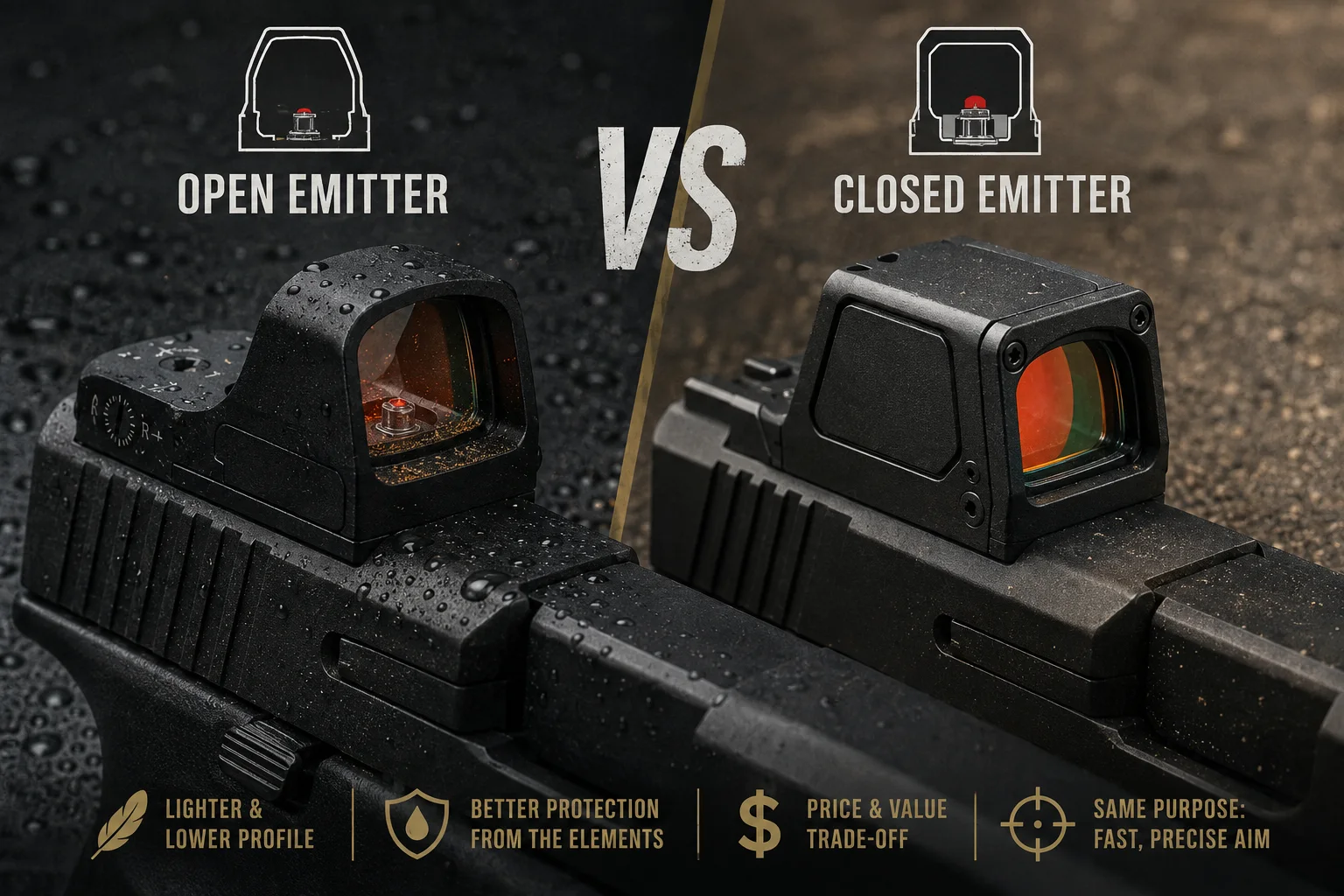
Open vs closed emitter red dot sights compared side by side, showing the exposed open design and sealed closed design with key differences.

Reading time: 5 mins

If you’ve been shopping for a pistol optic, you’ve probably run into this exact question: open vs closed emitter red dot—which one belongs on your gun? It’s one of the most debated choices in the optics world, and there’s no single right answer for everyone. But the difference between the two is very simple.

An open emitter has one lens with the LED sitting right behind it, exposed to the air, while a closed, or enclosed, emitter seals that same LED inside a fully protected housing with two lenses instead of one. You trade a little weight and money for peace of mind when things get wet or dirty.

Below, you’ll see how each design works, what’s true and what’s overblown about their downsides, and how to match one to how you carry or shoot.

Highlights

  • An open emitter red dot uses one exposed lens; a closed emitter red dot seals the LED in a two-lens housing.
  • Open emitters are lighter, cheaper, and fit the widest range of mounts.
  • Closed emitters resist rain, sweat, and debris better, making them a strong daily-carry pick.
  • Battery life depends more on the optic’s tech than on emitter type.
  • Most open-emitter “failures” are just a quick wipe away from being fixed.

What “Emitter” Actually Means

Nearly every red dot sight uses a small LED to project the glowing dot onto the lens, though a handful of designs use tritium or fiber optics instead.

That light source is the emitter, and “open vs closed” is purely about whether it sits exposed or gets sealed away from the elements—it has nothing to do with reticle shape, battery type, or brightness.

Open Emitter Red Dots: How They Work

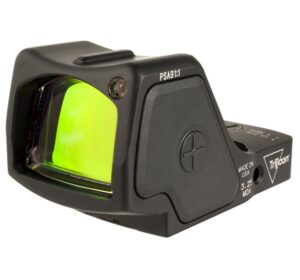
An open emitter keeps things simple: the LED sits at the back of a single lens, fully visible, and beams the dot straight onto the glass in front of you. It’s still the most common design on the market, found on optics like the Trijicon RMR, several Holosun models, and SIG’s ROMEOZero line.
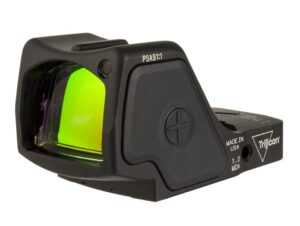
What you gain with an open emitter red dot:

  • Lighter weight and a lower profile on your slide
  • Generally more affordable than closed-emitter options
  • Easy to wipe clean in seconds
  • The widest range of compatible holsters and mounting footprints

The trade-off is that the exposed LED can pick up rain, sweat, dust, or lint, which can temporarily block your dot.

Battery life, though, isn’t tied to housing type at all—some open designs now match or beat closed models on runtime thanks to shake-awake tech and solar assist.

Shooters who carry these optics daily tend to say the same thing: a blocked dot is a wipe-and-go inconvenience, not a real failure. A quick pass with a cloth or a shot of compressed air usually brings it right back.

Closed (Enclosed) Emitter Red Dots: How They Work

A closed emitter takes the same LED and seals it inside the optic’s body, tucked behind two lenses instead of one—popular examples include the Trijicon RCR and Holosun’s EPS and EPS Carry.

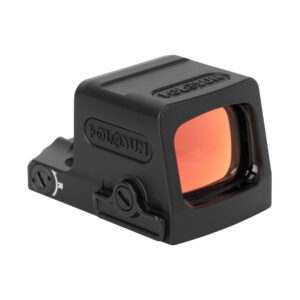
What you gain with a closed emitter red dot:

  • Full protection from rain, sweat, fog, and debris
  • Often paired with solar backup for extra runtime
  • A strong fit for guns that live in a holster all day in humid conditions

The trade-offs are real, too. Closed emitters run heavier and taller than open designs, cost more on average, and their mounting footprints haven’t caught up to the sheer variety available for open models—though that gap is closing fast as more brands roll out enclosed options built for concealed carry.

Open vs Closed Emitter: Side-by-Side

FeatureOpen EmitterClosed Emitter
WeightLighterHeavier
Profile heightLowerTaller
Weather and debris resistanceGood, needs occasional cleaningExcellent, fully sealed
Battery lifeDepends on the modelDepends on the model
Typical priceGenerally lowerGenerally higher
Mounting compatibilityWidest varietyGrowing, still narrower

Is an Open Emitter Sight Even a “Red Dot”?

You might run into a technical argument that only a closed-emitter, two-lens optic truly counts as a “red dot sight,” while open-emitter designs are technically “mini-reflex sights.”

That distinction has some history, but in everyday buying conversations, “red dot” is the umbrella term shooters use for both.

Don’t get hung up on the vocabulary—focus on the design that actually fits how you shoot.

Real-World Reliability: Debris, Weather, and Carry

Let’s talk about what actually happens in the field, since a lot of fear gets sold as fact here. Lint, sweat, rain, and even snow can land on an exposed emitter and briefly block your dot, but context matters.

At the range or in a dry home-defense safe, an open emitter will rarely give you any trouble. Carrying deep concealed in a humid climate and sweating through a holster daily? That’s exactly where a closed emitter earns its extra weight.

Don’t let worst-case stories scare you off open emitters entirely. A wipe or a blast of compressed air clears most blockages in seconds, and that’s basic upkeep, not a design flaw.

Red-dot maintenance is important no matter which one you choose.

Which One Should You Choose?

Your best pick really comes down to how and where you carry:

  • Concealed carry in humid or high-sweat conditions: lean toward a closed emitter for peace of mind
  • Range use, competition, or drier climates: an open emitter is lighter, cheaper, and plenty reliable
  • Budget-conscious, first-time buyers: open emitter designs typically offer the best price-to-performance entry point
  • Duty use or offset rifle mounts: either design works, and enclosed options are showing up more often as manufacturers build tougher, more sealed housings for professional use

If you’re picking a concealed carry red dot sight, prioritize how it handles sweat over how it performs on a dry range day.

Common Myths About Open and Closed Emitters

  • “Open emitters are unreliable.” Most owners run them for years without a functional problem, treating debris as quick clean-up, not failure.
  • “Closed emitters never have issues.” They still need lens care, and their water resistance has real limits, not unlimited protection.
  • “Enclosed always means better.” Weight, price, and mounting compatibility are genuine trade-offs, so that’s worth noting.

Price and Value: Is Closed Emitter Worth the Upgrade?

This really comes down to a value question, not just a spec sheet: ask yourself whether the extra weatherproofing solves a problem you actually have.

If you carry daily in a humid climate, the added cost often pays for itself in peace of mind. If your gun mostly stays dry, plenty of shooters just run both—a closed emitter for daily carry and a lighter open emitter for the range.

Frequently Asked Questions

Are closed emitter red dots more accurate than open emitter?

Not really. Accuracy comes down to dot size and glass quality, not emitter type, though the closed design’s extra lens surface can affect clarity slightly without changing where your bullet lands.

Do open emitter red dots fail in the rain?

They don’t fail—they can temporarily fog up or block the dot, but a quick wipe usually solves it. That’s a maintenance moment, not a broken optic.

Which emitter type is better for a concealed carry red dot sight?

For daily carry in humid or sweaty conditions, most shooters prefer a closed emitter for peace of mind, while drier climates work fine with an open design.

Can I upgrade from open to closed emitter on the same pistol?

Sometimes, but not always as a simple swap. Closed-emitter optics often use different mounting footprints than open designs, so check compatibility with your slide before you buy.

Conclusion

There’s no universal winner in the open vs closed emitter red dot debate, just the right tool for how you actually shoot and carry.

The smartest move is matching the design to your routine, not chasing whichever option sounds tougher on paper.

Ready to find the right optic for your setup? Browse Gold Trigger’s lineup of red dot sights. You can also call us at 713-485-5773.

Disclaimer: This guide is for educational purposes only and isn’t professional advice. Product examples are illustrative, not endorsements. Always verify current specs, compatibility, and pricing with the manufacturer or retailer, and account for your firearm, use case, and local laws before buying. Firearms and related accessories carry inherent risks, and users are responsible for safe handling and operation. This guide doesn’t replace manufacturer instructions or professional training.

Comments

Leave a Reply

Your email address will not be published. Required fields are marked *

Open vs Closed Emitter Red Dot: The Real Difference

Open vs closed emitter red dot sights compared side by side, showing the exposed open design and sealed closed design with key differences.

Reading time: 5 mins

If you’ve been shopping for a pistol optic, you’ve probably run into this exact question: open vs closed emitter red dot—which one belongs on your gun? It’s one of the most debated choices in the optics world, and there’s no single right answer for everyone. But the difference between the two is very simple.

An open emitter has one lens with the LED sitting right behind it, exposed to the air, while a closed, or enclosed, emitter seals that same LED inside a fully protected housing with two lenses instead of one. You trade a little weight and money for peace of mind when things get wet or dirty.

Below, you’ll see how each design works, what’s true and what’s overblown about their downsides, and how to match one to how you carry or shoot.

Highlights

  • An open emitter red dot uses one exposed lens; a closed emitter red dot seals the LED in a two-lens housing.
  • Open emitters are lighter, cheaper, and fit the widest range of mounts.
  • Closed emitters resist rain, sweat, and debris better, making them a strong daily-carry pick.
  • Battery life depends more on the optic’s tech than on emitter type.
  • Most open-emitter “failures” are just a quick wipe away from being fixed.

What “Emitter” Actually Means

Nearly every red dot sight uses a small LED to project the glowing dot onto the lens, though a handful of designs use tritium or fiber optics instead.

That light source is the emitter, and “open vs closed” is purely about whether it sits exposed or gets sealed away from the elements—it has nothing to do with reticle shape, battery type, or brightness.

Open Emitter Red Dots: How They Work

An open emitter keeps things simple: the LED sits at the back of a single lens, fully visible, and beams the dot straight onto the glass in front of you. It’s still the most common design on the market, found on optics like the Trijicon RMR, several Holosun models, and SIG’s ROMEOZero line.

What you gain with an open emitter red dot:

  • Lighter weight and a lower profile on your slide
  • Generally more affordable than closed-emitter options
  • Easy to wipe clean in seconds
  • The widest range of compatible holsters and mounting footprints

The trade-off is that the exposed LED can pick up rain, sweat, dust, or lint, which can temporarily block your dot.

Battery life, though, isn’t tied to housing type at all—some open designs now match or beat closed models on runtime thanks to shake-awake tech and solar assist.

Shooters who carry these optics daily tend to say the same thing: a blocked dot is a wipe-and-go inconvenience, not a real failure. A quick pass with a cloth or a shot of compressed air usually brings it right back.

Closed (Enclosed) Emitter Red Dots: How They Work

A closed emitter takes the same LED and seals it inside the optic’s body, tucked behind two lenses instead of one—popular examples include the Trijicon RCR and Holosun’s EPS and EPS Carry.

What you gain with a closed emitter red dot:

  • Full protection from rain, sweat, fog, and debris
  • Often paired with solar backup for extra runtime
  • A strong fit for guns that live in a holster all day in humid conditions

The trade-offs are real, too. Closed emitters run heavier and taller than open designs, cost more on average, and their mounting footprints haven’t caught up to the sheer variety available for open models—though that gap is closing fast as more brands roll out enclosed options built for concealed carry.

Open vs Closed Emitter: Side-by-Side

FeatureOpen EmitterClosed Emitter
WeightLighterHeavier
Profile heightLowerTaller
Weather and debris resistanceGood, needs occasional cleaningExcellent, fully sealed
Battery lifeDepends on the modelDepends on the model
Typical priceGenerally lowerGenerally higher
Mounting compatibilityWidest varietyGrowing, still narrower

Is an Open Emitter Sight Even a “Red Dot”?

You might run into a technical argument that only a closed-emitter, two-lens optic truly counts as a “red dot sight,” while open-emitter designs are technically “mini-reflex sights.”

That distinction has some history, but in everyday buying conversations, “red dot” is the umbrella term shooters use for both.

Don’t get hung up on the vocabulary—focus on the design that actually fits how you shoot.

Real-World Reliability: Debris, Weather, and Carry

Let’s talk about what actually happens in the field, since a lot of fear gets sold as fact here. Lint, sweat, rain, and even snow can land on an exposed emitter and briefly block your dot, but context matters.

At the range or in a dry home-defense safe, an open emitter will rarely give you any trouble. Carrying deep concealed in a humid climate and sweating through a holster daily? That’s exactly where a closed emitter earns its extra weight.

Don’t let worst-case stories scare you off open emitters entirely. A wipe or a blast of compressed air clears most blockages in seconds, and that’s basic upkeep, not a design flaw.

Red-dot maintenance is important no matter which one you choose.

Which One Should You Choose?

Your best pick really comes down to how and where you carry:

  • Concealed carry in humid or high-sweat conditions: lean toward a closed emitter for peace of mind
  • Range use, competition, or drier climates: an open emitter is lighter, cheaper, and plenty reliable
  • Budget-conscious, first-time buyers: open emitter designs typically offer the best price-to-performance entry point
  • Duty use or offset rifle mounts: either design works, and enclosed options are showing up more often as manufacturers build tougher, more sealed housings for professional use

If you’re picking a concealed carry red dot sight, prioritize how it handles sweat over how it performs on a dry range day.

Common Myths About Open and Closed Emitters

  • “Open emitters are unreliable.” Most owners run them for years without a functional problem, treating debris as quick clean-up, not failure.
  • “Closed emitters never have issues.” They still need lens care, and their water resistance has real limits, not unlimited protection.
  • “Enclosed always means better.” Weight, price, and mounting compatibility are genuine trade-offs, so that’s worth noting.

Price and Value: Is Closed Emitter Worth the Upgrade?

This really comes down to a value question, not just a spec sheet: ask yourself whether the extra weatherproofing solves a problem you actually have.

If you carry daily in a humid climate, the added cost often pays for itself in peace of mind. If your gun mostly stays dry, plenty of shooters just run both—a closed emitter for daily carry and a lighter open emitter for the range.

Frequently Asked Questions

Are closed emitter red dots more accurate than open emitter?

Not really. Accuracy comes down to dot size and glass quality, not emitter type, though the closed design’s extra lens surface can affect clarity slightly without changing where your bullet lands.

Do open emitter red dots fail in the rain?

They don’t fail—they can temporarily fog up or block the dot, but a quick wipe usually solves it. That’s a maintenance moment, not a broken optic.

Which emitter type is better for a concealed carry red dot sight?

For daily carry in humid or sweaty conditions, most shooters prefer a closed emitter for peace of mind, while drier climates work fine with an open design.

Can I upgrade from open to closed emitter on the same pistol?

Sometimes, but not always as a simple swap. Closed-emitter optics often use different mounting footprints than open designs, so check compatibility with your slide before you buy.

Conclusion

There’s no universal winner in the open vs closed emitter red dot debate, just the right tool for how you actually shoot and carry.

The smartest move is matching the design to your routine, not chasing whichever option sounds tougher on paper.

Ready to find the right optic for your setup? Browse Gold Trigger’s lineup of red dot sights. You can also call us at 713-485-5773.

Disclaimer: This guide is for educational purposes only and isn’t professional advice. Product examples are illustrative, not endorsements. Always verify current specs, compatibility, and pricing with the manufacturer or retailer, and account for your firearm, use case, and local laws before buying. Firearms and related accessories carry inherent risks, and users are responsible for safe handling and operation. This guide doesn’t replace manufacturer instructions or professional training.

Leave a Reply

Your email address will not be published. Required fields are marked *

Shopping cart1
Holosun EPS-CARRY-RD-2 Open Reflex Sight, 2-MOA Red Dot
-
+
Subtotal
$329.99
Total
$329.99