
Trijicon Red Dot Sights: The Complete Buyer’s Guide

Published on: August 26, 2026
Trijicon Red Dot Sights

Reading time: 7 mins

If you’re searching for a Trijicon red dot, keep in mind that they don’t make one red dot; they make an entire family, and each one is built for a different gun and a different job.

That’s good news, actually. There’s a Trijicon red dot built specifically for what you do, whether that’s carrying concealed, competing on the clock, or running an AR-15.

Trijicon earned that reputation the hard way, and its combat optics have followed U.S. service members into the field since the 1990s. Below, we’ll walk through every current Trijicon red dot, who each one is really for, and how the lineup stacks up against the competition.

Highlights

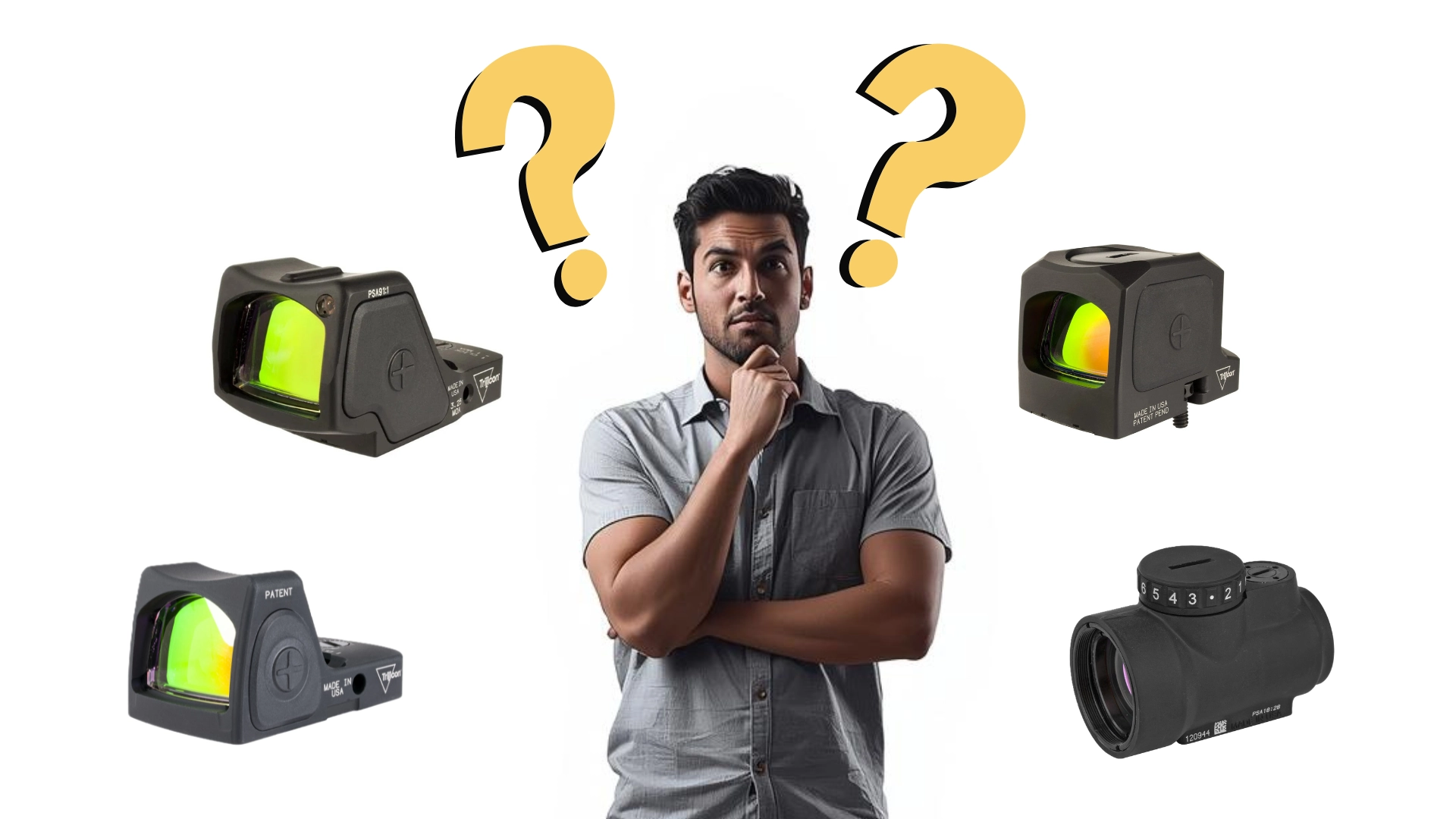
  • Trijicon’s current red dot lineup has four main families: the RMR Type 2, RCR, SRO, and MRO.
  • The RMR Type 2 is the go-to pick for concealed carry and duty use.
  • The SRO trades a bit of durability for a much bigger sight window, which is great for competition.
  • The MRO is Trijicon’s rifle, carbine, and shotgun optic, built on a completely separate mount system.
  • Trijicon red dots sit in the premium price tier, generally landing somewhere above $500, depending on the model.

What Makes a Trijicon Red Dot Different?

Trijicon didn’t build its name by being the cheapest option on the shelf. It built it on durability.

Every Trijicon product gets tested to MIL-STD-810G, a U.S. military standard that simulates real-world abuse like drops, temperature swings, and moisture exposure.

That same durability-first mindset is why the U.S. military has trusted Trijicon’s combat optics since the mid-1990s, when U.S. Special Operations Command first selected the company’s magnified ACOG scope for the M4 Carbine.

When it comes to Trijicon red dot sights, there are really two families to know. One group mounts on pistols and shares a common footprint: the RMR Type 2, RCR, and SRO. The other group is built for rifles, carbines, and shotguns: the MRO and MRO HD.

Trijicon also makes magnified optics like the ACOG, but that’s a different category entirely. This guide sticks to red dots and reflex sights.

Here’s a fun bit of history: the RMR wasn’t originally designed for pistols. Trijicon built it in 2009 as a fast, close-range companion to the magnified ACOG on rifles, over-engineered to survive being dropped along with the host gun. Shooters later realized it worked just as well bolted to a pistol slide, and that’s how it became the optic every other pistol red dot gets measured against.

One more thing to know early: some Trijicon red dots run on a standard CR2032 battery, while others use a battery-free tritium and fiber-optic system that never needs power.

Types of Trijicon Red Dots at a Glance

Before digging into any single model, it helps to see the whole lineup side by side. Here’s a quick snapshot of the current Trijicon red dot models and what each is built for.

  • RMR Type 2: Best for concealed carry and duty use.
  • RCR: Best for pistols that see rain, dust, or hard daily use.
  • SRO: Best for competition and fast target transitions.
  • MRO/MRO HD: Best for AR-15s, patrol rifles, and shotguns.

Now let’s look at each one a little closer.

Trijicon Red Dot for Pistol: RMR, RCR, and SRO

The RMR (Ruggedized Miniature Reflex) is the sight that basically started this whole category. It uses an open-emitter design, meaning the lens sits exposed rather than sealed inside a housing, and decades of use have made it the benchmark every other pistol red dot gets compared against.

The RMR Type 2 comes in three illumination options: Automatic LED, Adjustable LED, and a battery-free Dual-Illuminated version that runs on tritium and fiber optics instead of a battery. That range of options makes it a natural fit for carry, duty, or backup use on a rifle offset mount.

The RCR (Ruggedized Closed Reflex) takes the same RMR footprint and seals the emitter inside the housing. That makes it noticeably more resistant to rain, dust, and holster lint, though it runs a bit heavier than the RMR and, for now, only ships in one dot size.

If you’re torn between the two, our Trijicon RCR vs RMR comparison breaks down exactly which one fits your use case.

The SRO (Specialized Reflex Optic) swaps that small, rectangular RMR window for a much bigger, round one. That makes it easier to find and track the dot during fast target transitions, which is exactly why competitive shooters love it.

The trade-off is durability. All that extra glass gives the SRO less structural protection than the RMR’s tighter, more armored window, so it’s better suited to the range and the match than to hard daily carry.

Trijicon Red Dot for AR-15 and Shotguns: MRO and MRO HD

The MRO (Miniature Rifle Optic) is Trijicon’s dedicated red dot for rifles, carbines, and shotguns. It’s a sealed, enclosed-emitter design that doesn’t share the RMR footprint, since it runs on a completely different mounting system built for long guns.

A few things set the MRO apart. It carries a larger 25mm objective lens for a wider field of view, and battery life is rated up to five years of continuous use on a single CR2032.

The MRO HD version adds a 68 MOA circle around a 2 MOA center dot, which helps with faster close-range target acquisition. Trijicon also builds an MRO Patrol version aimed squarely at duty rifles, with the same rugged housing and long battery life.

Trijicon sells RMR Dual Defense kits, too. These pair an RMR Type 2 with co-witnessed tritium night sights, giving you a backup aiming solution if your battery ever dies or the optic fails.

How to Choose the Best Trijicon Red Dot for Your Firearm

The fastest way to narrow this down is to think about what you’re actually going to do with the gun. Here’s a simple breakdown:

  • Concealed carry or duty pistol: Go with the RMR Type 2.
  • Pistol used in rain, dust, or rough conditions: Go with the RCR.
  • Competition pistol (USPSA, IPSC, etc.): Go with the SRO.
  • AR-15 or patrol rifle: Go with the MRO or MRO HD.
  • Shotgun for home defense or duty: Go with the MRO.

Beyond use case, a few other factors are worth weighing. Think about your preferred dot size, whether you want an open or enclosed emitter, and whether your slide is already cut for the RMR footprint.

If you’re not sure how mounting footprints work, our guide on red dot mounts and our step-by-step on how to mount a red dot sight on a pistol walk you through it in plain language.

Trijicon Red Dot Price: What to Expect

Trijicon sits firmly in the premium tier of the red dot market, and the Trijicon red dot price reflects that. As a reliable anchor point, the MRO originally launched at $579 without a mount and $629 with one, while the SRO carries a manufacturer-suggested price of around $800+.

The RMR Type 2 and RCR typically land somewhere in between those two numbers, though exact pricing shifts often as models get refreshed with new features. Treat any specific number you see online as a snapshot in time, not a fixed rule.

That premium exists for a reason: MIL-STD durability testing, a strong warranty, and a track record built on decades of military and law enforcement use.

Trijicon RMR vs SRO vs MRO: Which One Wins?

Here’s the honest answer: none of them “wins” outright, because they’re not built to do the same job.

If you’re comparing Trijicon RMR vs SRO vs MRO, think of it less as a competition and more as three tools for three different tasks. The RMR wins on durability and concealability for carry, the SRO wins on sight picture and speed for competition, and the MRO wins simply because it’s the only one built for rifles, carbines, and shotguns in the first place.

It’s also worth being honest about where Trijicon stands in the market. Compared to a brand like Holosun, Trijicon typically costs more and offers fewer reticle options, and most models skip solar backup illumination entirely.

In return, you get a longer track record of durability testing and duty use. If reliability matters more to you than having every possible feature, Trijicon is worth the premium. If you want more reticle choices and solar backup at a lower price, it’s worth cross-shopping other brands before you decide.

Common Questions About Trijicon Red Dots

Is a Trijicon red dot worth it?

For most carry, duty, or competition shooters, yes. You’re paying more upfront for a proven durability track record, though budget-focused shooters may find better value elsewhere.

What’s the difference between the RMR and the SRO?

The RMR is smaller and more durable, which makes it better for carry and duty. The SRO has a bigger window for faster target acquisition, which makes it better for competition.

Do all Trijicon red dots use the same mounting footprint?

No. The RMR, RCR, and SRO all share the same footprint, while the MRO runs on a completely different rifle mounting system.

How long do Trijicon red dot batteries last?

It depends on the model and brightness setting, but most CR2032-powered models run anywhere from two to five years before you need a fresh battery.

Which Trijicon optic does the military use?

The ACOG has served with U.S. forces since the 1990s and became the Marine Corps’ official combat optic in the mid-2000s. Trijicon’s red dots, especially the RMR, have also seen wide use with military and law enforcement.

Conclusion

A Trijicon red dot isn’t a single product; it’s an entire lineup built around one core idea: durability first. Whether you need the RMR Type 2 for carry, the RCR for harsh conditions, the SRO for competition, or the MRO for your rifle or shotgun, there’s a model matched to your exact use case.

Price is the trade-off. You’re paying a premium compared to some competitors, but that premium buys you a track record most other brands simply haven’t earned yet.

Ready to find your fit? Browse Gold Trigger’s lineup of red dot sights; we even carry some Trijicon red dot sights.

Disclaimer: This article is for informational purposes only and isn’t a substitute for professional advice. Always consult your firearm’s manufacturer specifications and follow all applicable local, state, and federal laws before purchasing or installing any optic. We strongly recommend having red dot sights mounted and zeroed by a qualified professional. Pricing and specifications are subject to change and should be verified directly with the manufacturer or retailer at the time of purchase.

Comments

Leave a Reply

Your email address will not be published. Required fields are marked *

Trijicon Red Dot Sights: The Complete Buyer’s Guide

Trijicon Red Dot Sights

Reading time: 7 mins

If you’re searching for a Trijicon red dot, keep in mind that they don’t make one red dot; they make an entire family, and each one is built for a different gun and a different job.

That’s good news, actually. There’s a Trijicon red dot built specifically for what you do, whether that’s carrying concealed, competing on the clock, or running an AR-15.

Trijicon earned that reputation the hard way, and its combat optics have followed U.S. service members into the field since the 1990s. Below, we’ll walk through every current Trijicon red dot, who each one is really for, and how the lineup stacks up against the competition.

Highlights

  • Trijicon’s current red dot lineup has four main families: the RMR Type 2, RCR, SRO, and MRO.
  • The RMR Type 2 is the go-to pick for concealed carry and duty use.
  • The SRO trades a bit of durability for a much bigger sight window, which is great for competition.
  • The MRO is Trijicon’s rifle, carbine, and shotgun optic, built on a completely separate mount system.
  • Trijicon red dots sit in the premium price tier, generally landing somewhere above $500, depending on the model.

What Makes a Trijicon Red Dot Different?

Trijicon didn’t build its name by being the cheapest option on the shelf. It built it on durability.

Every Trijicon product gets tested to MIL-STD-810G, a U.S. military standard that simulates real-world abuse like drops, temperature swings, and moisture exposure.

That same durability-first mindset is why the U.S. military has trusted Trijicon’s combat optics since the mid-1990s, when U.S. Special Operations Command first selected the company’s magnified ACOG scope for the M4 Carbine.

When it comes to Trijicon red dot sights, there are really two families to know. One group mounts on pistols and shares a common footprint: the RMR Type 2, RCR, and SRO. The other group is built for rifles, carbines, and shotguns: the MRO and MRO HD.

Trijicon also makes magnified optics like the ACOG, but that’s a different category entirely. This guide sticks to red dots and reflex sights.

Here’s a fun bit of history: the RMR wasn’t originally designed for pistols. Trijicon built it in 2009 as a fast, close-range companion to the magnified ACOG on rifles, over-engineered to survive being dropped along with the host gun. Shooters later realized it worked just as well bolted to a pistol slide, and that’s how it became the optic every other pistol red dot gets measured against.

One more thing to know early: some Trijicon red dots run on a standard CR2032 battery, while others use a battery-free tritium and fiber-optic system that never needs power.

Types of Trijicon Red Dots at a Glance

Before digging into any single model, it helps to see the whole lineup side by side. Here’s a quick snapshot of the current Trijicon red dot models and what each is built for.

  • RMR Type 2: Best for concealed carry and duty use.
  • RCR: Best for pistols that see rain, dust, or hard daily use.
  • SRO: Best for competition and fast target transitions.
  • MRO/MRO HD: Best for AR-15s, patrol rifles, and shotguns.

Now let’s look at each one a little closer.

Trijicon Red Dot for Pistol: RMR, RCR, and SRO

The RMR (Ruggedized Miniature Reflex) is the sight that basically started this whole category. It uses an open-emitter design, meaning the lens sits exposed rather than sealed inside a housing, and decades of use have made it the benchmark every other pistol red dot gets compared against.

The RMR Type 2 comes in three illumination options: Automatic LED, Adjustable LED, and a battery-free Dual-Illuminated version that runs on tritium and fiber optics instead of a battery. That range of options makes it a natural fit for carry, duty, or backup use on a rifle offset mount.

The RCR (Ruggedized Closed Reflex) takes the same RMR footprint and seals the emitter inside the housing. That makes it noticeably more resistant to rain, dust, and holster lint, though it runs a bit heavier than the RMR and, for now, only ships in one dot size.

If you’re torn between the two, our Trijicon RCR vs RMR comparison breaks down exactly which one fits your use case.

The SRO (Specialized Reflex Optic) swaps that small, rectangular RMR window for a much bigger, round one. That makes it easier to find and track the dot during fast target transitions, which is exactly why competitive shooters love it.

The trade-off is durability. All that extra glass gives the SRO less structural protection than the RMR’s tighter, more armored window, so it’s better suited to the range and the match than to hard daily carry.

Trijicon Red Dot for AR-15 and Shotguns: MRO and MRO HD

The MRO (Miniature Rifle Optic) is Trijicon’s dedicated red dot for rifles, carbines, and shotguns. It’s a sealed, enclosed-emitter design that doesn’t share the RMR footprint, since it runs on a completely different mounting system built for long guns.

A few things set the MRO apart. It carries a larger 25mm objective lens for a wider field of view, and battery life is rated up to five years of continuous use on a single CR2032.

The MRO HD version adds a 68 MOA circle around a 2 MOA center dot, which helps with faster close-range target acquisition. Trijicon also builds an MRO Patrol version aimed squarely at duty rifles, with the same rugged housing and long battery life.

Trijicon sells RMR Dual Defense kits, too. These pair an RMR Type 2 with co-witnessed tritium night sights, giving you a backup aiming solution if your battery ever dies or the optic fails.

How to Choose the Best Trijicon Red Dot for Your Firearm

The fastest way to narrow this down is to think about what you’re actually going to do with the gun. Here’s a simple breakdown:

  • Concealed carry or duty pistol: Go with the RMR Type 2.
  • Pistol used in rain, dust, or rough conditions: Go with the RCR.
  • Competition pistol (USPSA, IPSC, etc.): Go with the SRO.
  • AR-15 or patrol rifle: Go with the MRO or MRO HD.
  • Shotgun for home defense or duty: Go with the MRO.

Beyond use case, a few other factors are worth weighing. Think about your preferred dot size, whether you want an open or enclosed emitter, and whether your slide is already cut for the RMR footprint.

If you’re not sure how mounting footprints work, our guide on red dot mounts and our step-by-step on how to mount a red dot sight on a pistol walk you through it in plain language.

Trijicon Red Dot Price: What to Expect

Trijicon sits firmly in the premium tier of the red dot market, and the Trijicon red dot price reflects that. As a reliable anchor point, the MRO originally launched at $579 without a mount and $629 with one, while the SRO carries a manufacturer-suggested price of around $800+.

The RMR Type 2 and RCR typically land somewhere in between those two numbers, though exact pricing shifts often as models get refreshed with new features. Treat any specific number you see online as a snapshot in time, not a fixed rule.

That premium exists for a reason: MIL-STD durability testing, a strong warranty, and a track record built on decades of military and law enforcement use.

Trijicon RMR vs SRO vs MRO: Which One Wins?

Here’s the honest answer: none of them “wins” outright, because they’re not built to do the same job.

If you’re comparing Trijicon RMR vs SRO vs MRO, think of it less as a competition and more as three tools for three different tasks. The RMR wins on durability and concealability for carry, the SRO wins on sight picture and speed for competition, and the MRO wins simply because it’s the only one built for rifles, carbines, and shotguns in the first place.

It’s also worth being honest about where Trijicon stands in the market. Compared to a brand like Holosun, Trijicon typically costs more and offers fewer reticle options, and most models skip solar backup illumination entirely.

In return, you get a longer track record of durability testing and duty use. If reliability matters more to you than having every possible feature, Trijicon is worth the premium. If you want more reticle choices and solar backup at a lower price, it’s worth cross-shopping other brands before you decide.

Common Questions About Trijicon Red Dots

Is a Trijicon red dot worth it?

For most carry, duty, or competition shooters, yes. You’re paying more upfront for a proven durability track record, though budget-focused shooters may find better value elsewhere.

What’s the difference between the RMR and the SRO?

The RMR is smaller and more durable, which makes it better for carry and duty. The SRO has a bigger window for faster target acquisition, which makes it better for competition.

Do all Trijicon red dots use the same mounting footprint?

No. The RMR, RCR, and SRO all share the same footprint, while the MRO runs on a completely different rifle mounting system.

How long do Trijicon red dot batteries last?

It depends on the model and brightness setting, but most CR2032-powered models run anywhere from two to five years before you need a fresh battery.

Which Trijicon optic does the military use?

The ACOG has served with U.S. forces since the 1990s and became the Marine Corps’ official combat optic in the mid-2000s. Trijicon’s red dots, especially the RMR, have also seen wide use with military and law enforcement.

Conclusion

A Trijicon red dot isn’t a single product; it’s an entire lineup built around one core idea: durability first. Whether you need the RMR Type 2 for carry, the RCR for harsh conditions, the SRO for competition, or the MRO for your rifle or shotgun, there’s a model matched to your exact use case.

Price is the trade-off. You’re paying a premium compared to some competitors, but that premium buys you a track record most other brands simply haven’t earned yet.

Ready to find your fit? Browse Gold Trigger’s lineup of red dot sights; we even carry some Trijicon red dot sights.

Disclaimer: This article is for informational purposes only and isn’t a substitute for professional advice. Always consult your firearm’s manufacturer specifications and follow all applicable local, state, and federal laws before purchasing or installing any optic. We strongly recommend having red dot sights mounted and zeroed by a qualified professional. Pricing and specifications are subject to change and should be verified directly with the manufacturer or retailer at the time of purchase.

Leave a Reply

Your email address will not be published. Required fields are marked *

Shopping cart0
There are no products in the cart!