Red Dot vs Scope for Hunting: Which Fills Your Tag?

Published on: July 27, 2026
Red Dot vs Scope for Hunting: Which Fills Your Tag?

Reading time: 7 mins

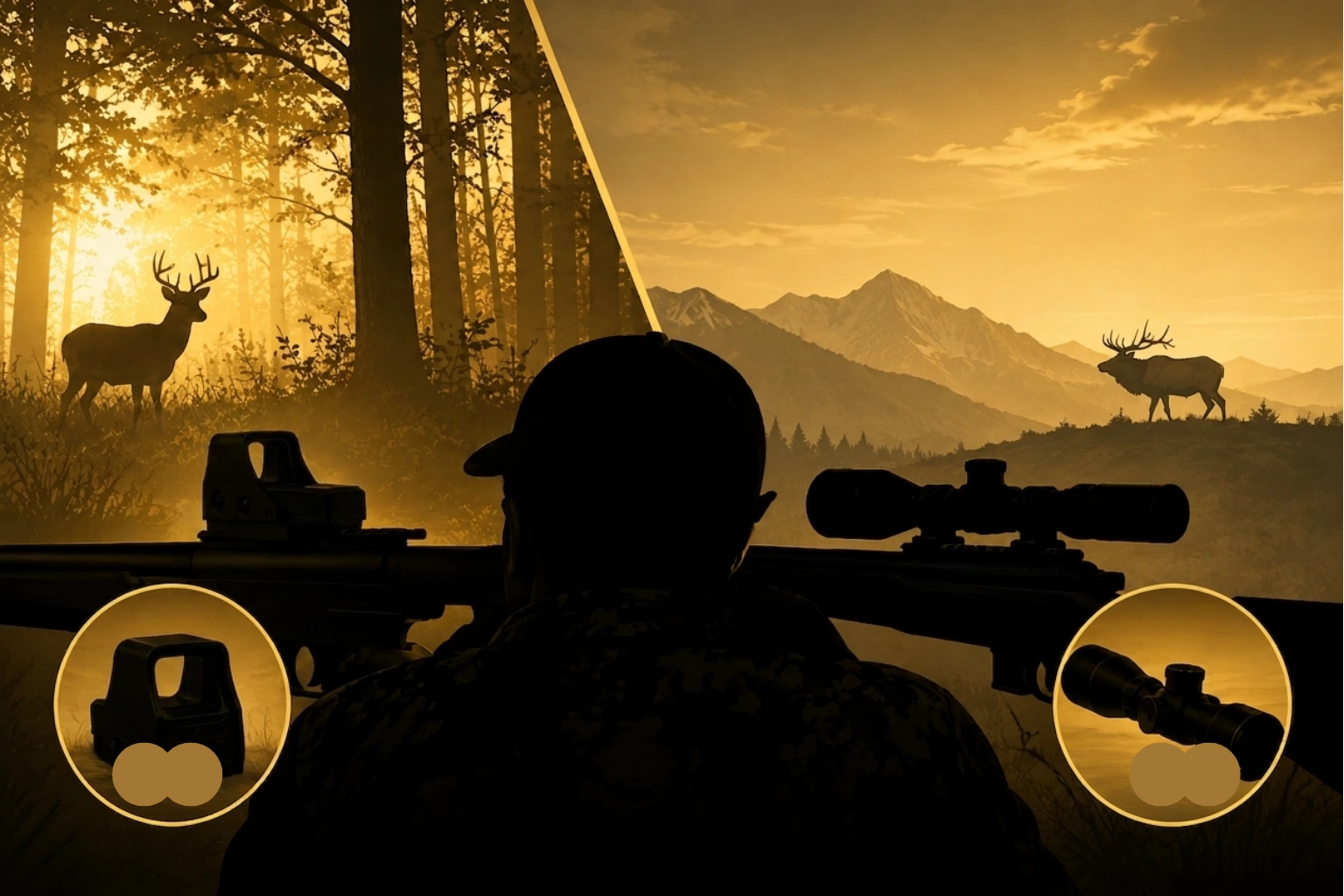
When it comes to red dot vs scope for hunting, it comes down to one question: how close is your shot going to be? Red dots win when things happen fast and close. Scopes win when you need to see far enough to confirm what you’re aiming at and place a clean, ethical shot.

That’s the short version. But “it depends” doesn’t help much when you’re standing in a store trying to make a real decision.

This guide skips the usual spec sheet comparison. Instead, we’ll walk through real hunting scenarios, treestands, open country, hogs, turkeys, varmints, and crossbows, so you can match your optic to how you actually hunt. This might also help if you’re looking for the best red dot sight on the market.

Highlights

  • Red dot sights are built for close, fast shots on moving game like hogs and treestand deer.
  • Rifle scopes give you the magnification you need once shots stretch past roughly 150 yards.
  • Treestand and ground blind hunting tends to reward speed over reach, since most opportunities come in close.
  • Crossbow optic rules shift by state, so check your local regulations before you mount anything.
  • A hybrid setup, like a magnifier behind a red dot or an LPVO, can cover both worlds if your hunts vary.

Red Dot vs Scope: The Core Difference

A red dot sight puts a glowing dot on a clear window with no magnification. You shoot with both eyes open and find your target quickly.

A rifle scope works differently. It magnifies your target so you can see it clearly at a distance. Most hunters aim through it with one eye, especially at higher zoom, though lower-power scopes still work fine with both eyes open.

Think of it this way: dots are built for speed, and scopes are built for precision at range. Neither one is better on its own. It’s about which job you’re asking it to do.

Match the Optic to Your Hunt

Treestand and Ground Blind Whitetail Hunting

Treestand hunting rewards speed. You’re often working a tight shot window, and a deer can decide to move at any second.

A red dot’s unlimited eye relief means your head position doesn’t have to be perfect to get on target. That matters when you’re twisted around in a stand or shooting through a blind window.

Whitetail deer are essentially red-green colorblind. Their eyes only pick up blue and green wavelengths well, so a red dot’s glow doesn’t register as an alarming color to them the way it might seem to you. What actually gives you away is movement, not the dot itself, which is one more reason a fast, forgiving sight makes sense up close.

Deer are also most active at dawn and dusk, which happens to be when their blue-shifted vision works best and when the light is toughest on your eyes, too. An illuminated red dot holds its visibility in that low light far better than a plain crosshair does.

Open-Country and Spot-and-Stalk Hunting

Elk, mule deer, and pronghorn live in a different world. Shots regularly stretch well past 150 yards, and you need magnification just to tell a legal animal from one you should pass on.

A scope earns its keep here in three ways:

  • Identification—confirming the animal, its sex, and its legality before you shoot.
  • Precision—seeing your point of aim clearly enough to place an ethical shot.
  • Holdover—using a BDC, or bullet drop compensator, reticle to account for bullet drop at range, something a red dot simply can’t do.

In this kind of country, a red dot isn’t just limited. It becomes a real liability.

Hog Hunting and Predator Calling

Hogs and called-in predators move fast and rarely give you much time to think. A red dot, or a green dot for bright daylight, lets you track a moving target with both eyes open and break the shot the moment it’s right. Green shows up better than red in strong sunlight because human eyes are naturally more sensitive to that part of the light spectrum.

Hunting hogs after dark changes the equation entirely, since a thermal-assisted optic becomes far more useful than either a standard red dot or scope. Just double-check your state’s rules on night hunting first, since they vary.

Turkey Hunting

Turkey hunting happens close, but don’t let that fool you into thinking speed beats precision here. A turkey’s vital zone sits in the head and neck, which is a small target compared to how big the bird looks strutting around. A fine, well-placed dot beats a fast but sloppy one every time.

Varmint and Predator Shooting at Range

For prairie dogs, distant coyotes, or anything small and far off, a high-magnification scope is really the only sensible choice. At these distances, parallax adjustment and a fine crosshair matter more than reticle illumination ever will.

Crossbow Hunting: A Special Case

Crossbows deserve their own conversation. Arrow trajectories drop faster and more dramatically than rifle bullets, which is why speed-compensating scopes with multiple aiming points exist as their own category.

Crossbow hunting regulations also get complicated fast. Colorado, for example, generally limits crossbow hunters to non-magnifying optics during archery season, and full magnification is only available through a documented disability accommodation, one that still restricts battery-powered aiming devices.

Other states are far more relaxed and allow full magnification outright. Before you mount anything, check your state wildlife agency’s current rules. It can get you into real trouble if you assume your home state’s rules apply everywhere.

Quick-Decision Chart

Hunting ScenarioTypical Shot DistanceBest OpticWhy
Treestand or ground blind deerClose rangeRed dotFast, forgiving, strong in low light
Open-country elk, mule deer, pronghorn150+ yardsRifle scopeMagnification for ID and precision
Hog hunting or predator callingClose, fast-movingRed dot or green dotBoth-eyes-open tracking
Turkey huntingClose rangeRed dot with fine reticlePrecision on a small vital zone
Varmint or long-range shooting200+ yardsHigh-magnification scopeParallax control, fine crosshair
Crossbow huntingVaries by state lawCheck local regulations firstLegal limits often apply

Still not sure? If most of your hunting happens in thick woods or from a stand, lean toward a red dot. If you’re chasing game across open country, lean toward a scope.

Ethics, Legality, and Safety

A magnified scope helps you confirm a clean, legal shot before you take it. A red dot asks something different of you: know your effective range cold, since there’s no zoom to lean on if you misjudge the distance.

Hunting regulations can restrict the use of magnified optics, especially for crossbows or during certain primitive weapons seasons. Always check your state wildlife agency’s rules before you buy or mount anything new.

And no matter which optic you’re running, positive target identification comes first, always. Never take a shot at an animal, or at a distance, when you can’t clearly confirm.

Can You Get the Best of Both?

If your hunting style crosses scenarios, like sitting a stand at dawn and still-hunting open country later in the day, a hybrid setup might make sense. A magnifier mounted behind a red dot, or a low-power variable optic, gives you speed up close and reach at distance.

Just know hybrid setups come with trade-offs: more weight, more cost, and a bit more complexity on your rifle. It’s a strong option for versatile hunters, not a default, just because it sounds like the safe choice.

Frequently Asked Questions

Is a red dot good enough for deer hunting?

Yes, especially from a treestand or ground blind, where shots tend to happen close. For open-country deer hunting at longer range, a scope is the better call.

What magnification scope is best for hunting?

A 3-9x scope is a common, versatile pick for most hunting situations, though open-country hunters chasing elk or pronghorn often want more reach.

Can I use a red dot and scope on the same rifle?

Yes. A magnifier behind a red dot, or an LPVO, lets you get speed and reach out of one setup. See the hybrid section above for the trade-offs involved.

Conclusion

There’s no single best optic for hunting. A red dot sight rewards you with speed and forgiveness up close, while a rifle scope gives you the reach and precision you need when the game is far away and hard to identify.

The right call comes down to how you actually hunt. Match your optic to your terrain, your game, and your typical shot distance, and you’ll spend a lot less time second-guessing your gear once you’re in the field.

Ready to gear up? Gold Trigger carries a selection of red dots and scopes built for real hunting conditions, not just the range. Browse our collection, or give us a call at 713-485-5773, and we’ll help you find the right optic for your next hunt.

Disclaimer: The information in this guide is for educational and informational purposes only and does not constitute hunting, legal, or safety advice. Optic choice does not replace hunter education, marksmanship practice, or your own judgment in the field. Always verify your effective range with your specific optic and firearm or crossbow combination before hunting. Hunting regulations, including restrictions on magnified optics for certain weapons or seasons, vary by state and jurisdiction. Consult your state wildlife agency for current rules before purchasing or using any optic. Always follow all local, state, and federal firearm and hunting laws, practice safe firearm handling, and never take a shot unless you can positively identify your target and what lies beyond it. Gold Trigger is not responsible for the misuse of any product or information referenced in this article.

Comments

Leave a Reply

Your email address will not be published. Required fields are marked *

Red Dot vs Scope for Hunting: Which Fills Your Tag?

Red Dot vs Scope for Hunting: Which Fills Your Tag?

Reading time: 7 mins

When it comes to red dot vs scope for hunting, it comes down to one question: how close is your shot going to be? Red dots win when things happen fast and close. Scopes win when you need to see far enough to confirm what you’re aiming at and place a clean, ethical shot.

That’s the short version. But “it depends” doesn’t help much when you’re standing in a store trying to make a real decision.

This guide skips the usual spec sheet comparison. Instead, we’ll walk through real hunting scenarios, treestands, open country, hogs, turkeys, varmints, and crossbows, so you can match your optic to how you actually hunt. This might also help if you’re looking for the best red dot sight on the market.

Highlights

  • Red dot sights are built for close, fast shots on moving game like hogs and treestand deer.
  • Rifle scopes give you the magnification you need once shots stretch past roughly 150 yards.
  • Treestand and ground blind hunting tends to reward speed over reach, since most opportunities come in close.
  • Crossbow optic rules shift by state, so check your local regulations before you mount anything.
  • A hybrid setup, like a magnifier behind a red dot or an LPVO, can cover both worlds if your hunts vary.

Red Dot vs Scope: The Core Difference

A red dot sight puts a glowing dot on a clear window with no magnification. You shoot with both eyes open and find your target quickly.

A rifle scope works differently. It magnifies your target so you can see it clearly at a distance. Most hunters aim through it with one eye, especially at higher zoom, though lower-power scopes still work fine with both eyes open.

Think of it this way: dots are built for speed, and scopes are built for precision at range. Neither one is better on its own. It’s about which job you’re asking it to do.

Match the Optic to Your Hunt

Treestand and Ground Blind Whitetail Hunting

Treestand hunting rewards speed. You’re often working a tight shot window, and a deer can decide to move at any second.

A red dot’s unlimited eye relief means your head position doesn’t have to be perfect to get on target. That matters when you’re twisted around in a stand or shooting through a blind window.

Whitetail deer are essentially red-green colorblind. Their eyes only pick up blue and green wavelengths well, so a red dot’s glow doesn’t register as an alarming color to them the way it might seem to you. What actually gives you away is movement, not the dot itself, which is one more reason a fast, forgiving sight makes sense up close.

Deer are also most active at dawn and dusk, which happens to be when their blue-shifted vision works best and when the light is toughest on your eyes, too. An illuminated red dot holds its visibility in that low light far better than a plain crosshair does.

Open-Country and Spot-and-Stalk Hunting

Elk, mule deer, and pronghorn live in a different world. Shots regularly stretch well past 150 yards, and you need magnification just to tell a legal animal from one you should pass on.

A scope earns its keep here in three ways:

  • Identification—confirming the animal, its sex, and its legality before you shoot.
  • Precision—seeing your point of aim clearly enough to place an ethical shot.
  • Holdover—using a BDC, or bullet drop compensator, reticle to account for bullet drop at range, something a red dot simply can’t do.

In this kind of country, a red dot isn’t just limited. It becomes a real liability.

Hog Hunting and Predator Calling

Hogs and called-in predators move fast and rarely give you much time to think. A red dot, or a green dot for bright daylight, lets you track a moving target with both eyes open and break the shot the moment it’s right. Green shows up better than red in strong sunlight because human eyes are naturally more sensitive to that part of the light spectrum.

Hunting hogs after dark changes the equation entirely, since a thermal-assisted optic becomes far more useful than either a standard red dot or scope. Just double-check your state’s rules on night hunting first, since they vary.

Turkey Hunting

Turkey hunting happens close, but don’t let that fool you into thinking speed beats precision here. A turkey’s vital zone sits in the head and neck, which is a small target compared to how big the bird looks strutting around. A fine, well-placed dot beats a fast but sloppy one every time.

Varmint and Predator Shooting at Range

For prairie dogs, distant coyotes, or anything small and far off, a high-magnification scope is really the only sensible choice. At these distances, parallax adjustment and a fine crosshair matter more than reticle illumination ever will.

Crossbow Hunting: A Special Case

Crossbows deserve their own conversation. Arrow trajectories drop faster and more dramatically than rifle bullets, which is why speed-compensating scopes with multiple aiming points exist as their own category.

Crossbow hunting regulations also get complicated fast. Colorado, for example, generally limits crossbow hunters to non-magnifying optics during archery season, and full magnification is only available through a documented disability accommodation, one that still restricts battery-powered aiming devices.

Other states are far more relaxed and allow full magnification outright. Before you mount anything, check your state wildlife agency’s current rules. It can get you into real trouble if you assume your home state’s rules apply everywhere.

Quick-Decision Chart

Hunting ScenarioTypical Shot DistanceBest OpticWhy
Treestand or ground blind deerClose rangeRed dotFast, forgiving, strong in low light
Open-country elk, mule deer, pronghorn150+ yardsRifle scopeMagnification for ID and precision
Hog hunting or predator callingClose, fast-movingRed dot or green dotBoth-eyes-open tracking
Turkey huntingClose rangeRed dot with fine reticlePrecision on a small vital zone
Varmint or long-range shooting200+ yardsHigh-magnification scopeParallax control, fine crosshair
Crossbow huntingVaries by state lawCheck local regulations firstLegal limits often apply

Still not sure? If most of your hunting happens in thick woods or from a stand, lean toward a red dot. If you’re chasing game across open country, lean toward a scope.

Ethics, Legality, and Safety

A magnified scope helps you confirm a clean, legal shot before you take it. A red dot asks something different of you: know your effective range cold, since there’s no zoom to lean on if you misjudge the distance.

Hunting regulations can restrict the use of magnified optics, especially for crossbows or during certain primitive weapons seasons. Always check your state wildlife agency’s rules before you buy or mount anything new.

And no matter which optic you’re running, positive target identification comes first, always. Never take a shot at an animal, or at a distance, when you can’t clearly confirm.

Can You Get the Best of Both?

If your hunting style crosses scenarios, like sitting a stand at dawn and still-hunting open country later in the day, a hybrid setup might make sense. A magnifier mounted behind a red dot, or a low-power variable optic, gives you speed up close and reach at distance.

Just know hybrid setups come with trade-offs: more weight, more cost, and a bit more complexity on your rifle. It’s a strong option for versatile hunters, not a default, just because it sounds like the safe choice.

Frequently Asked Questions

Is a red dot good enough for deer hunting?

Yes, especially from a treestand or ground blind, where shots tend to happen close. For open-country deer hunting at longer range, a scope is the better call.

What magnification scope is best for hunting?

A 3-9x scope is a common, versatile pick for most hunting situations, though open-country hunters chasing elk or pronghorn often want more reach.

Can I use a red dot and scope on the same rifle?

Yes. A magnifier behind a red dot, or an LPVO, lets you get speed and reach out of one setup. See the hybrid section above for the trade-offs involved.

Conclusion

There’s no single best optic for hunting. A red dot sight rewards you with speed and forgiveness up close, while a rifle scope gives you the reach and precision you need when the game is far away and hard to identify.

The right call comes down to how you actually hunt. Match your optic to your terrain, your game, and your typical shot distance, and you’ll spend a lot less time second-guessing your gear once you’re in the field.

Ready to gear up? Gold Trigger carries a selection of red dots and scopes built for real hunting conditions, not just the range. Browse our collection, or give us a call at 713-485-5773, and we’ll help you find the right optic for your next hunt.

Disclaimer: The information in this guide is for educational and informational purposes only and does not constitute hunting, legal, or safety advice. Optic choice does not replace hunter education, marksmanship practice, or your own judgment in the field. Always verify your effective range with your specific optic and firearm or crossbow combination before hunting. Hunting regulations, including restrictions on magnified optics for certain weapons or seasons, vary by state and jurisdiction. Consult your state wildlife agency for current rules before purchasing or using any optic. Always follow all local, state, and federal firearm and hunting laws, practice safe firearm handling, and never take a shot unless you can positively identify your target and what lies beyond it. Gold Trigger is not responsible for the misuse of any product or information referenced in this article.

Leave a Reply

Your email address will not be published. Required fields are marked *

Shopping cart0
There are no products in the cart!