



Absolute Co-Witness vs 1/3: The Real Difference
Published on: July 29, 2026
Reading Time: 6 mins
Absolute co-witness vs 1/3 comes down to one simple thing: how high your red dot sits above your iron sights. Get that height right, and your dot and irons work together instead of fighting each other.
This guide breaks down what each setup means, the real mount heights behind them, and which one fits your gun and how you use it.
Highlights
- Absolute co-witness lines your dot up with your irons; 1/3 co-witness tucks the irons into the bottom of the window.
- The right pick depends on your gun, your irons, and how you use it—not just personal taste.
- Mount heights differ by brand, so check your optic’s spec sheet before you buy.
- Night vision changes the equation and usually rules out co-witness altogether.
What Absolute Co-Witness and Lower 1/3 Co-Witness Actually Mean
Before you pick a side, you need to know what “co-witness” means. It simply describes how your iron sights line up when you look through your red dot.
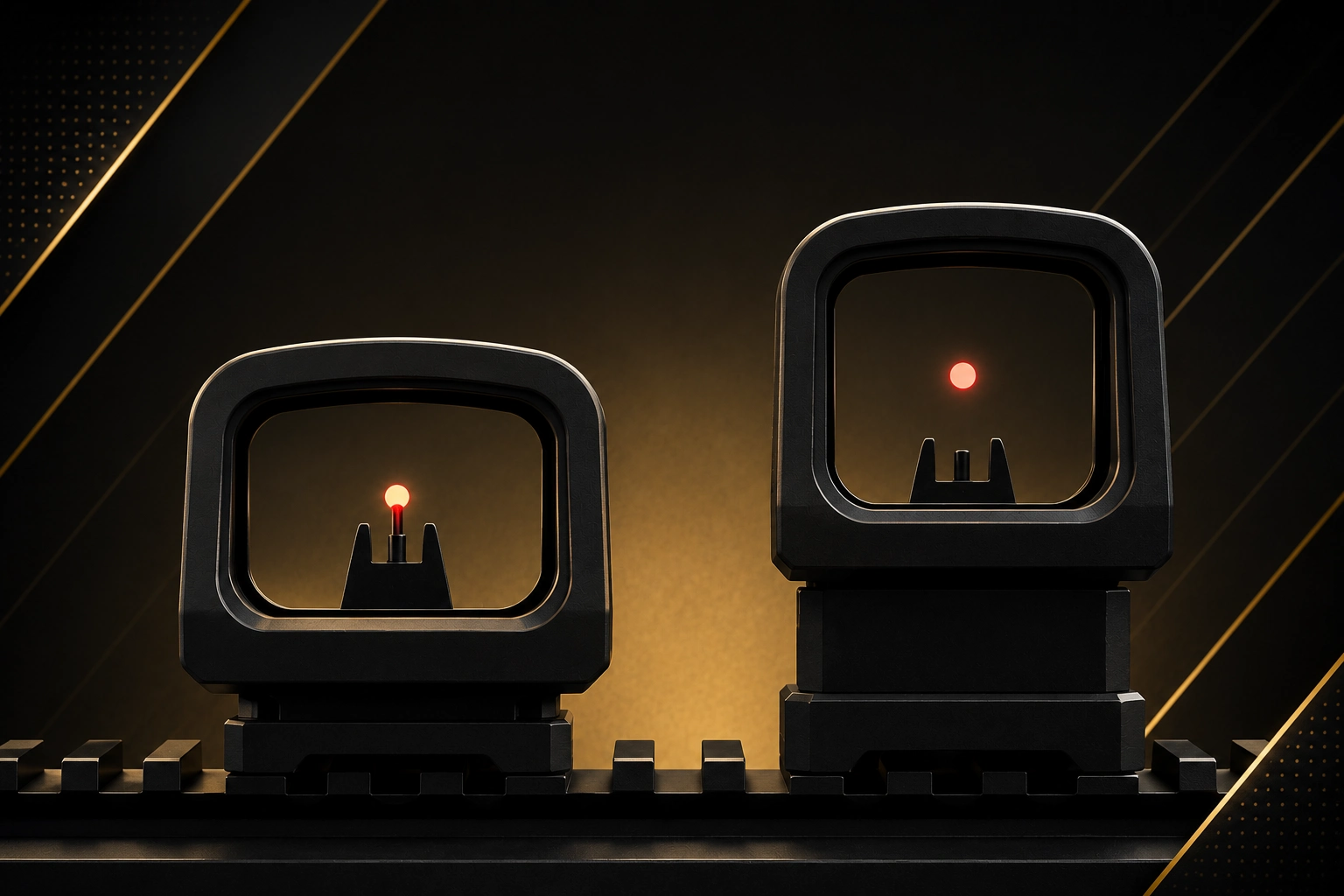
You get two main flavors. Absolute co-witness puts your optic at the same height as your iron sights, so the dot sits right on top of your front sight post. Lower 1/3 co-witness raises the optic slightly higher, so your irons only show up in the bottom third of the window.
Neither absolute nor lower 1/3 is a special feature tied to any single brand—it’s just a mounting height. Swap the red dot mount or add a spacer to switch setups without buying a new optic.
Exact AR-15 Iron Sight and Red Dot Mount Heights
Shooters and mount makers commonly peg standard AR-15 iron sights at around 2.6 inches above the center of the bore.
Absolute co-witness mounts are built to match that reference point, usually landing around 1.4 inches measured from the top of your rail to the center of your optic. Those two numbers aren’t competing figures, just measured from different starting lines: one from the bore center, the other from the rail top.
Lower 1/3 co-witness sits taller, typically between 1.54 and 1.69 inches from the rail, depending on the maker. That range is wider than most guides admit, and here’s why: the actual military standard your rail is built to, MIL-STD-1913, only defines the width and spacing of the rail slots. It says nothing about accessory height, which is exactly why co-witness height was left to each manufacturer to decide.
A quick riser check helps:
- A 0.83-inch riser typically provides absolute co-witness on a standard AR-15.
- A 1-inch riser typically yields a lower 1/3 co-witness on the same gun.
- Confirm the exact height against your specific optic and mount’s spec sheet, since the numbers do shift by brand.
Absolute Co-Witness: Pros, Cons, and Best Uses
Absolute co-witness has one big advantage: your cheek weld never changes. Whether you’re using the dot or the irons, your head stays put, so switching between them is instant.
That consistency comes at a cost. Your iron sights sit right in the middle of your optic window, which can clutter your sight picture, especially with fixed sights instead of flip-up ones.
Absolute co-witness works best when:
- You’re running flip-up or folding backup iron sights.
- You want your dot and irons to serve as a true backup for each other, like on a duty or home-defense carbine.
- You’re setting up a pistol red dot, which usually means pairing it with taller suppressor-height sights to make true absolute alignment possible.
Lower 1/3 Co-Witness: Pros, Cons, and Best Uses
Lower 1/3 co-witness trades some of that instant backup speed for a cleaner sight picture. Since the irons sit low in the window, your view through the dot feels more open and less busy.
The tradeoff is you’ll need to drop your cheek weld slightly to use the irons. It’s a small shift, but it takes a bit of practice to make it automatic.
Lower 1/3 tends to be the better fit when:
- Your platform has fixed iron sights that can’t fold down. AK-pattern rifles are the classic example, since the front sight has been pinned or clamped to the gas block.
- You’re a competition shooter who wants the widest, cleanest field of view possible.
- You want a more relaxed, higher cheek weld, which some shooters find more comfortable while wearing ear protection.
Which Red Dot Mount Height Should You Choose?
There’s no single right answer, but there’s a clear way to think it through based on how you’ll actually use your gun.
- Duty or home-defense rifle with flip-up irons: absolute co-witness gives instant backup with zero head movement.
- Fixed iron sights, like most AK or PCC platforms: you’re often locked into lower 1/3 by design.
- Competition or 3-Gun: lower 1/3 usually wins for its open, uncluttered field of view.
- Pistol red dot with suppressor-height sights: absolute co-witness is the standard pairing.
- Running a magnifier: match its height to whatever your specific magnifier mount calls for. Since lower 1/3 heights vary widely across brands, mixing components from different makers can cause more alignment headaches here, not fewer.
- Running night vision: this is its own category. True NVG-ready setups usually need an “extra-tall” mount around 1.93 inches, which typically won’t co-witness with standard irons. Don’t lump this in with regular lower 1/3—it’s a separate mounting decision.
How Zeroing a Red Dot Sight Differs Between the Two
Zeroing works the same basic way no matter which setup you pick. You zero your iron sights first, then zero your red dot separately, since they’re two independent systems sharing one mount.
Here’s where the setups actually look different once you’re done. A correct absolute co-witness zero means the dot sits almost exactly on top of your front sight post. A correct lower 1/3 zero still puts the dot above the irons instead of stacked on them, since that gap is built into the mount height itself.
That difference trips up a lot of new shooters. If you’re running lower 1/3 and the dot doesn’t sit right on your front post, that’s not a bad zero—that’s just how the setup is supposed to look.
Common Co-Witness Mistakes and Myths
A few habits and misunderstandings show up again and again, worth clearing up before you buy anything.
- Myth: Absolute co-witness is more “tactical” than lower 1/3. In reality, it’s about matching your platform and mission, not proving skill.
- Mistake: Assuming co-witness height is the same across every brand, or buying a riser before confirming your iron sight height and platform compatibility. Check the spec sheet first.
- Myth: Co-witness applies to magnified optics like LPVOs or prism scopes. It doesn’t—co-witness only applies to non-magnified red dots and holographic sights paired with irons.
- Mistake: Skipping a re-zero after switching mount heights. Any height change means confirming your zero again.
Choosing the Right Mount for Your Setup
Once you know which height you want, the hardware decision comes down to two things: your optic’s footprint and your iron sight height.
Match your mount or spacer to your optic’s specific footprint, whether that’s an Aimpoint Micro pattern, an RMR footprint, or something else. A mount built for the wrong footprint won’t fit correctly, no matter how good the height numbers look on paper.
Conclusion
Absolute co-witness vs 1/3 isn’t about which one is objectively better. It’s about what your gun, your iron sights, and your intended use actually call for.
Absolute co-witness gives you instant, zero-shift backup sights, while lower 1/3 gives you a cleaner field of view at the cost of a small cheek weld shift. Your platform and mission should drive the decision, not just personal taste.
Are you looking for a red dot sight? Browse Gold Trigger’s red dot sights. You may also call us at 713-485-5773.
Disclaimer: This article is for general informational and educational purposes only and isn’t a substitute for professional firearms training. Always follow your firearm and optic manufacturer’s specific instructions before installing any mount, riser, or sighting system. Improper mounting or zeroing can affect accuracy and safe operation, so seek hands-on instruction from a qualified firearms instructor or gunsmith if you’re unsure. All firearm use, modification, and accessory installation should comply with applicable federal, state, and local laws. Gold Trigger isn’t liable for outcomes resulting from misuse, improper installation, or failure to follow manufacturer guidance.
Comments