



Prism Scope vs Red Dot: Which One Should You Trust?
Published on: August 3, 2026
Reading time: 6 mins
A red dot wins on speed, weight, and versatility, while a prism scope wins on daylight reliability and clarity for tricky eyes—but the right pick really comes down to your gun, your mission, and your eyes.
Maybe you landed here after reading about red dot astigmatism, and you’re wondering if switching optics is the fix you need. Or maybe just out of curiosity, or for a different reason altogether. Nevertheless, this guide breaks down the real differences, shows you exactly when each optic wins, and gives you a simple framework so you don’t have to guess.
Highlights
- A red dot uses a projected LED reticle; a prism scope uses a reticle etched directly into glass.
- Etched reticles stay visible in daylight even if the battery dies—red dots go completely dark.
- Red dot sights are used on pistols, rifles, and shotguns, while prism scopes are mainly used on rifles and some shotguns.
- Prism scopes often come with built-in fixed magnification, so you can skip buying a separate magnifier.
- If astigmatism blurs your dot, an etched reticle is often easier on your eyes.
Prism Scope vs Red Dot: The Core Difference
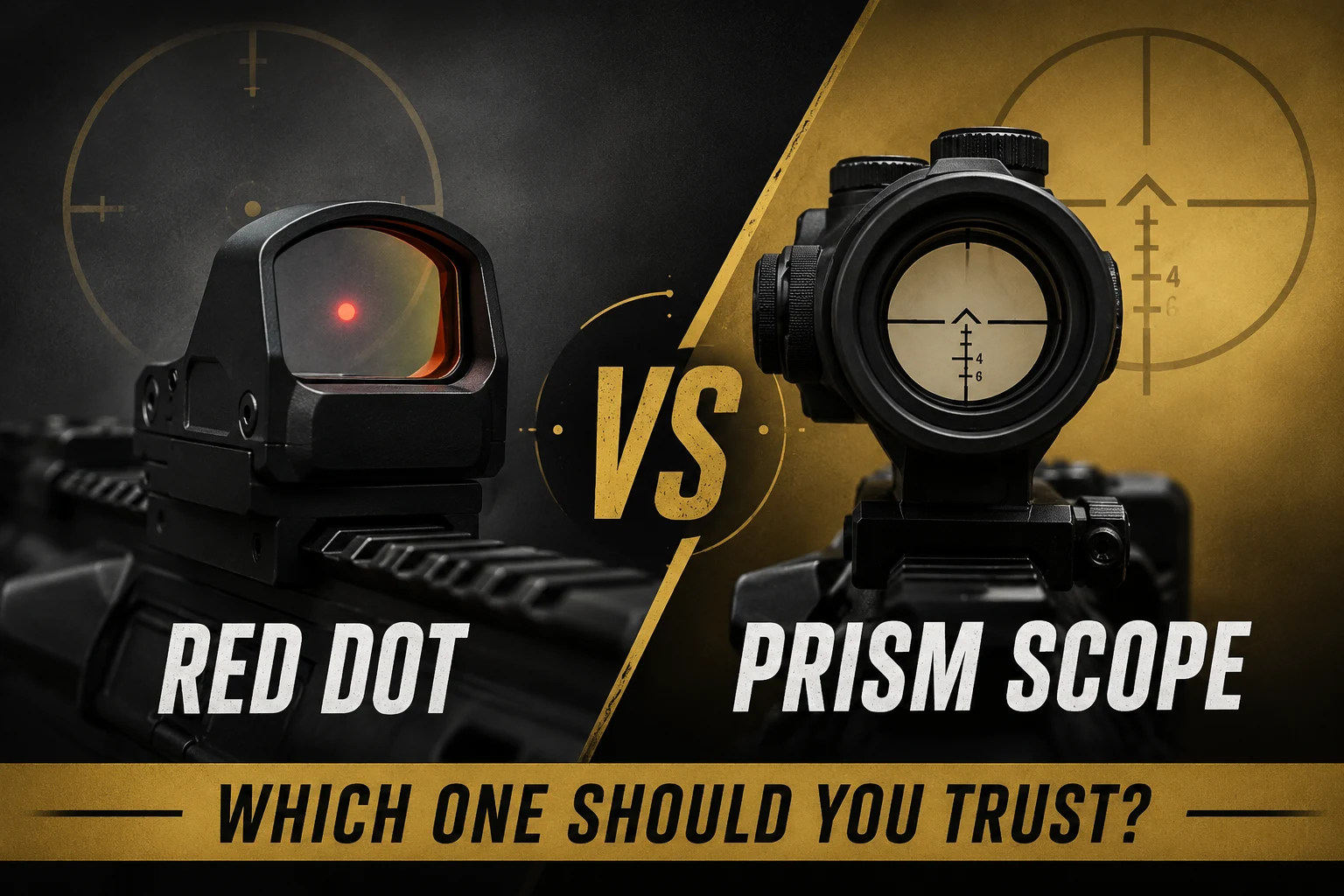
A red dot projects a beam of light onto a lens, and that beam is what you see as your aiming point.
A prism scope works differently. Instead of projecting anything, it uses a glass prism to fold the light path, and the reticle is physically etched into that glass.
How Red Dot Sights Work (And Where They Win)
A red dot beams an LED reticle onto a coated lens. There’s no glass prism doing the work, and there’s no built-in zoom—if you want magnification, you’ll need to add a separate magnifier behind it.
This simple design is exactly why red dots are so popular. Here’s where they genuinely shine:
- Fast target acquisition. Red dots typically have very forgiving eye relief and are designed to be parallax-free or nearly parallax-free at practical shooting distances, so your eye does not need to be perfectly centered behind the lens.
- They fit many firearms. You can mount a red dot on a pistol, a rifle, or a shotgun.
- Simple, clean sight picture. One dot, no clutter, which is ideal for close-quarters and fast-moving situations.
- A lower price of entry, generally speaking. Red dots often start cheaper than prism scopes at the entry level, though pricing varies a lot by brand and features, and the two categories overlap at the higher end.
Of course, nothing’s perfect. Red dots run entirely on battery power, and how long the battery lasts depends heavily on the model. Some cheaper units drain fast, while duty-grade optics often use auto-brightness or motion sensors to stretch a single battery across months of regular use.
They also can’t magnify on their own. If you have astigmatism, that tiny projected dot can look blurry, smeared, or starburst-shaped instead of clean and round.
We have a complete guide on how red dot sights work.
How Prism Scopes Work (And Where They Win)
A prism scope takes a completely different approach. Light travels through an internal glass prism, and the reticle itself is laser-etched right into that glass rather than projected onto it.
That construction gives prism scopes a few real advantages:
- Daylight reliability. Because the reticle is etched into the glass, it stays visible in daylight even if the illumination battery dies. In low light, though, you’ll still need some form of illumination, whether that’s a battery, fiber optic, or tritium, to actually see it clearly.
- Built-in magnification. Most prism scopes come in fixed powers like 1x, 3x, or 5x, so you get some reach without bolting on extra gear.
- More detailed reticles. Many prism scopes include bullet-drop compensation or ranging marks, which are handy for mid-range precision work.
- Friendlier for astigmatic eyes. Since the reticle is a physical etching rather than a projected light source, many shooters with astigmatism see it far more clearly than a red dot.
The tradeoffs are real, too. Prism scopes have a defined eye relief and eye box, similar to a traditional rifle scope, so they’re less forgiving if your head position shifts.
They’re also heavier and bulkier than most red dots; they don’t fit on a pistol, and they tend to run a bit pricier at a similar build quality, though budget and premium options exist on both sides.
Prism Scope vs Red Dot: Side-by-Side Comparison
| Feature | Red Dot | Prism Scope |
|---|---|---|
| Reticle type | Projected LED | Etched glass |
| Magnification | None (add-on only) | Fixed (1x-5x typical) |
| Eye relief | Forgiving, effectively unlimited | Defined, like a scope |
| Visible without battery | No | Yes, in daylight |
| Pistol-compatible | Yes | generally not a good fit for standard handguns |
| Typical weight | Light | Heavier |
| Astigmatism-friendly | Can be difficult | Generally easier |
Which One Fits Your Use Case?
Specs are useful, but they don’t tell you what to actually buy. Let’s match the optic to the job.
Home Defense
Inside a house, most encounters happen at very close range, so a red dot’s speed usually wins here. If you’re worried about a dead battery in a worst-case moment, a prism scope’s daylight-visible reticle is a reasonable backup plan.
Duty, Concealed Carry, or an Everyday Carbine
Weight and size matter a lot when you’re carrying gear all day, and that’s where a compact red dot usually pulls ahead of the bulkier prism scope.
Hunting
Many rifle hunting scenarios call for a bit more reach than home defense or close-quarters work, and a prism scope’s fixed magnification plus BDC reticle can genuinely help here. Just know that your actual hunting distances will vary widely depending on the game and terrain you’re working with.
Competition or 3-Gun
Shooters chasing both speed and precision often run a red dot paired with a flip-to-the-side magnifier, giving them the best of both without committing to a single fixed magnification.
If Astigmatism Is Your Real Problem
A prism scope’s etched reticle sidesteps the projected-dot distortion that causes starbursts and blur, but it’s not your only option. Lowering brightness, sizing up your dot, or trying corrective lenses can also help.
Common Myths About Prism Scopes and Red Dots
A few misconceptions keep floating around, so let’s clear them up.
- “Prism scopes are always more accurate.” Not exactly. Their reticles can be more detailed, but real-world accuracy still depends heavily on the shooter, not just the glass.
- “Red dots are only good for close range.” Pair one with a magnifier, and you can stretch well past typical close-quarters distances.
- “You need a working battery to see anything.” Not with a prism scope in daylight. The etched reticle stays visible even without battery-powered illumination as long as there’s enough ambient light to read it.
- “A prism scope fixes astigmatism.” It doesn’t fix your eyes. It just uses a different optical approach that happens to be easier for many astigmatic eyes to resolve. If you want the condition itself addressed, that’s a conversation for an eye doctor, not an optics chart.
Can You Run Both?
Yes. This is commonly known as a “piggyback” or “offset” configuration.
Also, a red dot with a flip-mount magnifier is a popular way to get red-dot speed with prism-scope-like reach when you need it.
Plenty of shooters also just run different optics on different platforms: a red dot on the pistol, a prism scope or magnifier setup on the rifle. There’s no rule that says your whole gun safe has to match.
Frequently Asked Questions
Is a prism scope better than a red dot?
Neither is universally better. A red dot is faster and lighter; a prism scope keeps its reticle visible in daylight without a battery and is often friendlier for astigmatic eyes.
Can you put a prism scope on a pistol?
Prism scopes are generally designed for rifles and some shotguns, and they are not commonly used on pistols.
Do prism scopes need batteries?
Only for illumination in low light. In daylight, the etched reticle remains visible even with the battery dead or removed.
Which is better for astigmatism, a prism scope or a red dot?
A prism scope’s etched reticle is generally easier for astigmatic eyes to resolve than a red dot’s projected LED dot.
What magnification do prism scopes come in?
Most come in fixed powers like 1x, 3x, or 5x, rather than an adjustable zoom range.
Conclusion
At the end of the day, a red dot and a prism scope solve the same basic problem—getting your eye on target fast, using two very different pieces of engineering. Red dots give you speed, low weight, and pistol-to-shotgun versatility, while prism scopes give you a daylight-reliable reticle, built-in magnification, and often a clearer sight picture if your eyes struggle with a projected dot.
There’s no universal winner here. Your home-defense carbine, your hunting rig, and your competition gun might genuinely call for different answers, and that’s completely normal.
Gold Trigger can help you if you’re looking for a red dot sight. Browse our selection, compare a few side by side, and pick the one that actually fits how you shoot. You can also call us at 713-485-5773.
Disclaimer: The information in this article is for educational purposes only and does not constitute medical or professional advice. Firearm laws and regulations vary by jurisdiction—always comply with all applicable federal, state, and local laws before purchasing or using any firearm accessory. For vision concerns affecting your shooting performance, consult a licensed optometrist or ophthalmologist. Always handle all firearms safely and responsibly. Gold Trigger assumes no liability for any injury, damage, or legal consequence resulting from the use or misuse of any information presented here.
Comments