



Best Budget Red Dot for AR-15: 7 Picks That Hold Zero
Published on: June 16, 2026
Reading time: 7 minutes
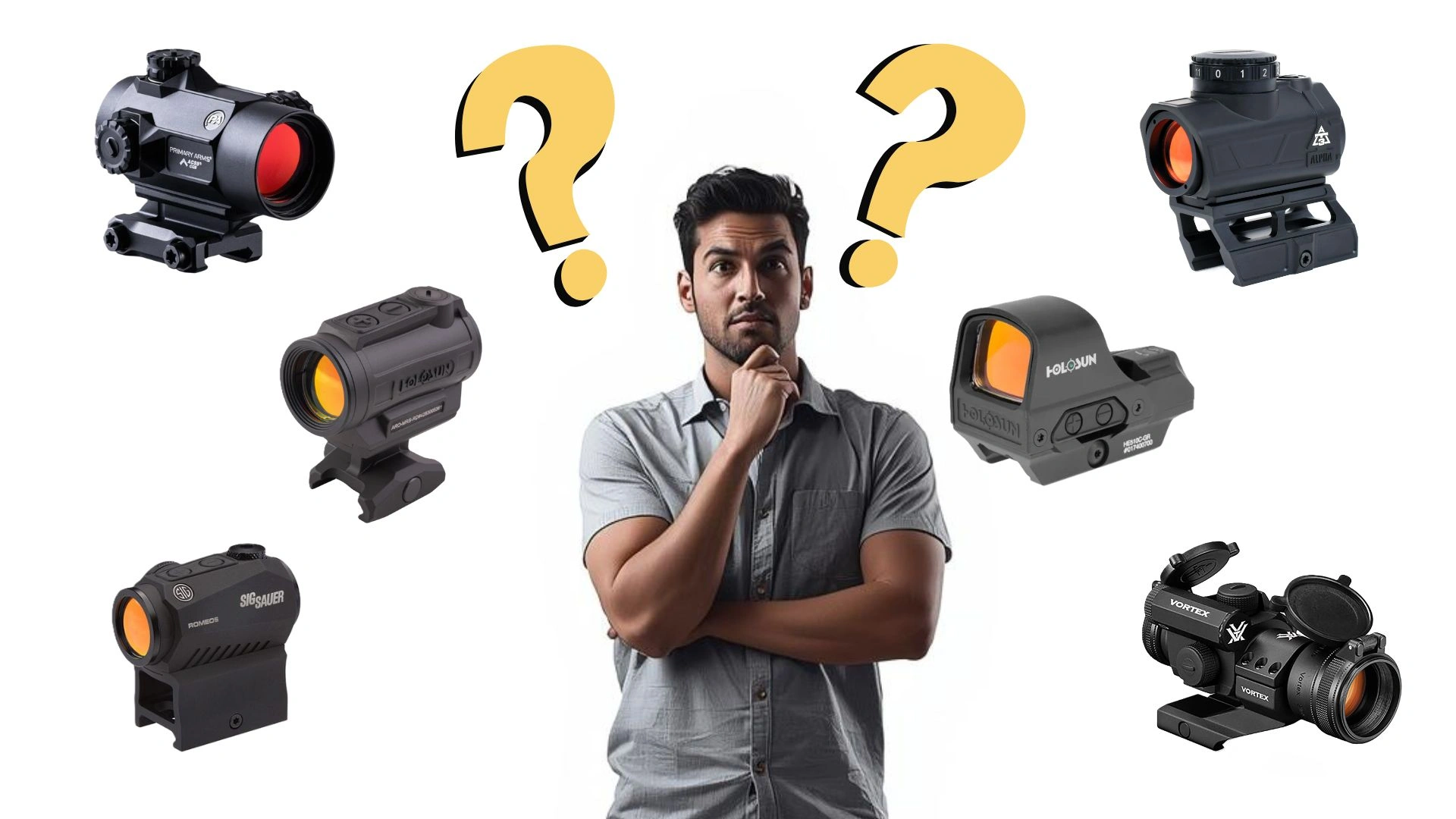
Looking for the best budget red dot for AR-15 rifle use? Here’s the short answer: the Sig Sauer Romeo5 leads at $130-$150, the Holosun ARO is the top closed-emitter pick that starts at $130, and the Holosun 510C is the go-to for magnifier setups—all under $350.
The best red dot for AR still depends on your build, even a budget one. This guide breaks each pick down by use case.
Highlights
- The Sig Sauer Romeo5 is the top overall budget pick for most AR-15 owners, priced at around $130-$150.
- The Holosun ARO is a closed-emitter optic—the LED is fully sealed against dust and debris.
- All battery life ratings here are at mid-level brightness, not maximum power.
- A cheap mount causes more zero loss than a budget optic—don’t cut corners there.
- Suppressed DI builds need more frequent zero checks due to increased bolt carrier cycling speed.
What “Budget” Means for an AR-15 Optic
Budget in this guide means $100–$350, split into three tiers. Sub-$100 no-name optics are excluded for one reason: they fail the most basic AR-15 test. Direct-impingement 5.56 cycling is relentless, and a weak housing or mount interface will walk your zero after just a few magazines.
The mount matters as much as the optic. A $130 optic on a quality mount outperforms that same optic on a flimsy $15 riser—every time.
| Tier | Price Range | Best Use Case | Key Feature |
|---|---|---|---|
| Mid-Budget | $100–$149 | Range, home defense AR | Shake-awake, aluminum housing |
| Upper-Budget | $150–$200 | Precision/competition AR | Multi-reticle, IPX7 or IP67 |
| Near-Premium | $200–$350 | All-purpose, upgrade path | Solar failsafe, wider window |
Top 7 Best Budget Red Dots for AR-15 Rifles, Ranked
1. Best Overall: Sig Sauer Romeo5
Price: $130-$150
The Romeo5 is the benchmark budget AR-15 optic in 2026—proven across range, home defense, and competition use.
MOTAC—Motion Activated Illumination—powers the optic the instant your rifle moves and shuts off when idle. For a home defense carbine sitting ready for weeks at a time, that’s the feature that matters most. The SOR52001 variant includes both mount heights out of the box, saving you $30–$50 on an aftermarket add-on.
- Specs: 2 MOA, 8 day + 2 NV settings, MOTAC shake-awake, IPX7, CR2032, 40,000+ hrs, 5.1 oz, Ships with low + 1.41″ riser (SOR52001 variant)
- Trade-off: 2 MOA is harder to find fast under stress than 4–6 MOA. CQB-only builds should jump to pick #7.
- Best for: Home defense carbines, general-purpose AR-15 builds, new red dot users.
2. Best Closed Emitter Under $150: Holosun ARO
Price: Around $135
Most guides treat the Holosun ARO as a pistol optic. It’s not—ARO stands for Advanced Rifle Optic, and its closed-emitter design is an advantage most budget lists miss entirely.
Here’s the practical difference: on an open-emitter optic, the LED sits exposed to the environment—dust and debris can reach it over time. On the ARO, the LED is fully sealed inside the housing. For a truck gun or a rifle stored in a dusty range bag, that protection is genuinely valuable.
- Specs: 2 MOA, 10 day + 2 NV settings, Shake-awake, IP67, CR2032, 50,000 hrs, 3.38 oz, Ships with lower 1/3 + low mounts, No solar failsafe (that’s the ARO EVO)
- Trade-off: the ARO’s 22mm window is narrower than open-emitter options at this price. If a wide field of view matters more than debris protection, the Romeo5 is the better fit.
- Best for: Dusty environments, vehicle-stored rifles, any build that needs a sealed LED.
3. Best for Range and Precision Work: Primary Arms SLx MD-25
Price: Around $199
Most budget lists jump from the Romeo5 straight to the 510C. The MD-25 fills that gap—and it’s the only pick here with a built-in ranging reticle.
The ACSS CQB reticle is what sets this optic apart. Instead of a plain dot, it uses a 65 MOA horseshoe with a chevron at center—the tip of that chevron is your exact zero point. Three BDC drops below the chevron give you bullet compensation out to 600 yards for 5.56 and 7.62 NATO loads. If you’d prefer a clean, single-point sight picture, the plain 2 MOA version is $50 less and equally capable for range work.
- Specs: 25mm window, 2 MOA dot or ACSS CQB reticle, AutoLive shake-awake, IP67, CR2032, 6.5 oz, Battery: 50,000 hrs (2 MOA) or 12,000+ hrs (ACSS CQB)
- Best for: Precision and range shooting under $200; anyone who wants a ranging reticle built in.
4. Best for Dedicated Home Defense: AT3 Tactical Alpha
Price: Around $119
If your AR lives in a nightstand or quick-access safe, the AT3 Alpha deserves a serious look. It’s the only optic in this guide with documented torture test data—1,000+ rounds including full-auto fire—with zero failures across drops and water immersion.
A 50,000-hour battery rating works out to roughly 5.7 years of continuous use. Paired with shake-awake, the optic manages itself completely—it’s live when you pick up the rifle and dark when you put it down.
- Specs: 2 MOA, 11 day + 2 NV settings, Shake-awake, CR2032, 50,000 hrs, Aluminum housing
- Trade-off: fewer aftermarket mount options compared to Holosun or Sig.
- Best for: Dedicated home defense builds where reliability and battery longevity come first.
5. Best for Magnifier Setups: Holosun 510C
Price: $300-$350
The 510C earns its place in a budget guide for one specific reason: window size. At 0.91 x 1.26 inches, it’s the widest open window of any optic in this guide—and that’s exactly what matters when you’re running a 3x flip-to-side magnifier.
When a magnifier engages, a small window kills your sight picture. The 510C’s large open window keeps the full reticle visible even with 3x glass behind it. The Holosun HM3X is the natural pairing.
- Specs: 6061 aluminum + titanium hood, IP67, Solar failsafe + shake-awake, MRS reticle (65 MOA circle + 2 MOA dot), CR2032, 50,000 hrs, 4.94 oz
- Trade-off: it’s bulky. If you’re not running magnification, the 510C is overkill.
- Best for: AR-15s running a 3x magnifier; versatile builds that want wide-field optics.
6. Best for AR-10 and .308 Builds: Vortex Strikefire II
Price: $89-$119
Almost no budget guide addresses .308 AR optic compatibility. That’s a real gap—and the Vortex Strikefire II fills it.
AR-10 platforms generate significantly more recoil energy per cycle than 5.56 ARs—heavier bolt carrier, more gas volume, more impulse per shot. Vortex advertises an extra-high recoil rating for the Strikefire II, and real-world .308 use backs it up. Always verify the manufacturer’s current specs before mounting any budget optic on a .308 platform.
- Specs: 30mm tube, 4 MOA red/green dot, 10 settings (2 NV), CR2 battery, 80,000 hrs at setting 6, 5.6 in / 7.2 oz, Vortex VIP lifetime warranty
- Trade-off: No shake-awake here—just a 12-hour auto-shutoff, so you’ll power it on manually before use. Fine for a range rifle; not the right call for home defense.
- Best for: AR-10 and .308 AR builds; shooters who want a fully transferable lifetime warranty.
7. Best for Astigmatism: Holosun 407K X2 Green
Price: $200-$250
If you have astigmatism, a 2 MOA red dot can appear as a starburst or comet smear—especially at rifle distances. The Holosun 407K X2 in green is built to work around exactly this.
On a rifle, your eye typically sits further from the optic than on a pistol. Mild astigmatism that’s tolerable at close range becomes a real distraction at 50–100 yards. Two things help: a larger dot (6 MOA resolves more cleanly for affected eyes) and green illumination.
Based on the CIE photopic luminosity function, the human eye is roughly 10x more sensitive to green light (~555nm) than red in daylight—which means a green dot appears crisp at lower brightness settings, and lower brightness reduces the light scattering that causes the starburst effect.
- Specs: 6 MOA green dot, 7075-T6 aluminum, IP67, Shake-awake, CR1632 side-load
- Trade-off: 6 MOA covers approximately 6 inches at 100 yards. This is a close-range tool, not a precision optic.
- Best for: AR-15 shooters with astigmatism or presbyopia; home defense and CQB builds.
Head-to-Head: All 7 Picks at a Glance
All battery life figures are rated at mid-level brightness. At maximum power, runtime drops significantly—sometimes to under 500 hours.
| Optic | Dot | Shake-Awake | Water Rating | Battery | Best For |
|---|---|---|---|---|---|
| Sig Sauer Romeo5 | 2 MOA | ✓ | IPX7 | 40,000 hrs | Home defense, all-purpose |
| Holosun ARO | 2 MOA | ✓ | IP67 | 50,000 hrs | Closed emitter, dusty use |
| Primary Arms SLx MD-25 | 2 MOA / ACSS CQB | ✓ | IP67 | 50K / 12K hrs | Precision, range work |
| AT3 Tactical Alpha | 2 MOA | ✓ | — | 50,000 hrs | Dedicated home defense |
| Holosun 510C | 2 MOA + ring | ✓ | IP67 | 50,000 hrs | Magnifier builds |
| Vortex Strikefire II | 4 MOA | ✗ | Waterproof | 80,000 hrs | AR-10 / .308 AR |
| Holosun 407K X2 Green | 6 MOA | ✓ | IP67 | 50,000 hrs | Astigmatism, CQB |
AR-15 Buying Factors Most Budget Guides Skip
Co-Witness Height: What It Actually Means
Co-witness height is one of the most overlooked specs when mounting a red dot on an AR-15. Get it wrong, and your backup iron sights become unusable.
With absolute co-witness, your dot and iron sights sit at the same height in the window—some shooters prefer this, others find it cluttered. With a lower 1/3 co-witness mount, the dot sits in the lower third of the window, and the irons appear below it for a cleaner sight picture.
For most standard flat-top ARs, lower 1/3 is the better setup.
Worth knowing: Picatinny and Weaver rails look nearly identical, but Picatinny slots are 0.206″ wide and consistently spaced, while Weaver slots are 0.180″ wide with variable spacing.
Most budget optics are Picatinny-spec. If you have an older Weaver rail, confirm compatibility before ordering.
Open Emitter vs. Closed Emitter
An open-emitter optic like the Romeo5 leaves the LED exposed to the environment—dust and debris can accumulate over time, though it’s not an issue for normal range or home use. A closed-emitter optic like the ARO seals the LED completely inside the housing.
The decision is simple: range and home defense use—open emitter is fine. Outdoor or dusty field conditions—closed emitter is worth the extra cost.
Running a Suppressor
Adding a suppressor to a direct-impingement AR-15 increases bolt carrier cycling speed. The suppressor traps muzzle gas, builds backpressure, and drives the bolt carrier rearward harder than the unsuppressed design intended—adding extra stress to your optic mounts over time.
Budget optics work fine on suppressed ARs. This isn’t a budget optic issue—it applies to premium optics, too. It’s just a reality of running a suppressed DI platform.
How to Zero Your Budget Red Dot
Budget optics hold zero reliably, but their adjustments are typically less refined than premium options—a clean initial zero is your safety net.
Three common 5.56 zero distances to consider:
- 25-yard zero. Easiest to set up. Second ballistic intersection at roughly 225 yards with standard 5.56 loads. Best for home defense and close-range builds.
- 50/200-yard zero. The most popular civilian carbine zero. Point of aim stays within about 1.5–2 inches of point of impact from 50 to ~225 yards. Best for general-purpose ARs.
- 36-yard zero. The USMC battlesight zero for full-length 5.56/M855 rifles. Effective to approximately 300 yards.
Always torque mount screws to the manufacturer’s specific spec—not a generic number. Typical torque ranges fall between 12 and 25 in-lbs, depending on the mount, and using the wrong value can cause more zero shift than the optic itself.
Verify zero every session for your first three outings, then quarterly for range rifles and pre-use for any defensive build.
Frequently Asked Questions
What is the best budget red dot for an AR-15?
The Sig Sauer Romeo5 is the top overall pick—shake-awake, IPX7 waterproofing, and proven zero retention at $120–$150. For a closed-emitter option under $150, the Holosun ARO is the strongest alternative.
Do budget red dots hold zero on an AR-15?
Yes—with the right mount. Named-brand optics from Sig, Holosun, AT3, and Vortex hold zero reliably under normal semi-auto fire. The weak point is almost always the mount, not the optic itself.
What MOA dot is best for an AR-15?
Use 2 MOA for precision and general-purpose shooting. Use 4–6 MOA for faster CQB acquisition. Home defense builds benefit from the larger dot; range and competition favor 2 MOA.
Can I run a budget red dot on a suppressed AR-15?
Yes, but plan for more maintenance. Use thread locker on your mount screws and verify zero every 200–300 rounds on any suppressed DI build.
What’s the difference between IPX7 and IP67?
IPX7 is waterproof to 1 meter for 30 minutes with no dust resistance rating. IP67 adds full dust-tight protection on top of that standard. Both work well for most civilian AR-15 use; IP67 wins in outdoor or dusty conditions.
Conclusion
Budget red dots for AR-15 rifles have never been more capable. The right pick comes down to your specific build—start with the Romeo5 for most standard ARs, the ARO if you need a sealed emitter, the 510C if you’re running a magnifier, and the Strikefire II for any .308 build. That last one is a gap most guides miss entirely.
Browse Gold Trigger’s selection of red dot sights—budget picks, mid-tier options, and premium optics all in one place. You can also call us at 713-485-5773.
Disclaimer: The products reviewed and recommended in this guide are intended for use with legally owned firearms only, in full compliance with all applicable federal, state, and local laws. Gold Trigger is not responsible for any injury, damage, or legal consequences resulting from the purchase, installation, or use of any firearm optic or accessory described herein. All red dot sights mounted on defensive or duty firearms should be regularly zeroed, inspected, and maintained by a qualified user. No optic—regardless of price—substitutes for proper firearm safety training and safe handling practices. Treat every firearm as if it is loaded at all times. Product prices and availability are subject to change; verify current pricing with the retailer before purchase. References to zero distances and ballistic data are approximate and will vary by ammunition, barrel length, sight height, and environmental conditions.
Comments