
Best Duty Red Dot Sights That Can Handle the Job

Published on: June 17, 2026
Best Duty Red Dot Sights That Can Handle the Job

Reading time: 8 mins

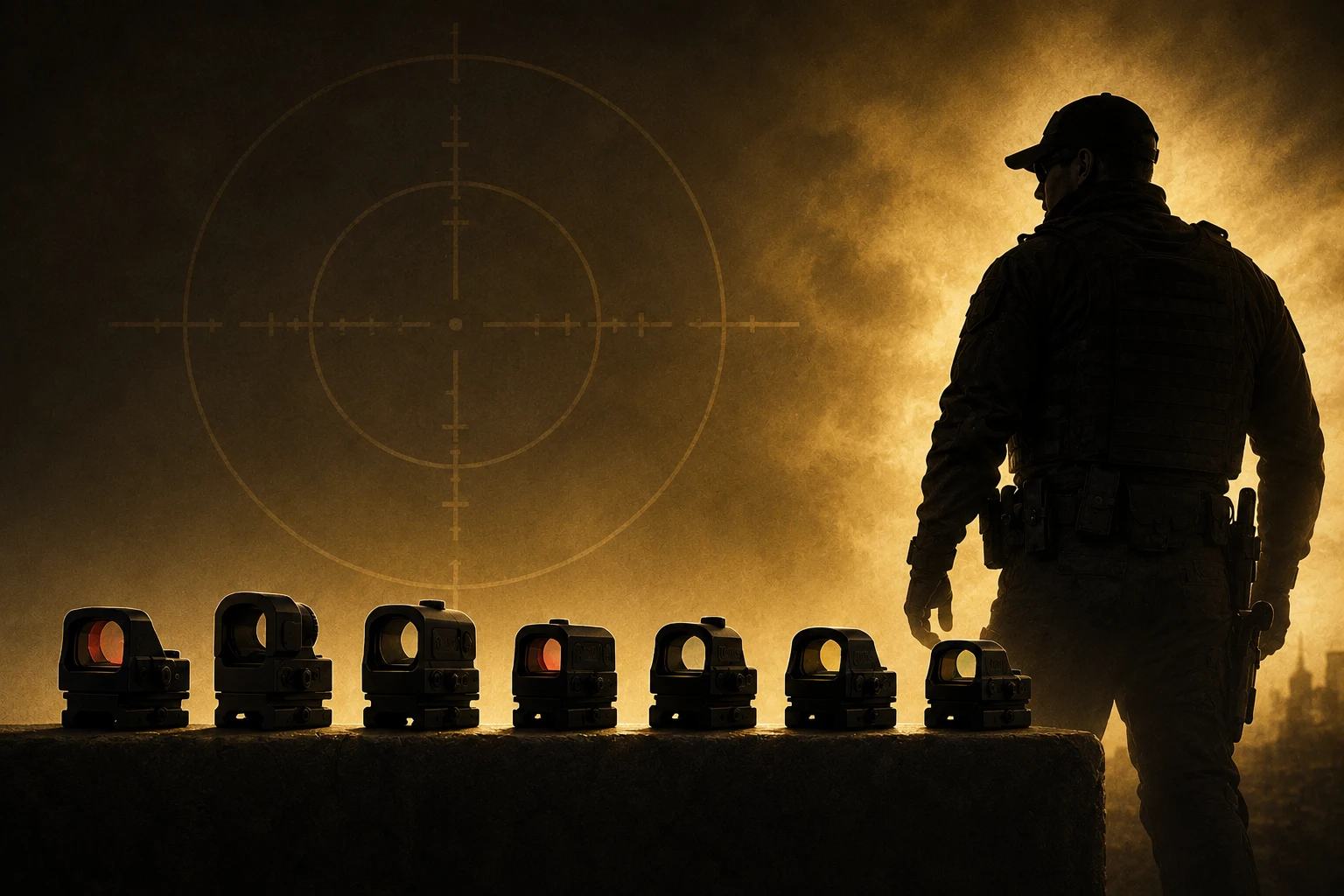
If you’re searching for the best duty red dot, you’ve already seen the same seven optics listed in the same order on a dozen different sites. What you haven’t seen is an honest answer to the question that actually matters: what separates a red dot that performs at the range from one that performs when everything goes wrong on a Tuesday night in the rain?

When looking for the best red dots, specs matter—but context matters more. Most buyers don’t get that context until after the purchase.

Highlights

  • The Trijicon RMR Type 2 is the top overall pick for duty use.
  • The Aimpoint ACRO P-2 is the better call if you work in rain, mud, or any environment where debris is a real concern.
  • Your standard duty holster won’t fit once you mount a red dot—figure this out before you buy the optic.
  • Always-on battery life matters more than shake-awake; 3+ years constant-on is the minimum bar.
  • Check your department’s approved optics list before purchasing anything—most buyers skip this and regret it.

What “Duty-Grade” Actually Means

A red dot can hold zero perfectly through 3,000 rounds at the range and still fail in the field. Not from bullet impact—from a concrete drop during a foot chase, from fog on an uncovered emitter, from pocket lint and daily carry debris, or from a retention struggle where the gun hits the ground.

A duty-grade red dot has to be durable in the specific ways that happen to law enforcement and military personnel. That’s a different failure environment than recreational shooting.

The five non-negotiables:

  • Zero retention under pistol-slide recoil. Pistols cycle violently, and duty-rated optics are tested for this specifically; range-ready optics often aren’t.
  • Constant-on battery life of 3+ years. Shake-awake is a battery conservation feature, not a duty readiness feature. If your optic is off when you draw, it’s already failed.
  • Submersion beyond IPX7. IPX7 (defined under IEC 60529) means just 1 meter for 30 minutes. Top duty optics are rated to 66–115 feet. That gap is the difference between “water resistant” and “doesn’t care that you fell in a ditch.”
  • Holster compatibility for Level II/III retention. This is the #1 missed factor. We’ll cover it in depth below.
  • Department or agency approval. This is the hard stop. An optic your department hasn’t approved isn’t a duty optic, regardless of how good it is.

This guide focuses on pistol-mounted red dots, with one patrol rifle pick included.

The 7 Best Duty Red Dot Sights for Real-World Use

1. Trijicon RMR Type 2

The Trijicon RMR Type 2‘s dominance in law enforcement isn’t because it’s the flashiest option—it’s because it survived the evaluation process that eliminated everything else.

The forged 7075-T6 aluminum housing uses a patented shape that redirects impact force away from the lens. When the gun gets dropped, thrown, or used in a way that wasn’t planned, the lens isn’t what absorbs the hit.

The 3.25 MOA dot runs over four years constant-on at setting 4 on a single CR2032. The RMR footprint is the widest-supported in the industry for Level II/III duty holsters.

The one real inconvenience: the bottom-loading battery requires removing the optic to swap the cell. Experienced users manage this by replacing it on a set schedule rather than waiting for it to die—which is better practice anyway.

  • Best for: Patrol officers, detectives, and military personnel who need proven pedigree and maximum holster compatibility.
  • The honest trade-off: very expensive (could reach to $700+); bottom battery access requires optic removal; open emitter leaves the LED exposed to environmental fouling.

2. Aimpoint ACRO P-2

Here’s an open-emitter failure mode that rarely gets discussed: your dot dies not from impact or battery death, but because it’s raining and debris is sitting between the LED and the lens. That happens. The Aimpoint ACRO P-2 was designed specifically to close that failure path.

Aimpoint introduced the ACRO series in 2018 as the first fully enclosed emitter design for pistols—and created an entirely new category of optic in the process. Nothing gets between the emitter and the lens: not rain, mud, sand, or anything else. The 3.5 MOA dot runs 50,000 hours (~5.7 years) on one side-loading CR2032 (no zero loss on battery swaps), submersible to 115 feet, built from 7075-T6 aluminum, with four NVD-compatible brightness settings.

The ACRO footprint is expanding into OEM pistol cuts, but it still has fewer Level II/III holster options than RMR. That’s the real operational constraint to check before buying.

  • Best for: High-tempo operators and patrol officers in environments where open-emitter fouling is a realistic risk.
  • The honest trade-off: Also very expensive; ACRO footprint means narrower duty holster selection versus RMR.

3. Holosun 509T

Departments don’t outfit one officer. At fleet scale, the difference between an ~$850 optic and a ~$400 one becomes a budget decision that can determine whether officers get optics at all. The Holosun 509T makes the case that enclosed-emitter protection doesn’t require a premium price.

The Grade 5 titanium housing is stronger and lighter than aluminum, with better corrosion resistance. Add the multi-reticle system (2 MOA dot / 32 MOA circle), solar failsafe, and up to 50,000 hours on a CR1632—and it’s a serious option.

The key thing buyers get wrong is that the 509T has its own proprietary clamping footprint, not a native RMR footprint. It ships with an RMR adapter plate—which works—but stacking that on a second adapter for your platform creates a “plate sandwich” with more potential failure points. For the most reliable setup, a directly milled 509T slide is the right call.

  • Best for: Departments outfitting multiple officers who need enclosed-emitter durability at roughly half the ACRO P-2’s cost.
  • The honest trade-off: Proprietary footprint; adapter plate setup adds mechanical complexity on some platforms.

4. Trijicon RCR

If you’ve run the RMR Type 2, you know the two genuine complaints: the bottom-loading battery and the open emitter. The Trijicon RCR (Ruggedized Closed Reflex) addresses both while keeping the RMR footprint native—meaning your existing RMR-cut slide and RMR-compatible holster work without modification.

It’s fully enclosed. The top-loading battery preserves zero during every swap. Forged 7075-T6 aluminum with the same patented impact-diverting housing shape as the RMR. 3.25 MOA dot. Six years of battery life at setting 5—the longest constant-on runtime on this list. Three NVD-compatible settings out of ten total. Waterproof to 66 feet.

The only fair knock: it’s newer. The RMR has been in production since the early 1990s, with over one million units produced as of 2026. The RCR doesn’t have that depth of field history yet. Early adoption data is strong, but if long-term proven reliability is the deciding factor for your agency, that gap is real.

  • Best for: Officers currently on the RMR who want a closed-emitter upgrade without changing their holster or slide cut.
  • The honest trade-off: Less long-term field data than the RMR; priced similarly to the ACRO P-2.

5. Aimpoint Micro T-2

The Aimpoint Micro T-2 has no shake-awake, no MOTAC, no auto-brightness, and no smart power management of any kind—and that is exactly why it belongs on a patrol rifle.

When you’re pulling a long gun from a patrol vehicle at 2 a.m. in response to a call, you don’t want to wonder if the optic woke up. You want it on. It’s been on. It runs 50,000 hours (~5.7 years) constant-on at setting 8 on one CR2032.

Hard-anodized aluminum alloy housing. 2 MOA dot. Submersible to 80 feet. Eight daylight and four NVD-compatible settings. LRP and QRP lever-release mounts are the standard configuration for patrol carbines.

  • Best for: Patrol rifle officers who need always-on reliability with zero variables.
  • The honest trade-off: Higher price point; no smart power features means battery replacement is a scheduled maintenance item.

6. Sig Sauer ROMEO2

Most optics on this list make a fixed choice: open or enclosed. The Sig Sauer ROMEO2 doesn’t. It ships as an open emitter and converts to fully enclosed using two steel shrouds and a polycarbonate rear window—all included in the box.

Train open, deploy enclosed, without buying two different optics.

It mounts directly to Sig P320 and P226 models with a Pro-cut slide. Standard slides need an adapter plate. Battery life is 25,000 hours (~2.9 years) on a CR2032. MOTAC and MAGNETAC are both included—the optic shuts off when holstered in a compatible holster and reactivates instantly on the draw. Three NVD-compatible settings out of fifteen total.

  • Best for: Agencies on P320 platforms who want one optic that transitions between training and duty without buying two.
  • The honest trade-off: 25,000-hour battery life is lower than the ACRO P-2 and 509T; Pro-cut footprint has fewer Level II/III holster options than RMR.

7. Holosun 507C X2
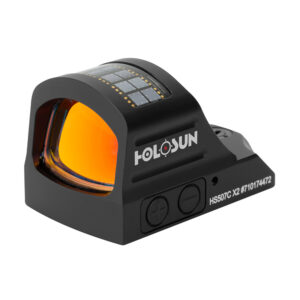
The Holosun 507C X2 doesn’t belong on a primary duty carry if you have other options. That’s the straight answer. Where it does belong: a transition gun for officers making their first move to red dot, a high-round training pistol where you don’t want to put range wear on a premium optic, or a backup where budget is the real constraint.

7075-T6 aluminum housing, multi-reticle system, solar failsafe, Shake Awake, 50,000-hour battery on a CR1632, native RMR footprint. Well-built for what it is.

The limitation you can’t engineer around is that it’s an open emitter. Debris and moisture can reach the LED. For full-time duty carry in unpredictable environments, that’s a real operational risk—not a theoretical one.

  • Best for: Officers transitioning to red dot, high-round training setups, backup pistols on a budget.
  • The honest trade-off: Open emitter limits viability for primary duty use in harsh conditions.

Quick Comparison Table

OpticEmitterDot (MOA)Battery LifeWaterproofFootprint
Trijicon RMR Type 2Open3.254+ yrs66 ftRMR
Aimpoint ACRO P-2Enclosed3.55.7 yrs115 ftACRO
Holosun 509TEnclosed2 / 32 MRS5.7 yrsIP67509T + adapter
Trijicon RCREnclosed3.256 yrs66 ftRMR
Aimpoint Micro T-2Open (recessed lens)25.7 yrs80 ftPicatinny
Sig ROMEO2Modular*3 or 6~2.9 yrsIPX7†DPP/Pro-cut
Holosun 507C X2Open2 / 32 MRS5.7 yrsIP67RMR
  • Ships as open emitter; converts to enclosed with included shrouds. †IPX7 = 1 meter for 30 minutes—the lowest waterproof rating on this list.

The Things Nobody Warns You About

The Holster Problem Catches Everyone Off Guard

Here’s the predictable sequence: you buy a red dot, mount it, go to holster the gun—and it doesn’t fit. You check the agency’s approved holster list. No optic-compatible options. Now there’s a new optic and no approved way to carry it on duty.

The moment you mount a red dot, your standard holster is incompatible—full stop. You need an optic-compatible holster with Level II or Level III retention, cut specifically for your optic model and platform.

Work this out before buying the optic. Confirm that an agency-approved, optic-compatible holster exists for your specific pairing, then buy.

Department Approval Is a Hard Gate

Some agencies maintain strict approved optics lists. Running an unapproved optic on a duty firearm can create liability exposure and put you outside armorer policy—which matters if your weapon is ever involved in an incident.

Verify with your agency’s firearms instructor before any purchase.

Mounting Is Only Half the Job

Holster draw friction loosens mounting screws over time. Always install with blue Loctite (medium-strength, removable) and verify zero monthly. If zero has drifted, check mounting screw torque before assuming the optic itself shifted.

NVD Compatibility: Know Before You Deploy

Not all optics on this list support night vision equally. Here’s where each one stands:

  • Full NVD support (3+ settings): Trijicon RMR Type 2, Aimpoint ACRO P-2, Aimpoint Micro T-2, Trijicon RCR
  • Limited NVD settings (2–3): Holosun 507C X2, Holosun 509T, Sig ROMEO2

If your agency uses or permits NVGs, this isn’t optional to know.

Choose by Role

  • Patrol Officer (pistol): Trijicon RMR Type 2 or Aimpoint ACRO P-2
  • Patrol Rifle Officer: Aimpoint Micro T-2
  • Detective / Plainclothes: Trijicon RMR Type 2 or Holosun 507C X2
  • Military / Operator: Aimpoint ACRO P-2 or Trijicon RCR
  • Budget Department Fleet: Holosun 509T or 507C X2
  • Firearms Instructor / Training: Holosun 507C X2 or 509T

Frequently Asked Questions

What’s the most trusted red dot for law enforcement?

The Trijicon RMR Type 2 leads on documented adoption. The Aimpoint ACRO P-2 is the fast-growing alternative for agencies prioritizing enclosed-emitter reliability.

Is 3 MOA or 6 MOA better for duty use?

3–3.5 MOA is the professional standard. At 25 yards, a 6 MOA dot subtends about 1.5 inches—enough to start covering precise aiming points on smaller targets. For duty engagements where precision and accountability matter, the smaller dot is the right call.

Can I put any red dot on my duty pistol?

No. Your department’s approved list, your slide’s optic cut, and available Level II/III holster options all constrain the decision. All three need to align. Start with the approved list and work backward.

How long should a duty red dot battery last?

Three years minimum on constant-on is the floor. The Trijicon RCR runs six years at setting 5—the longest on this list. Shake-awake is a convenience feature; always-on is the duty standard.

Open or enclosed emitter—which is better for duty?

Enclosed, if the rest of the system supports it. It eliminates the environmental fouling failure mode that open emitters can’t prevent when conditions are worst.

Conclusion

Choosing the best duty red dot isn’t just a spec comparison—it’s a system decision. The optic, the slide cut, the holster, and department policy all have to align, or the best optic on the market becomes unusable.

The Trijicon RMR Type 2 leads for most officers because of proven field history and the widest holster support. The ACRO P-2 leads when environmental protection is the priority. The RCR is the most compelling upgrade path for current RMR users. The Holosun 509T makes enclosed-emitter reliability accessible at department fleet pricing.

Sort the holster before the optic, get department approval before the purchase, and treat monthly zero verification as part of the job—not optional maintenance.

Ready to find the right fit? Browse our red dot sight selection at Gold Trigger—and if you’re not sure which optic works with your specific platform, we’re here to help you figure it out. You can also call us at 713-485-5773.

Disclaimer: The information in this article is for educational and informational purposes only. Always comply with all applicable federal, state, and local laws regarding firearm modifications. Before modifying any duty or service firearm, consult your department’s firearms policy, agency armorer, or authorized range officer. Gold Trigger assumes no liability for improper installation, misuse, or any injury, damage, or legal consequences arising from the use of any product discussed herein. Firearm modifications should only be performed by qualified individuals. Products featured here are for lawful use by eligible adults in accordance with applicable regulations.

Comments

Leave a Reply

Your email address will not be published. Required fields are marked *

Best Duty Red Dot Sights That Can Handle the Job

Best Duty Red Dot Sights That Can Handle the Job

Reading time: 8 mins

If you’re searching for the best duty red dot, you’ve already seen the same seven optics listed in the same order on a dozen different sites. What you haven’t seen is an honest answer to the question that actually matters: what separates a red dot that performs at the range from one that performs when everything goes wrong on a Tuesday night in the rain?

When looking for the best red dots, specs matter—but context matters more. Most buyers don’t get that context until after the purchase.

Highlights

  • The Trijicon RMR Type 2 is the top overall pick for duty use.
  • The Aimpoint ACRO P-2 is the better call if you work in rain, mud, or any environment where debris is a real concern.
  • Your standard duty holster won’t fit once you mount a red dot—figure this out before you buy the optic.
  • Always-on battery life matters more than shake-awake; 3+ years constant-on is the minimum bar.
  • Check your department’s approved optics list before purchasing anything—most buyers skip this and regret it.

What “Duty-Grade” Actually Means

A red dot can hold zero perfectly through 3,000 rounds at the range and still fail in the field. Not from bullet impact—from a concrete drop during a foot chase, from fog on an uncovered emitter, from pocket lint and daily carry debris, or from a retention struggle where the gun hits the ground.

A duty-grade red dot has to be durable in the specific ways that happen to law enforcement and military personnel. That’s a different failure environment than recreational shooting.

The five non-negotiables:

  • Zero retention under pistol-slide recoil. Pistols cycle violently, and duty-rated optics are tested for this specifically; range-ready optics often aren’t.
  • Constant-on battery life of 3+ years. Shake-awake is a battery conservation feature, not a duty readiness feature. If your optic is off when you draw, it’s already failed.
  • Submersion beyond IPX7. IPX7 (defined under IEC 60529) means just 1 meter for 30 minutes. Top duty optics are rated to 66–115 feet. That gap is the difference between “water resistant” and “doesn’t care that you fell in a ditch.”
  • Holster compatibility for Level II/III retention. This is the #1 missed factor. We’ll cover it in depth below.
  • Department or agency approval. This is the hard stop. An optic your department hasn’t approved isn’t a duty optic, regardless of how good it is.

This guide focuses on pistol-mounted red dots, with one patrol rifle pick included.

The 7 Best Duty Red Dot Sights for Real-World Use

1. Trijicon RMR Type 2

The Trijicon RMR Type 2‘s dominance in law enforcement isn’t because it’s the flashiest option—it’s because it survived the evaluation process that eliminated everything else.

The forged 7075-T6 aluminum housing uses a patented shape that redirects impact force away from the lens. When the gun gets dropped, thrown, or used in a way that wasn’t planned, the lens isn’t what absorbs the hit.

The 3.25 MOA dot runs over four years constant-on at setting 4 on a single CR2032. The RMR footprint is the widest-supported in the industry for Level II/III duty holsters.

The one real inconvenience: the bottom-loading battery requires removing the optic to swap the cell. Experienced users manage this by replacing it on a set schedule rather than waiting for it to die—which is better practice anyway.

  • Best for: Patrol officers, detectives, and military personnel who need proven pedigree and maximum holster compatibility.
  • The honest trade-off: very expensive (could reach to $700+); bottom battery access requires optic removal; open emitter leaves the LED exposed to environmental fouling.

2. Aimpoint ACRO P-2

Here’s an open-emitter failure mode that rarely gets discussed: your dot dies not from impact or battery death, but because it’s raining and debris is sitting between the LED and the lens. That happens. The Aimpoint ACRO P-2 was designed specifically to close that failure path.

Aimpoint introduced the ACRO series in 2018 as the first fully enclosed emitter design for pistols—and created an entirely new category of optic in the process. Nothing gets between the emitter and the lens: not rain, mud, sand, or anything else. The 3.5 MOA dot runs 50,000 hours (~5.7 years) on one side-loading CR2032 (no zero loss on battery swaps), submersible to 115 feet, built from 7075-T6 aluminum, with four NVD-compatible brightness settings.

The ACRO footprint is expanding into OEM pistol cuts, but it still has fewer Level II/III holster options than RMR. That’s the real operational constraint to check before buying.

  • Best for: High-tempo operators and patrol officers in environments where open-emitter fouling is a realistic risk.
  • The honest trade-off: Also very expensive; ACRO footprint means narrower duty holster selection versus RMR.

3. Holosun 509T

Departments don’t outfit one officer. At fleet scale, the difference between an ~$850 optic and a ~$400 one becomes a budget decision that can determine whether officers get optics at all. The Holosun 509T makes the case that enclosed-emitter protection doesn’t require a premium price.

The Grade 5 titanium housing is stronger and lighter than aluminum, with better corrosion resistance. Add the multi-reticle system (2 MOA dot / 32 MOA circle), solar failsafe, and up to 50,000 hours on a CR1632—and it’s a serious option.

The key thing buyers get wrong is that the 509T has its own proprietary clamping footprint, not a native RMR footprint. It ships with an RMR adapter plate—which works—but stacking that on a second adapter for your platform creates a “plate sandwich” with more potential failure points. For the most reliable setup, a directly milled 509T slide is the right call.

  • Best for: Departments outfitting multiple officers who need enclosed-emitter durability at roughly half the ACRO P-2’s cost.
  • The honest trade-off: Proprietary footprint; adapter plate setup adds mechanical complexity on some platforms.

4. Trijicon RCR

If you’ve run the RMR Type 2, you know the two genuine complaints: the bottom-loading battery and the open emitter. The Trijicon RCR (Ruggedized Closed Reflex) addresses both while keeping the RMR footprint native—meaning your existing RMR-cut slide and RMR-compatible holster work without modification.

It’s fully enclosed. The top-loading battery preserves zero during every swap. Forged 7075-T6 aluminum with the same patented impact-diverting housing shape as the RMR. 3.25 MOA dot. Six years of battery life at setting 5—the longest constant-on runtime on this list. Three NVD-compatible settings out of ten total. Waterproof to 66 feet.

The only fair knock: it’s newer. The RMR has been in production since the early 1990s, with over one million units produced as of 2026. The RCR doesn’t have that depth of field history yet. Early adoption data is strong, but if long-term proven reliability is the deciding factor for your agency, that gap is real.

  • Best for: Officers currently on the RMR who want a closed-emitter upgrade without changing their holster or slide cut.
  • The honest trade-off: Less long-term field data than the RMR; priced similarly to the ACRO P-2.

5. Aimpoint Micro T-2

The Aimpoint Micro T-2 has no shake-awake, no MOTAC, no auto-brightness, and no smart power management of any kind—and that is exactly why it belongs on a patrol rifle.

When you’re pulling a long gun from a patrol vehicle at 2 a.m. in response to a call, you don’t want to wonder if the optic woke up. You want it on. It’s been on. It runs 50,000 hours (~5.7 years) constant-on at setting 8 on one CR2032.

Hard-anodized aluminum alloy housing. 2 MOA dot. Submersible to 80 feet. Eight daylight and four NVD-compatible settings. LRP and QRP lever-release mounts are the standard configuration for patrol carbines.

  • Best for: Patrol rifle officers who need always-on reliability with zero variables.
  • The honest trade-off: Higher price point; no smart power features means battery replacement is a scheduled maintenance item.

6. Sig Sauer ROMEO2

Most optics on this list make a fixed choice: open or enclosed. The Sig Sauer ROMEO2 doesn’t. It ships as an open emitter and converts to fully enclosed using two steel shrouds and a polycarbonate rear window—all included in the box.

Train open, deploy enclosed, without buying two different optics.

It mounts directly to Sig P320 and P226 models with a Pro-cut slide. Standard slides need an adapter plate. Battery life is 25,000 hours (~2.9 years) on a CR2032. MOTAC and MAGNETAC are both included—the optic shuts off when holstered in a compatible holster and reactivates instantly on the draw. Three NVD-compatible settings out of fifteen total.

  • Best for: Agencies on P320 platforms who want one optic that transitions between training and duty without buying two.
  • The honest trade-off: 25,000-hour battery life is lower than the ACRO P-2 and 509T; Pro-cut footprint has fewer Level II/III holster options than RMR.

7. Holosun 507C X2
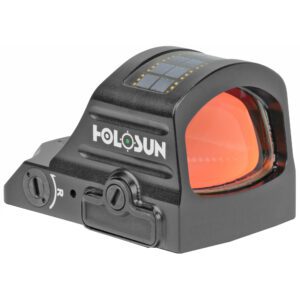
The Holosun 507C X2 doesn’t belong on a primary duty carry if you have other options. That’s the straight answer. Where it does belong: a transition gun for officers making their first move to red dot, a high-round training pistol where you don’t want to put range wear on a premium optic, or a backup where budget is the real constraint.

7075-T6 aluminum housing, multi-reticle system, solar failsafe, Shake Awake, 50,000-hour battery on a CR1632, native RMR footprint. Well-built for what it is.

The limitation you can’t engineer around is that it’s an open emitter. Debris and moisture can reach the LED. For full-time duty carry in unpredictable environments, that’s a real operational risk—not a theoretical one.

  • Best for: Officers transitioning to red dot, high-round training setups, backup pistols on a budget.
  • The honest trade-off: Open emitter limits viability for primary duty use in harsh conditions.

Quick Comparison Table

OpticEmitterDot (MOA)Battery LifeWaterproofFootprint
Trijicon RMR Type 2Open3.254+ yrs66 ftRMR
Aimpoint ACRO P-2Enclosed3.55.7 yrs115 ftACRO
Holosun 509TEnclosed2 / 32 MRS5.7 yrsIP67509T + adapter
Trijicon RCREnclosed3.256 yrs66 ftRMR
Aimpoint Micro T-2Open (recessed lens)25.7 yrs80 ftPicatinny
Sig ROMEO2Modular*3 or 6~2.9 yrsIPX7†DPP/Pro-cut
Holosun 507C X2Open2 / 32 MRS5.7 yrsIP67RMR
  • Ships as open emitter; converts to enclosed with included shrouds. †IPX7 = 1 meter for 30 minutes—the lowest waterproof rating on this list.

The Things Nobody Warns You About

The Holster Problem Catches Everyone Off Guard

Here’s the predictable sequence: you buy a red dot, mount it, go to holster the gun—and it doesn’t fit. You check the agency’s approved holster list. No optic-compatible options. Now there’s a new optic and no approved way to carry it on duty.

The moment you mount a red dot, your standard holster is incompatible—full stop. You need an optic-compatible holster with Level II or Level III retention, cut specifically for your optic model and platform.

Work this out before buying the optic. Confirm that an agency-approved, optic-compatible holster exists for your specific pairing, then buy.

Department Approval Is a Hard Gate

Some agencies maintain strict approved optics lists. Running an unapproved optic on a duty firearm can create liability exposure and put you outside armorer policy—which matters if your weapon is ever involved in an incident.

Verify with your agency’s firearms instructor before any purchase.

Mounting Is Only Half the Job

Holster draw friction loosens mounting screws over time. Always install with blue Loctite (medium-strength, removable) and verify zero monthly. If zero has drifted, check mounting screw torque before assuming the optic itself shifted.

NVD Compatibility: Know Before You Deploy

Not all optics on this list support night vision equally. Here’s where each one stands:

  • Full NVD support (3+ settings): Trijicon RMR Type 2, Aimpoint ACRO P-2, Aimpoint Micro T-2, Trijicon RCR
  • Limited NVD settings (2–3): Holosun 507C X2, Holosun 509T, Sig ROMEO2

If your agency uses or permits NVGs, this isn’t optional to know.

Choose by Role

  • Patrol Officer (pistol): Trijicon RMR Type 2 or Aimpoint ACRO P-2
  • Patrol Rifle Officer: Aimpoint Micro T-2
  • Detective / Plainclothes: Trijicon RMR Type 2 or Holosun 507C X2
  • Military / Operator: Aimpoint ACRO P-2 or Trijicon RCR
  • Budget Department Fleet: Holosun 509T or 507C X2
  • Firearms Instructor / Training: Holosun 507C X2 or 509T

Frequently Asked Questions

What’s the most trusted red dot for law enforcement?

The Trijicon RMR Type 2 leads on documented adoption. The Aimpoint ACRO P-2 is the fast-growing alternative for agencies prioritizing enclosed-emitter reliability.

Is 3 MOA or 6 MOA better for duty use?

3–3.5 MOA is the professional standard. At 25 yards, a 6 MOA dot subtends about 1.5 inches—enough to start covering precise aiming points on smaller targets. For duty engagements where precision and accountability matter, the smaller dot is the right call.

Can I put any red dot on my duty pistol?

No. Your department’s approved list, your slide’s optic cut, and available Level II/III holster options all constrain the decision. All three need to align. Start with the approved list and work backward.

How long should a duty red dot battery last?

Three years minimum on constant-on is the floor. The Trijicon RCR runs six years at setting 5—the longest on this list. Shake-awake is a convenience feature; always-on is the duty standard.

Open or enclosed emitter—which is better for duty?

Enclosed, if the rest of the system supports it. It eliminates the environmental fouling failure mode that open emitters can’t prevent when conditions are worst.

Conclusion

Choosing the best duty red dot isn’t just a spec comparison—it’s a system decision. The optic, the slide cut, the holster, and department policy all have to align, or the best optic on the market becomes unusable.

The Trijicon RMR Type 2 leads for most officers because of proven field history and the widest holster support. The ACRO P-2 leads when environmental protection is the priority. The RCR is the most compelling upgrade path for current RMR users. The Holosun 509T makes enclosed-emitter reliability accessible at department fleet pricing.

Sort the holster before the optic, get department approval before the purchase, and treat monthly zero verification as part of the job—not optional maintenance.

Ready to find the right fit? Browse our red dot sight selection at Gold Trigger—and if you’re not sure which optic works with your specific platform, we’re here to help you figure it out. You can also call us at 713-485-5773.

Disclaimer: The information in this article is for educational and informational purposes only. Always comply with all applicable federal, state, and local laws regarding firearm modifications. Before modifying any duty or service firearm, consult your department’s firearms policy, agency armorer, or authorized range officer. Gold Trigger assumes no liability for improper installation, misuse, or any injury, damage, or legal consequences arising from the use of any product discussed herein. Firearm modifications should only be performed by qualified individuals. Products featured here are for lawful use by eligible adults in accordance with applicable regulations.

Leave a Reply

Your email address will not be published. Required fields are marked *

Shopping cart0
There are no products in the cart!