Best Red Dot for AR: The Ultimate Buying Guide

Published on: May 27, 2026

Best Red Dot for AR The Ultimate Buying Guide

Reading time: 7 mins 45 sec

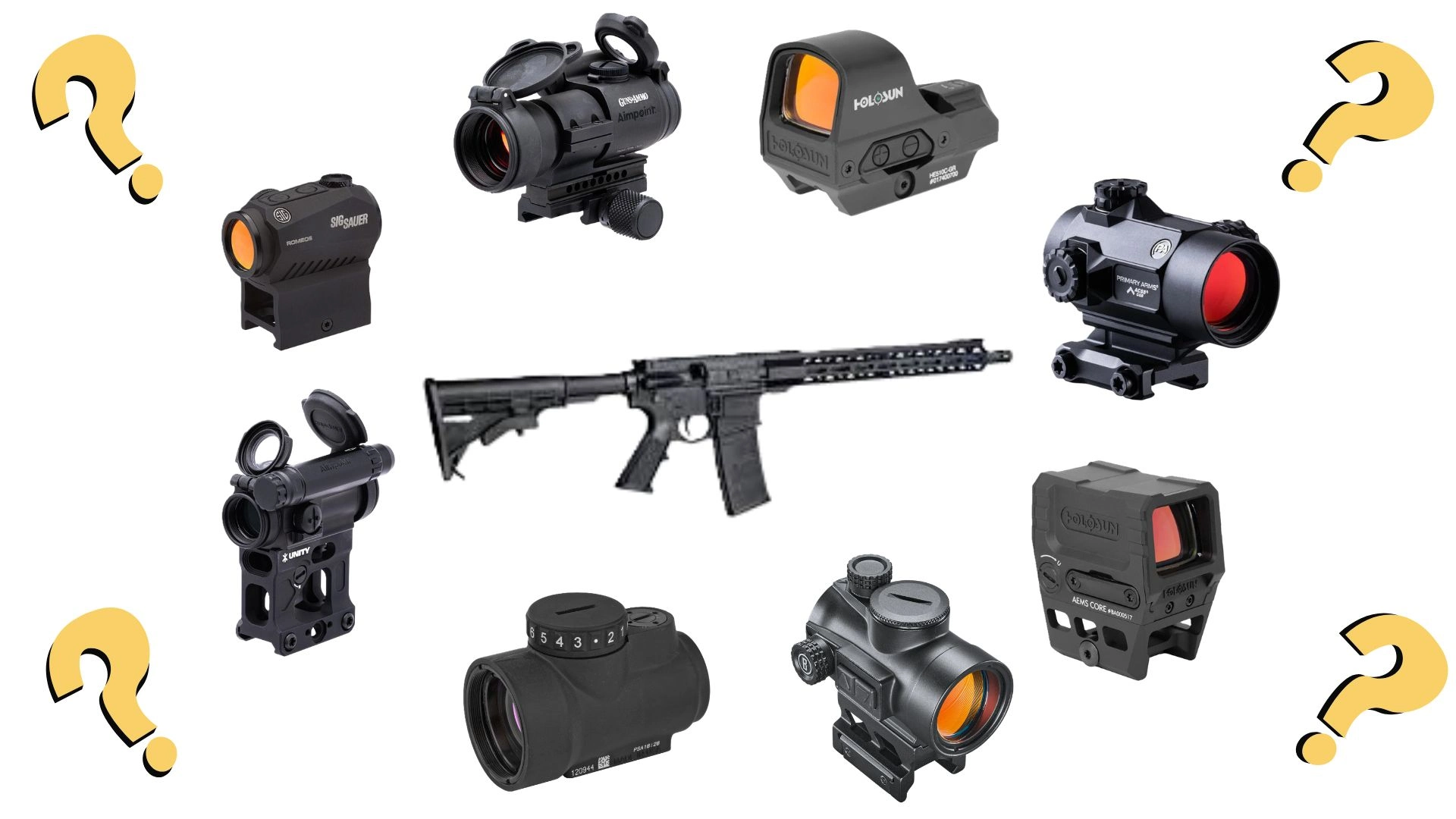
If you’re searching for the best red dot for AR rifles, here’s the thing most buying guides won’t tell you upfront: the right optic depends entirely on your build. A standard AR-15 rifle, an AR pistol, and a home defense setup each have different priorities—and what wins on one can be dead wrong on another.

This guide gets straight to the build-by-build breakdown, the tiered picks, and the AR pistol-specific factors that most optic guides gloss over.

Highlights

  • Your AR build type matters more than brand name when picking a red dot.
  • AR pistols need lighter, more compact optics than rifle-length ARs.
  • The mid-range tier ($200–$300) covers the vast majority of civilian AR needs.
  • Battery life ratings like “50,000 hours” are measured at mid-level brightness—runtime drops at full power.
  • Never skip zeroing—even a premium optic misses on a rifle that hasn’t been zeroed.

Why Your Build Changes Everything

The optic that’s perfect for a 16″ AR-15 can be completely wrong for a compact pistol build. Here’s a fast breakdown by configuration.

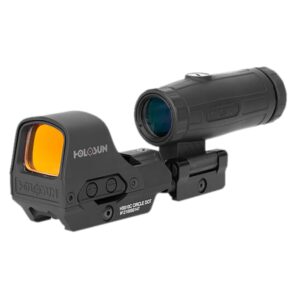
  • AR-15 Rifle (16″+ barrel): The most flexible platform. It handles larger, heavier optics without balance issues, and you’ve got full freedom to run a big open-window red dot or add a 3x flip-to-side magnifier behind it.
  • AR Pistol (barrel under 16″, no stock): Legally defined by the ATF as a firearm without a shoulder stock and a barrel under 16 inches. Without a stock, compact and light matters—heavy tube optics throw off balance on a short build. An SBR (short-barreled rifle) is a separate legal category requiring ATF registration; the optic logic for SBRs mirrors AR pistols.
  • AR-10 / .308 builds: These generate significantly more recoil energy than 5.56. Always check manufacturer recoil ratings before mounting a red dot on a .308 AR—not every optic is rated for it.
  • Home defense AR: Battery management and reliability are everything. You want shake-awake so the optic wakes up instantly when you grab the rifle, and a battery life measured in years, not months.
  • Competition / 3-gun AR: Dot size, window size, and lens clarity become premium factors. A larger viewing window speeds up transitions, and a 2 MOA dot gives you the precision for tighter targets at distance.

Key Specs That Actually Matter for AR Builds

Dot Size (MOA) for Your Use Case

MOA (Minute of Angle) equals approximately 1 inch of coverage at 100 yards. On a red dot, it tells you how large the dot appears.

  • 1–2 MOA: Precise, better for distance. Slower to pick up under stress.
  • 4–6 MOA: Faster acquisition, ideal for CQB and home defense. At 100 yards, a 4 MOA dot covers 4 inches—that’s the trade-off.

Home defense and CQB get 4–6 MOA; general-purpose and competition get 2 MOA; everything in between sits at 2–4 MOA.

Battery Type by Model

Not all premium red dots use the same battery. Here’s what the major AR-friendly models run on:

  • CR2032 (coin cell): Trijicon MRO, Holosun 510C, Aimpoint Micro T-2. Widely available.
  • DL1/3N (also labeled CR1/3N or 2L76, compact 3V lithium): Aimpoint PRO. Less common in retail stores—stock a spare when you buy one.
  • AAA (standard alkaline): Aimpoint CompM5. Easy to find anywhere.

Battery life specs are always measured at a mid-level brightness setting. At maximum brightness, runtime drops significantly—factor that in when comparing specs.

Housing: 6061 vs. 7075 Aluminum

Both alloys weigh nearly the same—the difference is in strength.

7075-T6 has nearly double the tensile strength of 6061-T6, making it more impact-resistant. 6061 offers better corrosion resistance and costs less to produce.

Premium and mil-spec optics use 7075 for durability under hard use, not to save weight. Some optics (like the Holosun 510C) combine a 6061 aluminum body with a separate titanium hood that absorbs impacts before they reach the glass—a smart engineering choice at that price point.

Best Red Dot for AR-15: Top Picks by Tier

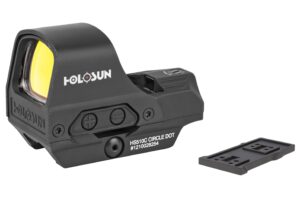
Best Overall: Holosun 510C (~$250–$290)
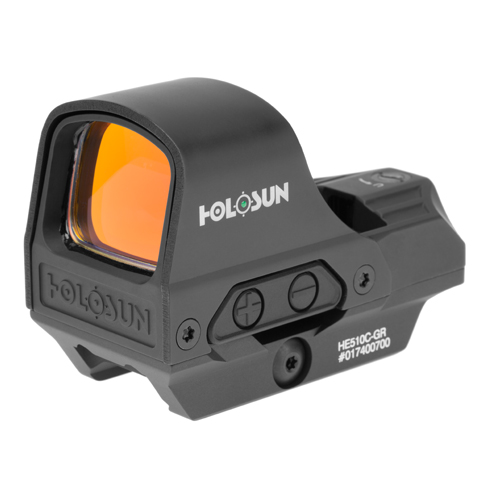
For most AR-15 owners who want one optic that handles range trips, training, and home defense backup, the Holosun 510C is hard to beat.

Its 0.91 x 1.26-inch open window gives you fast target acquisition, and the Multi-Reticle System on select models lets you toggle between a 65 MOA circle + 2 MOA dot, dot only, or circle only.

The 6061 aluminum body with titanium hood is IP67-rated (submersion to 1 meter for 30 minutes), and the solar failsafe plus shake-awake means you’re rarely worried about battery management.

The 510C uses a CR2032 battery rated for 50,000 hours at mid-level brightness—over 5 years of continuous use at that setting. The optic itself weighs 4.94 oz; with the included quick-detach mount, you’re at about 7.6 oz total.

Honest weakness: it’s bulkier than tube-style options and not the right call for an AR pistol or ultra-lightweight build. But on a standard AR-15, it punches well above its price.

Best Budget: SIG Sauer Romeo5 (~$150–$200)

At the top of the budget tier, the Romeo5 includes MOTAC (Motion Activated Illumination—SIG’s shake-awake equivalent), a 2 MOA dot, 10 brightness settings with 2 NV-compatible modes, and both low and absolute co-witness mounts in the box.

That’s a feature set you’d expect from something $100 more expensive.

The Bushnell TRS-26 ($199.95) could also fit in this category. It has a 3 MOA dot and manual on/off. It’s range-only gear—not for home defense—but it’s a legitimate entry point for getting familiar with red dots before spending more.

One rule for this tier: avoid no-name optics with no recoil rating and no brand accountability. A named brand’s budget optic will outlast a generic every time.

Best Mid-Range: $200–$300

This is where most civilian AR owners should land. The Holosun 510C sits at the top of this tier and doubles as the overall pick above.

Just below it, the Primary Arms SLX MD-25 ($199.99) is worth a look—25mm window, 2 MOA dot, shake-awake, and an ACSS Aurora reticle option for ranging. The Romeo5 anchors the lower end.

What you gain here over budget: better lens coatings, NV-compatible modes, side-loading batteries (no need to dismount the optic to swap cells), and more reliable zero retention under recoil.

Best Premium: $300–$700

  • Aimpoint PRO ($450–$500): The go-to for law enforcement and serious civilian users who want proven LE pedigree without crossing $1,000. It’s submersible to 45 meters, runs 30,000 hours on a single DL1/3N battery, and has a 2 MOA dot with 10 brightness settings (4 NV-compatible). It runs constantly—no auto-off—which is exactly what you want on a duty or home defense rifle. Just keep a spare DL1/3N battery on hand since it’s less common at retail.
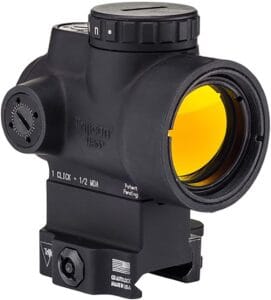
  • Trijicon MRO ($400–$500): The MRO‘s 25mm objective uses a tapered light path that Trijicon says delivers a viewing area 44% larger than comparable tube-style optics—and on the range it shows. The 4.1 oz figure you’ll see is optic-only weight, without a mount. Battery life is 5 years of continuous use on a single CR2032 at day setting 3. Clean glass, compact footprint, and a favorite of professional users for good reason.
  • Holosun AEMS ($315–$400): The Holosun AEMS is a newer closed-emitter option with a 35mm lens, IP68 waterproof rating, MRS reticle, NV modes, and 7075-T6 aluminum housing. The sealed emitter protects the LED better than the 510C’s open design—worth the step-up if you’re running in dusty or wet conditions regularly.

The “buy once, cry once” argument applies here only if you’re actually running the rifle in a duty or critical-use role. For a range rifle, mid-range covers you just fine.

Best Mil-Spec/Duty-Grade: $700+

  • Aimpoint CompM5 ($950–$1,100): Current-generation compact military red dot. Runs 50,000 hours on a single AAA battery at setting 7, 6 daylight and 4 NV settings, submersible to 45 meters, rated from -49°F to +160°F. Trusted by top-tier military units worldwide.
  • Aimpoint CompM4s ($1,000+): The exact optic issued to U.S. Army infantry as the M68 Close Combat Optic (CCO). It runs 80,000 hours on a single AA battery—over 9 years of continuous operation. Heavier at around 17.6 oz with the mount, but nothing else on the market matches that battery figure.
  • Aimpoint Micro T-2 ($900+): At 3.4 oz (optic only), this is the choice when you need the smallest possible serious optic. 50,000-hour battery on a CR2032, 12 brightness settings, submersible to 25 meters.

For civilian use, this tier is often overkill. But if the rifle is a serious home defense tool or you simply want gear that will never fail you under any condition, the investment holds up.

Best Red Dot for AR Pistol: What Changes at Short Barrel Lengths

An AR pistol—a firearm without a shoulder stock and a barrel under 16 inches per ATF classification—needs a different optic approach than a rifle-length build.

In 5.56, a shorter barrel doesn’t increase recoil impulse dramatically. What it does increase is muzzle blast and concussive force—and without a shoulder stock, your overall controllability drops. For pistol-caliber AR builds (9mm, .300 BLK), recoil dynamics shift further, so always check the optic’s rated recoil spec before mounting.

Here’s what matters specifically on an AR pistol:

  • Weight: Balance is more sensitive on a compact build. Heavy tube optics that work fine on a 16″ rifle tip the front of a short pistol build and make it harder to run quickly. Keep it under 3–4 oz if you can. The Holosun 407C/507C and Aimpoint Micro T-2 are built for exactly this.
  • Mount height: Without a stock, absolute co-witness can feel cluttered—lower 1/3 co-witness is the typical preference for a cleaner sight picture in a non-shouldered hold.
  • Compact footprint: The optic should sit within the receiver area. Nothing hanging past the gas block.

Top picks for AR pistols:

  • **Holosun 407C (2 MOA dot) / 507C (circle-dot MRS)**: Lightweight, solar failsafe, shake-awake. Both use the RMR footprint and are popular on pistol builds for good reason.
  • Aimpoint Micro T-2: 3.4 oz, 50,000 hours, 12 settings. The gold standard for compact builds where you can’t compromise on reliability.
  • Trijicon MRO: Its low profile and small footprint make it viable on pistol builds that need a step up in glass quality.

SBR owners, the same logic applies—you have a stock, so balance is slightly less critical, but compact and lightweight still wins on short builds.

Zeroing Your AR Red Dot: The Short Version

A $300 red dot properly zeroed beats a $1,000 optic that isn’t. This is the part most buyers skip—don’t.

Common zero distances for 5.56 AR builds:

  • 25-yard zero: Easy to establish, practical for AR pistols. The second ballistic intersection falls at roughly 225–250 yards, depending on your ammo and sight height.
  • 50-yard zero (50/200): The most popular civilian carbine zero. Trajectory stays within about 1.5–2 inches of your point of aim between 50 and ~225 yards—close enough for center-mass hits without holdover adjustments. The “200-yard” name is a rough average; the exact second crossing depends on your specific load.
  • 36-yard zero: The USMC battlesight zero for full-length 5.56 rifles with M855 62-grain ammo. Effective out to roughly 300 yards on that platform.

For AR pistols, use a 25-yard zero. The shorter effective range of a pistol build makes it the practical choice.

One mounting note before you zero: always torque to your mount manufacturer’s specific specification—not a generic range. The Trijicon MRO mount screws, for example, spec at 12 in-lbs; other mounts run 15–25 in-lbs. Using the wrong number risks zero shift or stripped threads.

Conclusion

Finding the best red dot for AR builds comes down to one thing: matching the optic to your specific platform and use case. A home defense AR pistol needs something completely different than a 16″ competition rifle—and knowing that before you buy saves you from a mount full of regret.

The mid-range tier handles most civilian AR owners just fine. Budget gets you in the game. Premium and mil-spec serve the professionals and the prepared. Pick the tier that fits how you actually use your rifle, zero it properly, and you’re set.

Browse Gold Trigger’s selection of red dot sights to find the right fit for your build—whether you’re running a full-length AR-15 or a compact pistol setup.

Disclaimer: The products and information in this guide are intended for use with legally owned firearms only. All applicable federal, state, and local laws regarding firearm ownership, modifications, and accessories must be followed. Short-barreled rifles (SBRs) are regulated under the National Firearms Act (NFA) and require proper ATF registration prior to construction or possession. NFA regulations are subject to legislative change—always verify current requirements with the ATF or a licensed attorney. This guide is for educational purposes only and does not constitute legal advice. The author and publisher assume no liability for the misuse or unlawful use of any product or information referenced herein.

Recent Posts

Categories

Comments

Leave a Reply

Your email address will not be published. Required fields are marked *

Best Red Dot for AR: The Ultimate Buying Guide

Best Red Dot for AR The Ultimate Buying Guide

Reading time: 7 mins 45 sec

If you’re searching for the best red dot for AR rifles, here’s the thing most buying guides won’t tell you upfront: the right optic depends entirely on your build. A standard AR-15 rifle, an AR pistol, and a home defense setup each have different priorities—and what wins on one can be dead wrong on another.

This guide gets straight to the build-by-build breakdown, the tiered picks, and the AR pistol-specific factors that most optic guides gloss over.

Highlights

  • Your AR build type matters more than brand name when picking a red dot.
  • AR pistols need lighter, more compact optics than rifle-length ARs.
  • The mid-range tier ($200–$300) covers the vast majority of civilian AR needs.
  • Battery life ratings like “50,000 hours” are measured at mid-level brightness—runtime drops at full power.
  • Never skip zeroing—even a premium optic misses on a rifle that hasn’t been zeroed.

Why Your Build Changes Everything

The optic that’s perfect for a 16″ AR-15 can be completely wrong for a compact pistol build. Here’s a fast breakdown by configuration.

  • AR-15 Rifle (16″+ barrel): The most flexible platform. It handles larger, heavier optics without balance issues, and you’ve got full freedom to run a big open-window red dot or add a 3x flip-to-side magnifier behind it.
  • AR Pistol (barrel under 16″, no stock): Legally defined by the ATF as a firearm without a shoulder stock and a barrel under 16 inches. Without a stock, compact and light matters—heavy tube optics throw off balance on a short build. An SBR (short-barreled rifle) is a separate legal category requiring ATF registration; the optic logic for SBRs mirrors AR pistols.
  • AR-10 / .308 builds: These generate significantly more recoil energy than 5.56. Always check manufacturer recoil ratings before mounting a red dot on a .308 AR—not every optic is rated for it.
  • Home defense AR: Battery management and reliability are everything. You want shake-awake so the optic wakes up instantly when you grab the rifle, and a battery life measured in years, not months.
  • Competition / 3-gun AR: Dot size, window size, and lens clarity become premium factors. A larger viewing window speeds up transitions, and a 2 MOA dot gives you the precision for tighter targets at distance.

Key Specs That Actually Matter for AR Builds

Dot Size (MOA) for Your Use Case

MOA (Minute of Angle) equals approximately 1 inch of coverage at 100 yards. On a red dot, it tells you how large the dot appears.

  • 1–2 MOA: Precise, better for distance. Slower to pick up under stress.
  • 4–6 MOA: Faster acquisition, ideal for CQB and home defense. At 100 yards, a 4 MOA dot covers 4 inches—that’s the trade-off.

Home defense and CQB get 4–6 MOA; general-purpose and competition get 2 MOA; everything in between sits at 2–4 MOA.

Battery Type by Model

Not all premium red dots use the same battery. Here’s what the major AR-friendly models run on:

  • CR2032 (coin cell): Trijicon MRO, Holosun 510C, Aimpoint Micro T-2. Widely available.
  • DL1/3N (also labeled CR1/3N or 2L76, compact 3V lithium): Aimpoint PRO. Less common in retail stores—stock a spare when you buy one.
  • AAA (standard alkaline): Aimpoint CompM5. Easy to find anywhere.

Battery life specs are always measured at a mid-level brightness setting. At maximum brightness, runtime drops significantly—factor that in when comparing specs.

Housing: 6061 vs. 7075 Aluminum

Both alloys weigh nearly the same—the difference is in strength.

7075-T6 has nearly double the tensile strength of 6061-T6, making it more impact-resistant. 6061 offers better corrosion resistance and costs less to produce.

Premium and mil-spec optics use 7075 for durability under hard use, not to save weight. Some optics (like the Holosun 510C) combine a 6061 aluminum body with a separate titanium hood that absorbs impacts before they reach the glass—a smart engineering choice at that price point.

Best Red Dot for AR-15: Top Picks by Tier

Best Overall: Holosun 510C (~$250–$290)
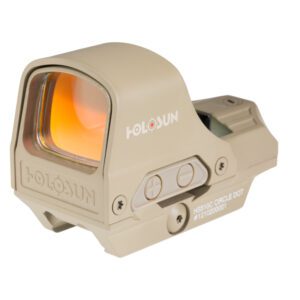
For most AR-15 owners who want one optic that handles range trips, training, and home defense backup, the Holosun 510C is hard to beat.

Its 0.91 x 1.26-inch open window gives you fast target acquisition, and the Multi-Reticle System on select models lets you toggle between a 65 MOA circle + 2 MOA dot, dot only, or circle only.

The 6061 aluminum body with titanium hood is IP67-rated (submersion to 1 meter for 30 minutes), and the solar failsafe plus shake-awake means you’re rarely worried about battery management.

The 510C uses a CR2032 battery rated for 50,000 hours at mid-level brightness—over 5 years of continuous use at that setting. The optic itself weighs 4.94 oz; with the included quick-detach mount, you’re at about 7.6 oz total.

Honest weakness: it’s bulkier than tube-style options and not the right call for an AR pistol or ultra-lightweight build. But on a standard AR-15, it punches well above its price.

Best Budget: SIG Sauer Romeo5 (~$150–$200)

At the top of the budget tier, the Romeo5 includes MOTAC (Motion Activated Illumination—SIG’s shake-awake equivalent), a 2 MOA dot, 10 brightness settings with 2 NV-compatible modes, and both low and absolute co-witness mounts in the box.

That’s a feature set you’d expect from something $100 more expensive.

The Bushnell TRS-26 ($199.95) could also fit in this category. It has a 3 MOA dot and manual on/off. It’s range-only gear—not for home defense—but it’s a legitimate entry point for getting familiar with red dots before spending more.

One rule for this tier: avoid no-name optics with no recoil rating and no brand accountability. A named brand’s budget optic will outlast a generic every time.

Best Mid-Range: $200–$300

This is where most civilian AR owners should land. The Holosun 510C sits at the top of this tier and doubles as the overall pick above.

Just below it, the Primary Arms SLX MD-25 ($199.99) is worth a look—25mm window, 2 MOA dot, shake-awake, and an ACSS Aurora reticle option for ranging. The Romeo5 anchors the lower end.

What you gain here over budget: better lens coatings, NV-compatible modes, side-loading batteries (no need to dismount the optic to swap cells), and more reliable zero retention under recoil.

Best Premium: $300–$700

  • Aimpoint PRO ($450–$500): The go-to for law enforcement and serious civilian users who want proven LE pedigree without crossing $1,000. It’s submersible to 45 meters, runs 30,000 hours on a single DL1/3N battery, and has a 2 MOA dot with 10 brightness settings (4 NV-compatible). It runs constantly—no auto-off—which is exactly what you want on a duty or home defense rifle. Just keep a spare DL1/3N battery on hand since it’s less common at retail.
  • Trijicon MRO ($400–$500): The MRO‘s 25mm objective uses a tapered light path that Trijicon says delivers a viewing area 44% larger than comparable tube-style optics—and on the range it shows. The 4.1 oz figure you’ll see is optic-only weight, without a mount. Battery life is 5 years of continuous use on a single CR2032 at day setting 3. Clean glass, compact footprint, and a favorite of professional users for good reason.
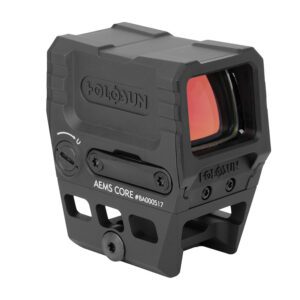
  • Holosun AEMS ($315–$400): The Holosun AEMS is a newer closed-emitter option with a 35mm lens, IP68 waterproof rating, MRS reticle, NV modes, and 7075-T6 aluminum housing. The sealed emitter protects the LED better than the 510C’s open design—worth the step-up if you’re running in dusty or wet conditions regularly.
The “buy once, cry once” argument applies here only if you’re actually running the rifle in a duty or critical-use role. For a range rifle, mid-range covers you just fine.

Best Mil-Spec/Duty-Grade: $700+

  • Aimpoint CompM5 ($950–$1,100): Current-generation compact military red dot. Runs 50,000 hours on a single AAA battery at setting 7, 6 daylight and 4 NV settings, submersible to 45 meters, rated from -49°F to +160°F. Trusted by top-tier military units worldwide.
  • Aimpoint CompM4s ($1,000+): The exact optic issued to U.S. Army infantry as the M68 Close Combat Optic (CCO). It runs 80,000 hours on a single AA battery—over 9 years of continuous operation. Heavier at around 17.6 oz with the mount, but nothing else on the market matches that battery figure.
  • Aimpoint Micro T-2 ($900+): At 3.4 oz (optic only), this is the choice when you need the smallest possible serious optic. 50,000-hour battery on a CR2032, 12 brightness settings, submersible to 25 meters.

For civilian use, this tier is often overkill. But if the rifle is a serious home defense tool or you simply want gear that will never fail you under any condition, the investment holds up.

Best Red Dot for AR Pistol: What Changes at Short Barrel Lengths

An AR pistol—a firearm without a shoulder stock and a barrel under 16 inches per ATF classification—needs a different optic approach than a rifle-length build.

In 5.56, a shorter barrel doesn’t increase recoil impulse dramatically. What it does increase is muzzle blast and concussive force—and without a shoulder stock, your overall controllability drops. For pistol-caliber AR builds (9mm, .300 BLK), recoil dynamics shift further, so always check the optic’s rated recoil spec before mounting.

Here’s what matters specifically on an AR pistol:

  • Weight: Balance is more sensitive on a compact build. Heavy tube optics that work fine on a 16″ rifle tip the front of a short pistol build and make it harder to run quickly. Keep it under 3–4 oz if you can. The Holosun 407C/507C and Aimpoint Micro T-2 are built for exactly this.
  • Mount height: Without a stock, absolute co-witness can feel cluttered—lower 1/3 co-witness is the typical preference for a cleaner sight picture in a non-shouldered hold.
  • Compact footprint: The optic should sit within the receiver area. Nothing hanging past the gas block.

Top picks for AR pistols:

  • **Holosun 407C (2 MOA dot) / 507C (circle-dot MRS)**: Lightweight, solar failsafe, shake-awake. Both use the RMR footprint and are popular on pistol builds for good reason.
  • Aimpoint Micro T-2: 3.4 oz, 50,000 hours, 12 settings. The gold standard for compact builds where you can’t compromise on reliability.
  • Trijicon MRO: Its low profile and small footprint make it viable on pistol builds that need a step up in glass quality.

SBR owners, the same logic applies—you have a stock, so balance is slightly less critical, but compact and lightweight still wins on short builds.

Zeroing Your AR Red Dot: The Short Version

A $300 red dot properly zeroed beats a $1,000 optic that isn’t. This is the part most buyers skip—don’t.

Common zero distances for 5.56 AR builds:

  • 25-yard zero: Easy to establish, practical for AR pistols. The second ballistic intersection falls at roughly 225–250 yards, depending on your ammo and sight height.
  • 50-yard zero (50/200): The most popular civilian carbine zero. Trajectory stays within about 1.5–2 inches of your point of aim between 50 and ~225 yards—close enough for center-mass hits without holdover adjustments. The “200-yard” name is a rough average; the exact second crossing depends on your specific load.
  • 36-yard zero: The USMC battlesight zero for full-length 5.56 rifles with M855 62-grain ammo. Effective out to roughly 300 yards on that platform.

For AR pistols, use a 25-yard zero. The shorter effective range of a pistol build makes it the practical choice.

One mounting note before you zero: always torque to your mount manufacturer’s specific specification—not a generic range. The Trijicon MRO mount screws, for example, spec at 12 in-lbs; other mounts run 15–25 in-lbs. Using the wrong number risks zero shift or stripped threads.

Conclusion

Finding the best red dot for AR builds comes down to one thing: matching the optic to your specific platform and use case. A home defense AR pistol needs something completely different than a 16″ competition rifle—and knowing that before you buy saves you from a mount full of regret.

The mid-range tier handles most civilian AR owners just fine. Budget gets you in the game. Premium and mil-spec serve the professionals and the prepared. Pick the tier that fits how you actually use your rifle, zero it properly, and you’re set.

Browse Gold Trigger’s selection of red dot sights to find the right fit for your build—whether you’re running a full-length AR-15 or a compact pistol setup.

Disclaimer: The products and information in this guide are intended for use with legally owned firearms only. All applicable federal, state, and local laws regarding firearm ownership, modifications, and accessories must be followed. Short-barreled rifles (SBRs) are regulated under the National Firearms Act (NFA) and require proper ATF registration prior to construction or possession. NFA regulations are subject to legislative change—always verify current requirements with the ATF or a licensed attorney. This guide is for educational purposes only and does not constitute legal advice. The author and publisher assume no liability for the misuse or unlawful use of any product or information referenced herein.

Leave a Reply

Your email address will not be published. Required fields are marked *

Shopping cart1
HOLOSUN HS510c Reflex Red Dot Sight + HM3X 3X Magnifier Combo Set
-
+
Subtotal
$484.99
Total
$484.99