



Best Red Dot for Remington 870: Pick Your Mount First
Published on: July 6, 2026
Reading time: 7 mins 15 sec
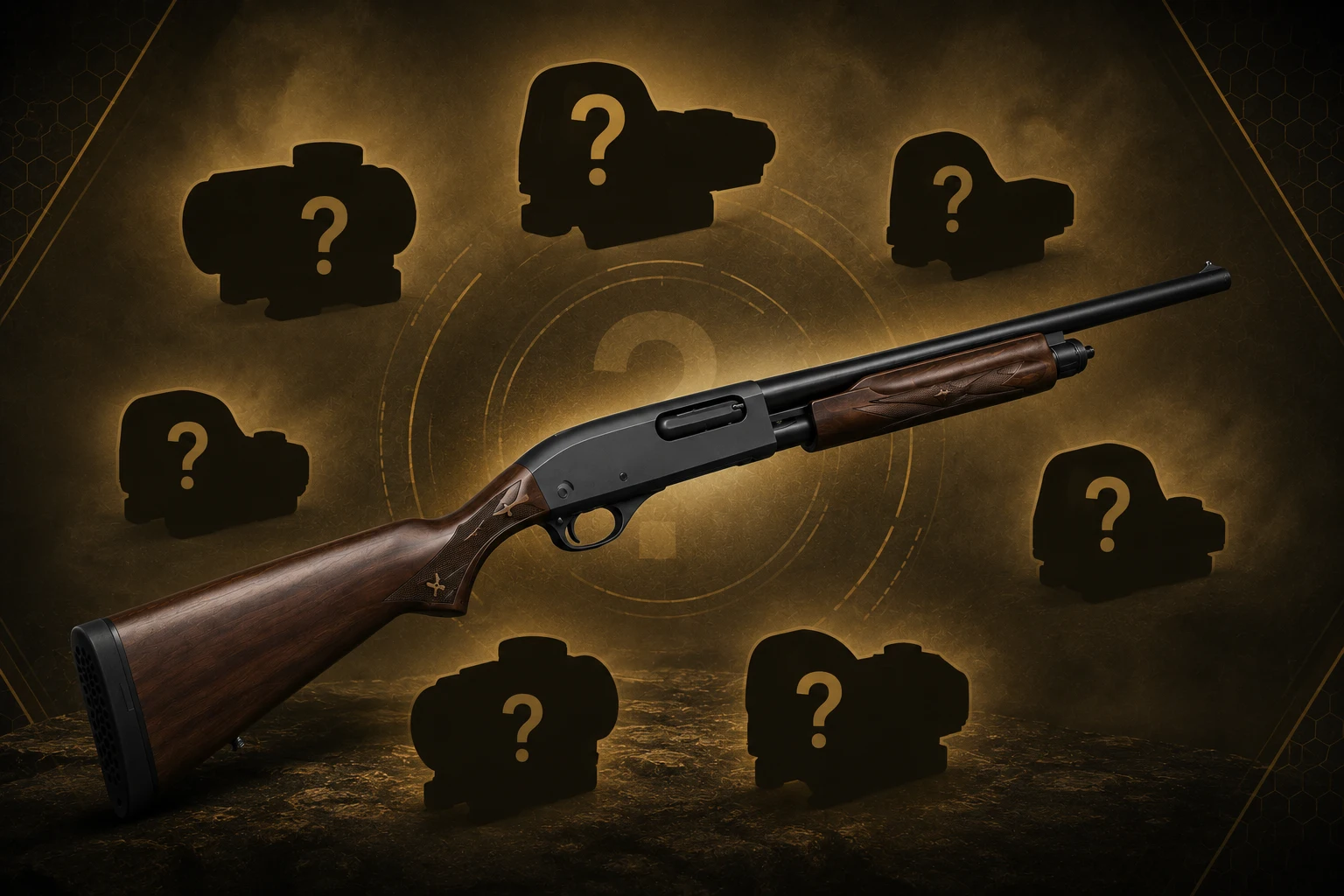
If you’re searching for the best red dot for a Remington 870, always remember that the optic isn’t your first decision. Your mount is. Shotgun red dot sights aren’t as simple as those for pistols or rifles.
Most lists hand you a red dot and assume it’ll bolt right on. But your 870 might not be drilled and tapped yet, and that changes what you can buy.
This guide flips the order. You’ll figure out what your 870 can accept, pick the mounting path that fits, then match an optic to that path and to how you use your gun.
Highlights
- Many 870s aren’t drilled and tapped from the factory, so check yours before you shop.
- You’ve got three mounting paths: drilled rail, saddle mount, or barrel clamp.
- 20-gauge and 12-gauge 870 receivers are different sizes, so mounts aren’t interchangeable.
- Saddle mounts skip the gunsmith but need Loctite and regular torque checks.
- Your optic pick should follow your mount, not the other way around.
Step 1: Figure Out What 870 You Actually Have
“Remington 870” isn’t one gun. It’s a whole family of them.
You’ve got the Express, the Express Tactical, the Wingmaster, the Police Magnum, the mag-fed 870DM, and 12-gauge versus 20-gauge models. Each one treats optics readiness a little differently.
Here’s the simple check. Look at the top of your receiver:
- Four small screws or threaded holes—your gun is drilled and tapped, so you’re ready for a rail.
- Smooth metal, no holes—you’ll need a different path, which we cover next.
Many Tactical and Turkey-trim 870s come pre-drilled from the factory, but this isn’t guaranteed across every year and batch. The 870 has been built in dozens of configurations since 1950, and drilling practices have varied along with them. Don’t assume based on the trim name alone. Always do the visual check yourself.
If your 870 is a 20-gauge, pay close attention here. Remington scaled down the 20-gauge receiver in the late 1970s, and that smaller receiver carries a different curve than the 12-gauge version. A 12-gauge-spec rail might bolt down if the screw holes happen to line up, but it’s unlikely to sit flush against that different curve. Don’t assume a fit just because the holes match.
The 870DM (mag-fed) is also its own animal, built on a detachable-magazine action rather than the standard tube-fed design. If you own one, confirm mount compatibility with the manufacturer before you buy anything.
Step 2: Choose Your Mounting Path
This step decides which optics are even on the table for you. Pick wrong here, and no red dot will save the setup.
Path A: Drilled-and-Tapped Receiver + Picatinny Rail
This is the gold standard if your receiver is ready for it. A rail bolted straight to the receiver doesn’t flex under recoil the way a clamp-on rail can, which keeps your zero more consistent shot after shot.
Most factory-drilled 870s use #6-48 screws, a thread size that’s been the firearms-industry standard for scope and optic mounting for decades. Quality rails typically include the right screws for this size, so you usually won’t need to source them separately.
Once the rail’s on, you’re working with a standard Picatinny or RMR-footprint base. The RMR footprint has become one of the most widely adopted mounting patterns in the optics world, which opens up far more compatible red dots than a proprietary mount would.
One honest caveat: if your receiver isn’t already drilled, this means a trip to a gunsmith. A handful of gunsmiths have voiced concerns about drilling certain 870 receivers, worried the metal’s too thin in spots.
The 870’s receiver is machined from a single block of hardened steel, and plenty of other smiths (and Remington itself, on factory-drilled trims) drill and tap these receivers routinely without issue. If one smith tells you no, get a second opinion before you give up on this path.
Path B: Saddle Mount (No Gunsmith Required)
A saddle mount skips drilling entirely. It works by replacing your two trigger pins with longer bolts that anchor the mount over the top of your receiver.
This path has real upsides:
- It’s fully reversible, with no permanent change to your gun.
- Installation is fast enough to do yourself.
- Many saddle mounts double as a side-saddle shell carrier.
The downside is that some saddle mounts can work loose over time under repeated heavy recoil. A few owners have also reported moisture getting trapped underneath, leading to rust. This doesn’t happen to everyone. Plenty of shooters run a saddle mount for years with zero issues, but quality and tightness matter more here than on a drilled rail.
This path is your most common option if your 870 is a stock or field-grade model that never came pre-drilled.
Path C: Barrel-Clamp or Cantilever Mount
This path skips the receiver altogether and clamps the mount to the barrel itself. It’s the right call if you’re building a dedicated slug or deer gun.
The advantage is simple: zero modification to your receiver. The catch is that your point of impact can shift if you ever swap back to a different barrel, since the optic is now tied to that barrel rather than the gun itself. This only makes sense if your 870 is staying a single-purpose slug gun.
Quick-Pick Guide
Not sure which path fits? Use this:
- Factory-drilled Tactical or Police model → Path A (rail)
- Stock Express or Wingmaster, never drilled → Path B (saddle mount)
- Dedicated slug or deer gun → Path C (barrel clamp)
Step 3: Best Red Dots for Each Mounting Path
Once your mount is sorted, your optic choice gets a lot easier.
Best for a Drilled-and-Tapped 870
If you’ve got a secure rail base, look for an optic with a tough, enclosed-emitter housing. Enclosed designs generally keep out dust, debris, and moisture better than open-emitter models, a useful baseline for a gun that sees rough handling and hard recoil.
An RMR-footprint optic is the practical advantage here. Because so many brands build around this footprint, you won’t be stuck hunting for a rare mounting plate down the road. The Holosun 507C-X2 is one strong option built around this exact footprint.
Best for a Saddle-Mounted 870
Since a saddle mount already adds a bit of height, pair it with a low-profile optic to keep your sight picture close to natural. And whatever you mount, don’t skip the blue Loctite on every screw, paired with regular torque checks. This one habit is the difference between a saddle mount that holds zero for years and one that works loose after a season of heavy use.
Best for a Dedicated Slug or Deer Gun
Pair your barrel-clamp mount with a smaller MOA dot built for precision rather than speed.
Installation Reality Check: What Actually Goes Wrong
Here’s what trips people up after they’ve already bought the optic.
Recoil works mounting screws loose over time more than most shooters expect. That’s why torque specs matter, and why you should tighten screws in a cross pattern rather than one at a time around the edge. This is standard practice across firearm optic mounting in general, not just on shotguns.
Blue Loctite isn’t optional here. Owners who’ve skipped it report mounts loosening. Owners who’ve used it report zero problems years later. It’s a five-minute step that prevents a real headache.
If you do need your receiver drilled, leave it to a gunsmith. Some experienced owners do this work themselves, but most advice, even from people comfortable with tools, points first-timers toward a professional. It’s a one-way modification, so get it right the first time.
If you ever remove a saddle mount to clean your trigger group, you may need to re-check your zero afterward. Removing and reinstalling the mount can shift things slightly, even when you’re careful.
Matching the Optic to How You Use Your 870
A quick gut-check based on your 870’s job:
- Home defense—prioritize always-on readiness and a mount that won’t shift after repeated buckshot recoil.
- Turkey hunting—keep your mount low-profile so you don’t lose your cheek weld for precise shots.
- Slug or deer hunting—go with the barrel-mount path and a dot sized for longer-range precision.
Frequently Asked Questions
Is the Remington 870 receiver drilled and tapped from the factory?
It depends on the specific model and trim. Many Tactical and Turkey models come pre-drilled, but this isn’t guaranteed across every batch, so check the top of your receiver for screw holes rather than assuming based on the model name.
Can I mount a red dot on my 870 without drilling it?
Yes. A saddle mount replaces your trigger pins with longer bolts and needs no drilling at all.
Will a 20-gauge 870 red dot mount fit a 12-gauge 870?
No. The 20-gauge receiver is smaller with a different curve, so a 12-gauge-spec mount is unlikely to sit flush even if the screw holes match up.
Do saddle mounts hold zero on a 12-gauge 870?
Generally yes, especially with Loctite and regular torque checks. They’re more prone to loosening over the long haul than a drilled rail, though, so check them periodically.
What’s the best red dot for home defense versus turkey hunting?
For home defense, prioritize an always-on optic on a secure mount. For turkey hunting, prioritize a low-profile mount that keeps your cheek weld natural. Both are covered in the section above.
Conclusion
Picking the best red dot for your Remington 870 starts with your mount, not the optic. Check whether your receiver is drilled and tapped, choose between a rail, a saddle mount, or a barrel clamp based on what you find, then pick an optic built for that setup.
Skip this order, and you risk buying a great optic that simply won’t sit right on your gun. Follow it, and you’ll end up with a setup that holds zero, fits your 870’s job, and doesn’t surprise you down the road.
Ready to gear up? Gold Trigger carries red dots and mounting hardware. Browse our red dot sight collection or give us a call at 713-485-5773.
Disclaimer: This article is for educational and informational purposes only and does not constitute professional gunsmithing, legal, or safety advice. Mounting optics, drilling, tapping, or otherwise modifying a firearm receiver can affect the safety, function, warranty, and resale value of the firearm. Always consult a licensed gunsmith before modifying your Remington 870. Confirm all federal, state, and local laws regarding firearm modifications and accessories before purchase or installation. Gold Trigger is not responsible for damage, injury, or malfunction resulting from improper installation or use of any product discussed in this article.
Comments