



How to Fix Red Dot Sight Starburst Effect
Published on: September 30, 2026
Reading time: 6 mins
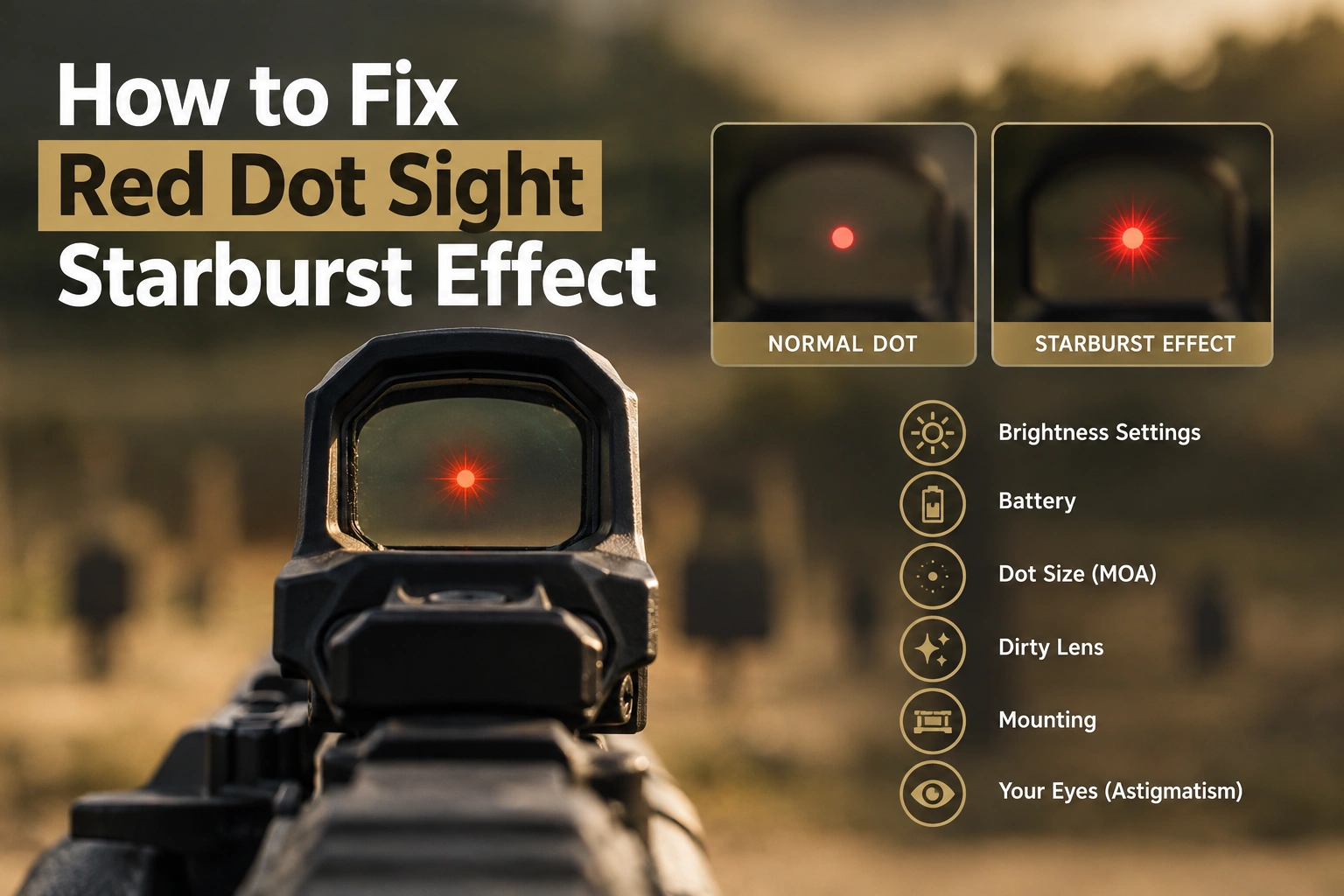
If your dot looks like a jagged little firework instead of a clean circle, you’re dealing with the red dot sight starburst effect. Here’s the good news: five of the six causes below have nothing to do with a broken optic.
It usually comes down to brightness, battery, dot size, a dirty lens, mounting, or how your eyes process light. This guide walks you through each one so you can fix it fast.
Highlights
- A red dot sight starburst is usually caused by brightness, battery, dot size, a dirty lens, mounting, or your eyes—not a broken optic.
- Lowering your brightness is the fastest, easiest fix to try first.
- A weak or poorly seated battery can cause flickering, which can also make the dot look messier.
- If the starburst holds its shape no matter how you rotate the optic, it’s likely your eyes, not your gear.
- Only send your optic back if the distortion rotates with the housing or persists at your lowest brightness setting.
What Is the Red Dot Starburst Effect?
A starburst is when your dot stops looking round and starts looking spiky, smeared, or haloed, usually worse at higher brightness or in low light.
It isn’t always the same problem when wearing different masks. Sometimes your eyes are distorting, and other times the light itself is spreading past its own edges before it reaches you, a phenomenon optics call bloom.
Bloom is the same reason a bright window looks like it’s bleeding light into a dark room, and it happens to any light source that’s too intense for its surroundings.
It’s also different from your dot drifting off target as you move your head, which is a separate issue called parallax and not what this guide covers.
Since bloom is just physics acting on light, almost every red dot sight will starburst under the wrong conditions, even expensive ones. Don’t assume you got a bad unit just yet.
Quick Diagnostic: Find Your Cause in 30 Seconds
Run through this checklist with your optic in hand:
- Happens mostly indoors or in low light? Probably brightness.
- Optic been sitting for months without a battery change? Probably the battery.
- Shape rotates when you rotate the optic body? That points to a real optic issue.
- Shape stays put no matter how you rotate the optic? That points to your eyes.
- Happens across more than one red dot brand you’ve tried? Also points to your eyes.
Cause #1: Your Red Dot Brightness Settings Are Too High
This is one of the easiest fixes on this list, and it’s worth trying first. The gap between indoor and outdoor light is bigger than most people realize.
Objects outside a window can be dozens of times brighter than the same room seen from inside, so a brightness level that’s perfect at noon will overwhelm your eye indoors.
Here’s the fix:
- Start at the lowest brightness where you can still see the dot against your target.
- Only raise it as the room or outdoor light gets brighter.
- If you carry outdoors and then head inside, remember to dial it back down.
Good rule of thumb: if you think you need one more click, try dropping half a click lower first.
Cause #2: A Weak or Old Red Dot Battery
A battery that’s dying, dirty, or not seated right sends inconsistent power to the emitter, which most reliably shows up as dimming or flickering. Some shooters also notice the dot looking messier as the battery fades.
Try this before you assume your optic is broken:
- Reseat the battery and make sure the cap is fully tightened.
- Wipe the contacts clean with a dry cloth.
- Swap in a fresh battery, ideally the exact type your manual calls for.
A quality lithium coin cell barely loses charge just sitting on a shelf. So if your optic suddenly acts up after a few months, it’s more likely a contact or seating problem than a dead cell.
Curious how long yours should last? See our guide on red dot battery life.
Cause #3: Your Red Dot MOA (Dot Size) Could Be a Factor
Your dot’s size, measured in MOA, can change how a starburst looks to you, but there’s no single rule that works for everyone. Some shooters see less distortion with a bigger dot since it gives their eye more shape to lock onto, while others see the opposite.
If brightness and battery are ruled out and starburst still bothers you, test a different MOA size in either direction at your local range before you buy.
Cause #4: Your Red Dot Lens Is Dirty
Dust, fingerprints, and rain spots on your lens scatter light, too, and that can look a lot like a starburst, even though it’s easy to overlook because it feels too simple to be the answer.
When you clean your lens:
- Do use a proper lens cloth and an optics-safe cleaning solution.
- Don’t use paper towels, your shirt, or tissues, since they can leave tiny scratches.
- Don’t use ammonia-based glass cleaners. Many report that ammonia and similar harsh chemicals break down anti-reflective coatings over time, the same coatings your red dot’s lens relies on.
If your optic is older and the starburst won’t clear up even after cleaning, worn coating could be the culprit, and it’s worth a warranty check.
Cause #5: How the Optic Sits on Your Gun
Where your optic sits, and how consistent your cheek weld is, matters more than people think. A proper stock weld locks in consistent eye relief, which is what gives you the same sight picture every time you shoulder the gun.
A loose or canted mount is a well-known cause of flickering and a shifting zero. Some shooters also notice their perceived starburst shift slightly with eye position, though that’s more anecdotal than proven.
Still, it costs nothing to check:
- Make sure your mount screws are torqued down with no play.
- Keep the same cheek weld every time you shoulder your gun.
- Try shifting the optic’s position slightly and see if it changes what you see.
If your mount is solid and your cheek weld is consistent, this probably isn’t your main issue.
Cause #6: Red Dot Astigmatism, the One You Can’t Fix on the Gun
If you’ve ruled out everything above, your eyes might be the real cause. It’s called red dot astigmatism. Astigmatism happens when your cornea or lens has an uneven curve.
Research reviewed by the National Institutes of Health puts it at roughly 13 percent of all refractive errors seen in eye exams. Mayo Clinic also notes that plenty of people don’t realize they have it until it’s pronounced enough to notice.
Quick way to check: rotate your optic on its axis while you watch the dot. If the shape stays put instead of rotating with the housing, that’s your eyes, not the optic.
This kind of starburst often fades in bright daylight, so don’t rule out astigmatism just because it looks fine outside.
When It’s Time to Send the Optic Back
Most starburst is normal and fixable, but a few signs point to a genuine defect:
- The distortion rotates right along with the optic housing.
- It’s still there even at your lowest brightness setting in daylight.
- You spot cracked glass, moisture, or damage inside the lens.
- The problem showed up suddenly after a drop or hard hit.
If any of these sound familiar, contact the manufacturer for a warranty check.
Conclusion
A red dot sight starburst rarely means your optic is broken. Most of the six causes here—brightness, battery, dot size, a dirty lens, and mounting—are things you can check yourself in a few minutes.
The one exception is your eyes. If astigmatism is the cause, you’re managing it with the right lens, dot size, or reticle choice, not fixing it outright, and that’s perfectly normal.
Ready for an optic built to handle tough conditions? Browse our lineup of red dot sights at Gold Trigger, or call us at 713-485-5773.
Disclaimer: This article is for general informational purposes only and isn’t professional optical, medical, or firearms safety advice. Persistent visual distortion or vision changes should be evaluated by a licensed eye doctor. Always follow manufacturer instructions and safe firearm handling practices when adjusting or troubleshooting any optic, and consult your product manual before attempting repairs. Gold Trigger isn’t liable for any injury, damage, or loss resulting from the use of this article.
Comments